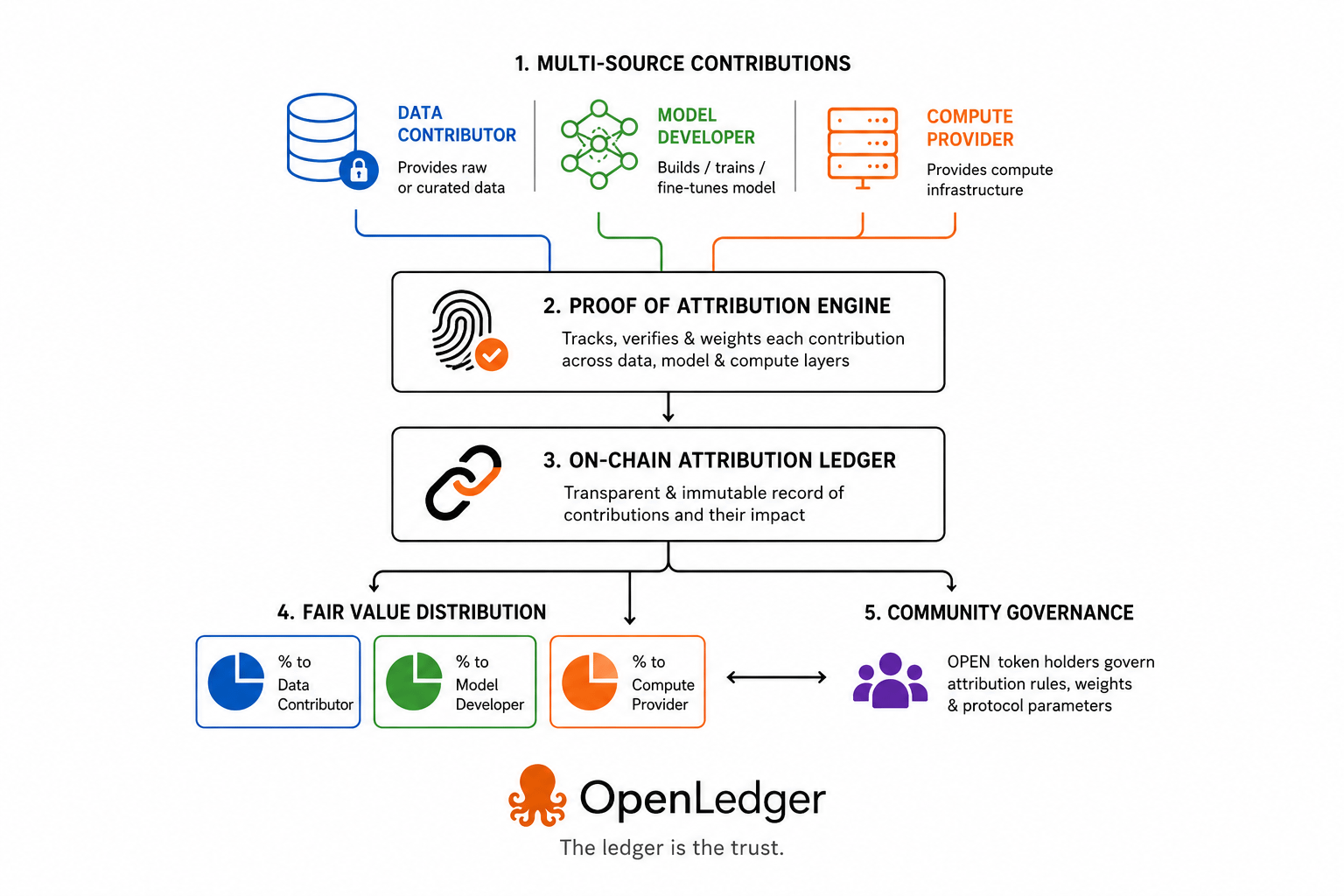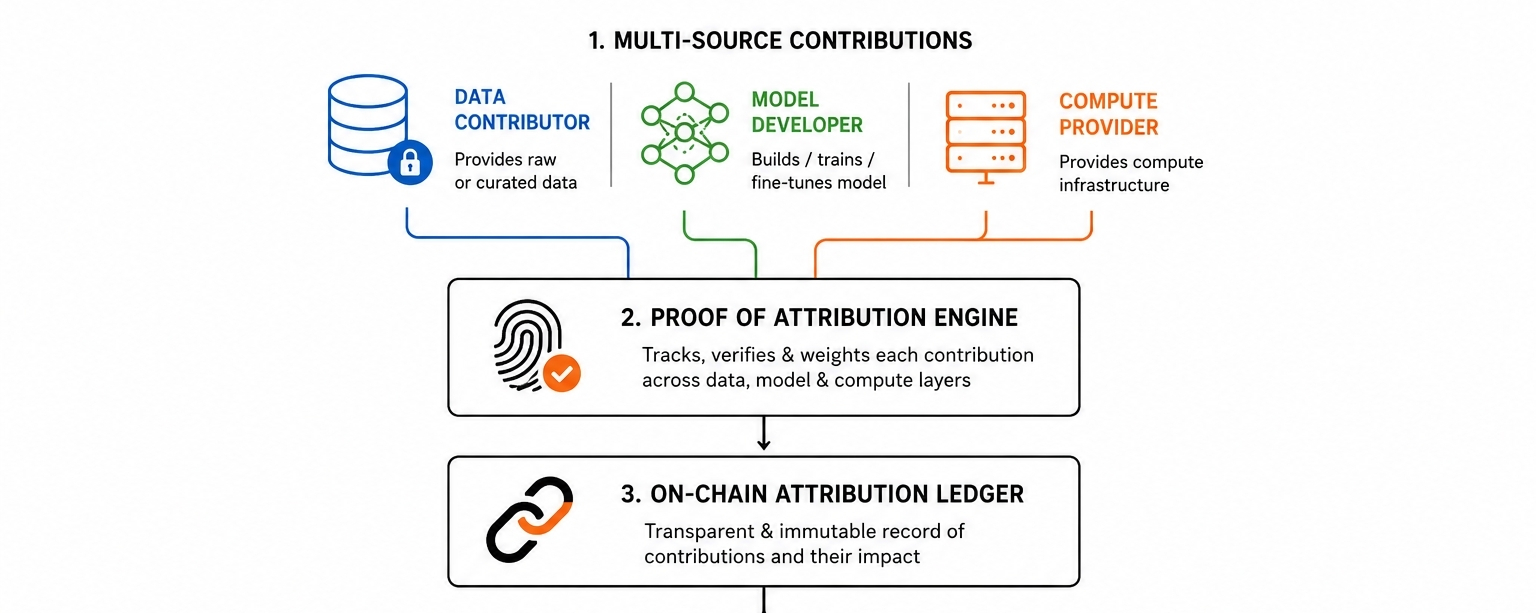
Been thinking about this for a while... when someone says "you'll get fair value for what you contributed," the first question that comes to mind is who decides that value? In the AI industry, the person providing data, the developer building the model, and the node supplying compute... all three can claim "my contribution matters most." OpenLedger says they can solve this equation through Proof of Attribution. I sat down to understand that and what I found is worth thinking about.🤔
Here's what actually bothers me about the current AI landscape. When a model makes a decision worth millions, nobody asks where the training data came from, whose architecture shaped the output, or whose infrastructure carried the load. That question just doesn't get asked. Not because people don't care, but because there was never a system designed to answer it honestly.
I stopped counting how many "fair and decentralized" projects I've seen come and go. At some point the phrase just loses meaning... not because the people building them are dishonest, but because good intentions and working mechanics are two very different things. Most protocols promise both. Very few survive the moment real money enters the picture. What made me look twice here was that OpenLedger isn't just repeating the phrase. They're attempting to build the infrastructure that would actually justify it.
So when I read that OPEN is being built around something called Proof of Attribution... a system that tracks contribution across data, models, and compute... my first instinct wasn't excitement. It was skepticism. Because that's a genuinely hard problem. Not technically hard in the abstract, but hard in the specific: how do you assign a percentage of value to a dataset that was one of ten thousand used to train a model....? How do you weigh compute time against data quality? These aren't questions with clean answers.😅
What makes me pay closer attention here is that OpenLedger isn't pretending the answer is simple. The structure they're building acknowledges that attribution has layers. A data contributor isn't doing the same thing as a compute provider, and treating them identically would be its own kind of unfairness. The fact that the system attempts to differentiate these contributions rather than flatten them into a single metric... that's the part I think most people are glossing over.
Take a concrete example. Imagine a medical AI model built on the platform. A hospital in Dhaka contributes anonymized patient records. A developer in Berlin fine-tunes the model architecture. A node operator in Singapore runs the inference. Under most existing systems, the value flows to whoever holds the token or controls the deployment. Under a functioning attribution model, each of those three parties has a traceable, verifiable claim. Whether that claim translates to proportional reward is where the real test begins.
The partnership with Balkeum Labs building a clinical assistant, or Ambios bringing in environmental sensor data... these aren't just ecosystem announcements. They're stress tests for this exact mechanism. If attribution works in those contexts, where data quality varies wildly and contributor types are completely different, then the system has real teeth.💪
I'll say this carefully though. The promise of fair value distribution has a long history of sounding better in whitepapers than in practice. Governance over who defines "fair" is itself a power structure. OPEN token holders having a say in that governance is meaningful only if the distribution of those tokens doesn't recreate the same concentration of influence the system is trying to dismantle.
That's not a reason to dismiss what's being built. It's a reason to watch the governance decisions closely once Mainnet is live. The technology can be sound and the incentive design can still fail..... Those are two separate conversations that often get collapsed into one.
What I keep coming back to is this: most projects in this space ask you to trust the team. OpenLedger is attempting to build something where "the ledger itself is the trust." That's a different proposition entirely. Whether the execution matches the architecture that's the question this cycle will eventually answer.
DYOR. This is not financial advice.🙏
@OpenLedger #OpenLedger #CryptoVibes #PizzaDay