

I noticed something strange when I first started studying data marketplaces. Anyone could upload anything. A file called "training_data_final" could be perfect. Or it could be random numbers. Or corrupted files. Or intentionally misleading information. Buyers had no way to know before paying.
I believe this is the core problem @OpenLedger solves better than anyone else. Not just creating a marketplace. Creating a trustworthy marketplace where quality is verified, not just claimed.
Bad data ruins everything. I have seen it happen too many times. A model trained on garbage data produces garbage results.. A marketplace full of low-quality datasets becomes useless to everyone. OpenLedger knows this. That is why data verification is not an afterthought. It is built into the foundation.
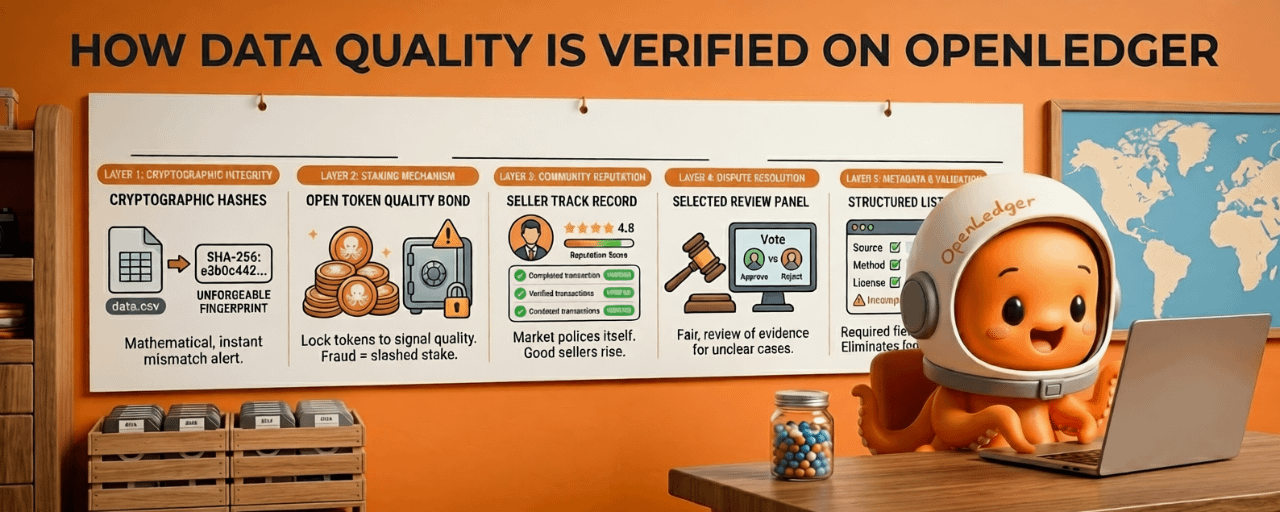
I look at how most platforms handle this problem. They do nothing. They say "buyer beware" and walk away. OpenLedger takes the opposite approach. Multiple layers of verification working together. Each layer solving a different piece of the trust puzzle.
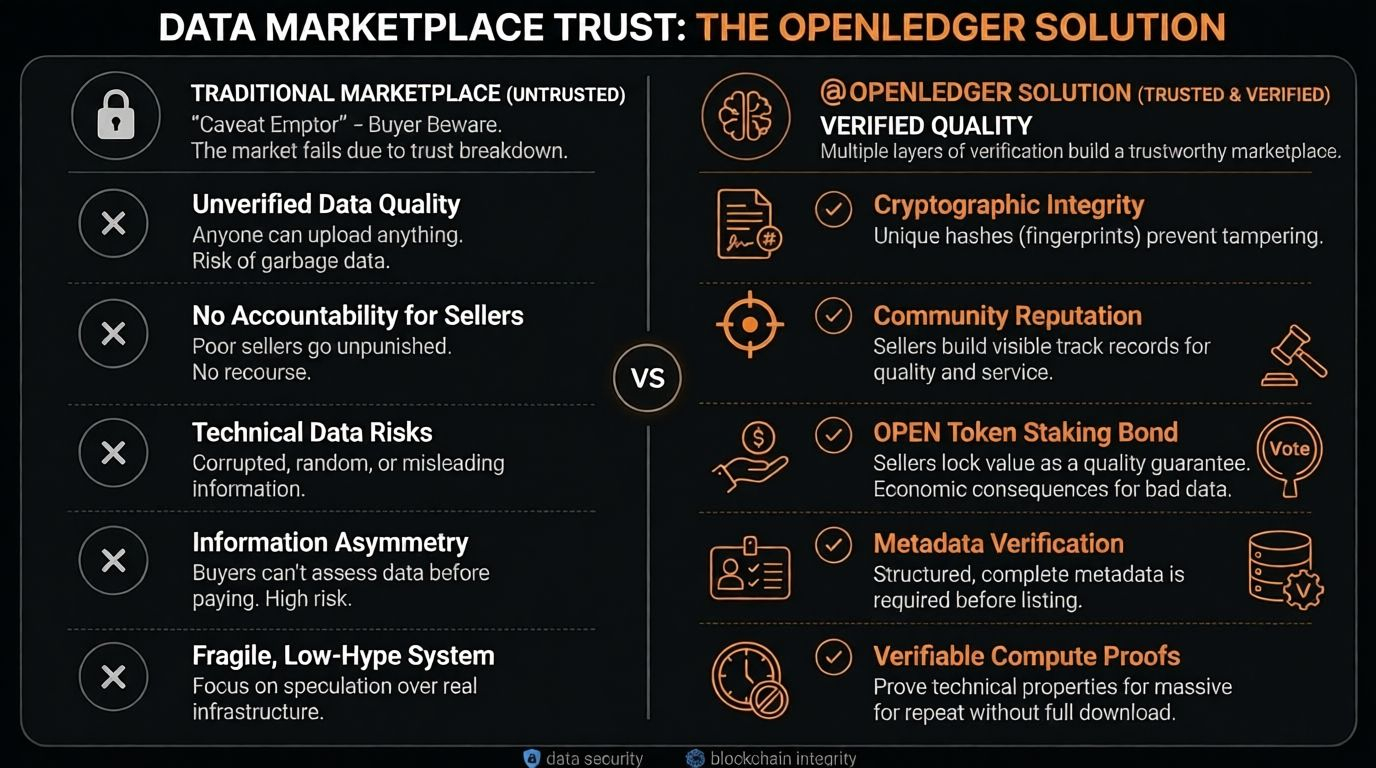
The first layer I noticed is cryptographic integrity. Before any dataset gets listed, OpenLedger computes a unique fingerprint of the file. A hash. Mathematical. Unforgeable. Anyone can verify that the dataset they receive matches what was listed. If a seller tries to upload garbage and then replace it with something else after payment, the hash changes. The buyer sees the mismatch immediately. No trust required. Just math.
The second layer is community reputation. I believe this is where OpenLedger really shines. Every seller builds a track record over time.. A seller who consistently provides high-quality, well-documented datasets earns high reputation scores. A seller who uploads garbage or misleads buyers earns low scores.. Buyers see these scores before purchasing. A new seller with no reputation can still sell, but buyers know they are taking a chance. Over time, good sellers rise. Bad sellers disappear. The market polices itself.
I look at the staking mechanism and see genuine innovation. Sellers who want to be taken seriously can lock OPEN tokens as a quality bond. If a buyer proves they received low-quality data that does not match the listing description, the network can slash the seller's stake. Part of the slashed tokens go to the buyer as compensation. Part goes to network treasury. This creates real economic consequences for bad behavior. A seller who values their staked tokens thinks twice before uploading garbage. I believe this aligns incentives perfectly.
The fourth layer I noticed is dispute resolution. Sometimes quality disputes are not obvious. A dataset might be technically correct but practically useless for a specific use case. OpenLedger has a dispute mechanism where selected token holders review evidence and vote on outcomes. Not fast. Not cheap. But fair. The existence of this mechanism alone prevents many disputes because sellers know someone will look closely if a buyer complains.
I look at metadata verification as another critical piece. Sellers must provide structured information about their datasets. Source. Collection method. Date range. License terms. Intended use cases. Known limitations. OpenLedger checks that metadata fields are filled completely before allowing a listing. Missing information gets flagged. Buyers see incomplete metadata as a warning sign. I believe this simple requirement eliminates many low-effort, low-quality listings automatically.
I find the staking mechanism particularly interesting to think about. A seller who believes in their data quality stakes more tokens to signal confidence. A seller who knows their data is marginal stakes little or nothing. Buyers can filter for staked listings when they need guaranteed quality. The market decides what level of risk is acceptable for each price point. I believe this creates a natural quality hierarchy without central control.
Another angle I noticed is verifiable compute. Some datasets are too large to download completely before purchasing. A buyer cannot verify a massive image dataset without spending days downloading and checking. OpenLedger allows sellers to provide verifiable proofs that their data meets claimed quality standards. Statistical sampling. Checksums on chunks. Cryptographic proofs of data properties. The technology is complex but the idea is simple. Prove quality without revealing the entire dataset. I believe this is ahead of what most marketplaces offer.
I look at what happens when someone still manages to sell bad data. OpenLedger maintains a blacklist. Sellers who lose disputes get marked. Their future listings appear with warnings. Repeat offenders get banned completely. The network learns over time which sellers to trust and which to avoid. I believe this creates strong disincentives for fraud.
I have watched other data marketplaces fail because they ignored verification. Buyers got burned once and never returned. OpenLedger seems to have learned those lessons. The verification layers are not perfect. No system is. But I believe they raise the cost of bad behavior high enough that honest sellers dominate.
For a buyer looking for quality data, I see OpenLedger offering real tools to evaluate before purchase. Check the seller's reputation. Look at staked amount. Read metadata. Verify hashes after purchase. Dispute if something is wrong. Each tool alone is helpful. Together, I believe they transform an inherently trust-based transaction into something closer to verifiable certainty.
I look at the whole system and see something rare in Web3. A marketplace that actually solves the problem it claims to solve. Not just speculation. Not just hype. Real infrastructure for trusted data exchange.
Data is the foundation of everything built on OpenLedger. The entire ecosystem depends on quality flowing through the marketplace. I believe OpenLedger's verification system protects that flow. Not perfectly. But well enough to make fraud expensive and honesty profitable.
That is how data markets should work. That is how OpenLedger works.
