
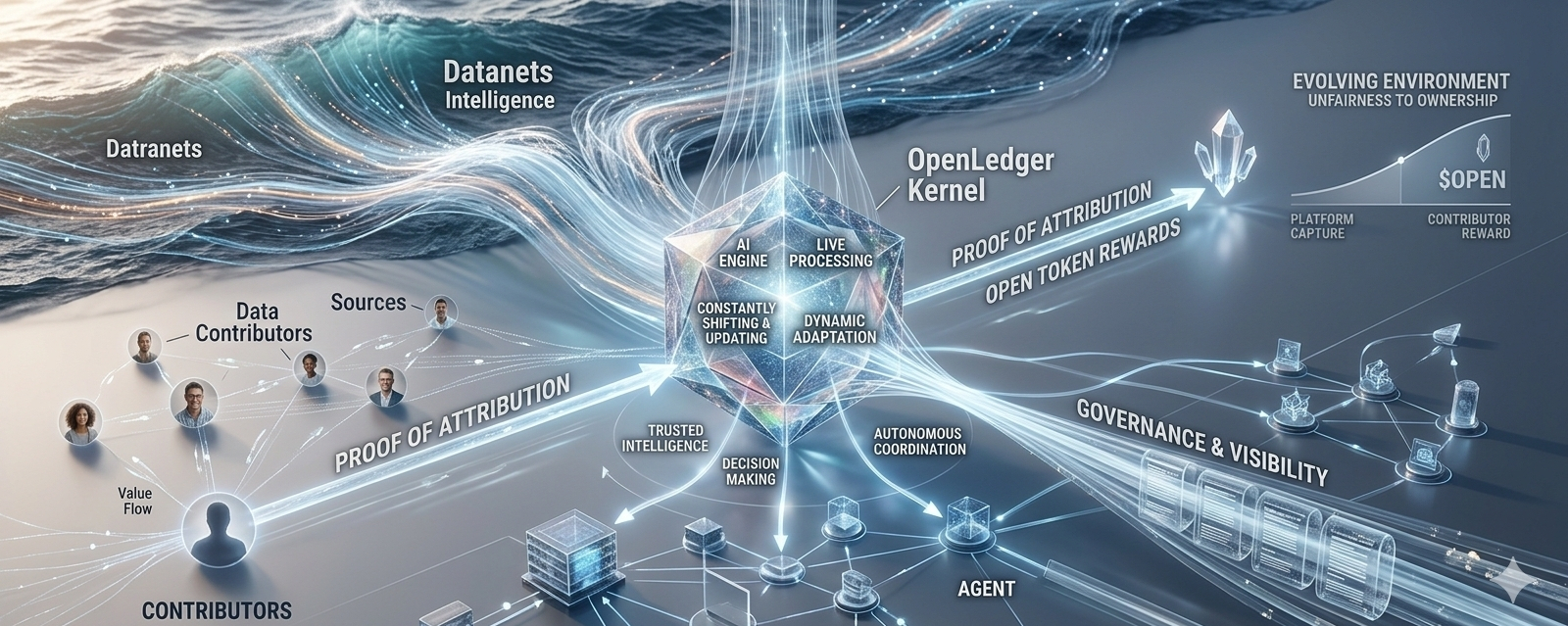
Sometimes when I hear the term “AI-native blockchain”, I stop for a moment and ask myself what it actually means. Are we really looking at a new kind of infrastructure, or are we just watching old blockchain ideas being dressed up with new AI language? That question feels important because in crypto, narratives move fast, and many projects try to sound futuristic before proving real depth. But when it comes to OpenLedger, the idea feels a little different. From the outside, it may look like another blockchain network, but the way it explains itself goes beyond a simple chain or protocol. OpenLedger is trying to present AI not as an extra feature sitting on top of the system, but as something deeply connected to the system itself. Not just a tool that responds when asked, but a live engine that keeps reading, adjusting, and evolving with the data around it.
The Formula 1 comparison may sound dramatic at first, but the more I think about it, the more it makes sense. In an F1 race, nothing stays still. Track conditions change, tires lose grip, weather can shift, rivals change pace, and every small signal can affect the next decision. The team is not just driving the car; they are constantly reading live information and adjusting strategy in real time. That is the kind of picture OpenLedger seems to be building around its AI-native blockchain idea. Its Datanets and on-chain data act like a continuous stream of intelligence. The system is not supposed to wait passively for input. It is always observing, always processing, always trying to understand what is happening around it. This is where the idea becomes interesting, because if AI can work with live data instead of static information, then its decisions may become more relevant, more adaptive, and closer to real market or network conditions.
But this also brings a serious question. Does more real-time data always mean better decisions, or can it also create more noise? Because in any intelligent system, data is only useful when it can be understood properly. If too much information keeps flowing in without strong filtering, the system may become reactive instead of intelligent. That is why dynamic strategy sounds powerful, but it is not simple. In the same way an F1 team changes tires when rain starts, an AI-driven system can update its behavior when new data appears. But adapting too quickly can sometimes become overreaction. A system that changes its view every second may look smart, but the real test is whether those changes actually improve outcomes or just create complexity.
Still, the core idea behind OpenLedger feels strong because it is not presenting AI as something fixed. It is trying to move away from the old version of AI where you give input, receive output, and never really know what happened in between. That black-box structure has always been one of the biggest problems in AI. We use the result, but we often do not understand the process, the data influence, or who contributed to making that intelligence possible. OpenLedger is trying to shift the conversation toward visibility, attribution, and economic connection. It is saying that data is not just raw material to be consumed silently. Data has value, contribution has value, and the people or sources behind that value should not disappear inside the machine.
This is where Proof of Attribution becomes one of the most interesting parts of the OpenLedger direction. The idea is not only to focus on what AI produces, but also on what helped AI produce it. Which data influenced a model? Which contributor added meaningful value? How much did that input matter? And if that contribution can be tracked, then rewards through $OPEN tokens can become part of the system. This touches one of the biggest questions in Web3 and AI together: who actually creates value, and who deserves to capture it? If data is the fuel behind intelligence, then ownership of that fuel becomes a major issue. Without attribution, AI economies can easily become unfair, where contributors provide the base value but platforms capture most of the benefit.
At the same time, I do not think this question is easy to solve. Even if a system can measure contribution, can it truly capture the full picture? Some impact is direct and visible, but some influence may be deeper, indirect, or difficult to measure. A single piece of data may not look important alone, but inside a larger model, it may help create better outcomes. So the challenge is not only tracking contribution, but tracking it in a way that feels fair and meaningful. That is why OpenLedger’s approach feels promising, but also ambitious. It is trying to connect intelligence, transparency, ownership, and rewards in one moving system, and that is not a small task.
What makes this whole idea more powerful is the mindset shift behind it. OpenLedger is not just trying to make AI faster or more useful. It is trying to redefine how we relate to AI. Instead of treating AI as a closed tool that gives answers, it imagines AI as an evolving environment where data, contributors, models, and economic incentives all interact. That could become important if the future of AI moves beyond simple chatbots and into agent-based systems, autonomous decision-making, and real-time coordination. In that kind of future, trust becomes just as important as intelligence. It will not be enough for AI to be smart. People will want to know where its intelligence came from, who contributed to it, how it changed, and who benefits from its value.
Still, I would not call OpenLedger a complete solution yet, because the real proof will come through adoption, execution, and whether the system can handle real-world complexity. But I also do not think it is fair to dismiss it as just another hype narrative. It feels more like a direction, a possible evolution where blockchain is not only used for transactions, but also for trust, attribution, permissions, and value distribution around AI. That direction matters because AI is becoming cheaper, faster, and more available, but trusted participation is still difficult to scale. If OpenLedger can make data contribution more transparent and economically meaningful, then it may have a stronger role than just being another AI blockchain project.
In the end, the most important question is not only whether OpenLedger is future infrastructure or just a new evolution. Maybe it is both. Maybe real infrastructure always begins as an evolution before people fully understand its importance. The idea of connecting real-time intelligence, data ownership, attribution, and tokenized rewards is not small. It is complex, risky, and still developing, but it points toward a future where AI is not only used by systems, but shaped by communities, contributors, and transparent value flows. Whether OpenLedger becomes a major part of that future is something time will prove. But the conversation it is opening is definitely worth paying attention to, because if data, attribution, and live intelligence really start working together, then the way we understand AI may slowly change forever.