
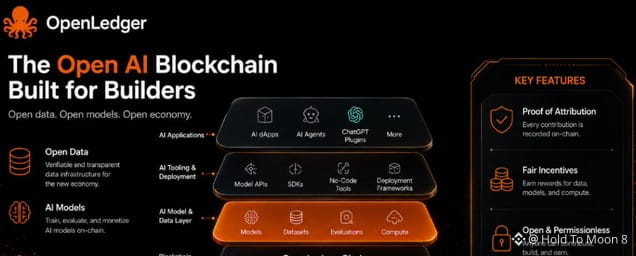
Amid the rapid rise of AI Agents, many platforms have demonstrated that artificial intelligence is no longer limited to simply answering questions. From AutoGPT and OpenClaw to workflow automation platforms like Zapier and n8n, the common goal has been to reduce manual effort and improve productivity. However, most existing solutions still face a significant gap between “understanding” and “execution.” This is precisely the gap that OctoClaw aims to bridge.
Introduced by OpenLedger with the message:
"Introducing OctoClaw. Where Octo comes alive. Your intelligent agent, built to simplify everything. Research, generate, execute, and automate across workflows. From data retrieval to on-chain execution, orchestrated in real time."
OctoClaw is positioned as an intelligent AI Agent capable of conducting research, generating content, executing actions, and automating workflows in real time. $OPEN
How Is OctoClaw Different from Existing AI Agents?
Compared to traditional AI chatbots such as ChatGPT and Claude, these tools excel at answering questions, generating content, and assisting users with information. However, they often require users to perform the next steps themselves. OctoClaw takes a different approach. Rather than simply providing answers, it is designed to become an execution layer capable of completing entire workflows.
When compared to OpenClaw, a well-known open-source AI Agent recognized for automating tasks directly on user devices, OctoClaw focuses more on accessibility and real-world deployment. While OpenClaw often requires users to manage their own operating environment, OctoClaw aims to provide a cloud-based agent experience that minimizes technical barriers and simplifies adoption.
As for workflow automation platforms like Zapier and n8n, they are highly effective for predefined processes based on triggers and actions. However, these systems can struggle when dealing with complex contexts, dynamic decision-making, or unstructured information. OctoClaw integrates AI reasoning capabilities, allowing it to adapt to changing data and make intelligent decisions beyond fixed workflows.
The Power of On-Chain Execution #OpenLedger
One of OctoClaw’s most compelling features is its ability to combine research, analysis, and on-chain execution within a single system. This capability is particularly valuable in the Web3 ecosystem, where users often rely on multiple tools to monitor blockchain data, analyze market opportunities, and interact with decentralized protocols.
OctoClaw seeks to unify these processes into a seamless workflow. Instead of manually gathering on-chain information, evaluating opportunities, and executing transactions separately, users can delegate the entire process to an intelligent agent capable of handling tasks from start to finish.
This approach aligns with the broader trend of AI Agents evolving into a new middleware layer between humans and digital systems, enabling more efficient interaction with increasingly complex technological environments.
The Future of AI Agents @OpenLedger
What makes OctoClaw particularly interesting is not its conversational ability, but its capacity to get things done. While many AI Agents today function primarily as intelligent assistants, OctoClaw is being developed as a true digital operator—an autonomous agent capable of researching, reasoning, executing, and automating workflows end-to-end.
If chatbots represented the first wave of the AI revolution, platforms like OctoClaw may represent the next stage, where AI moves beyond providing information and begins creating value through direct action. As Web3 and AI continue to converge, OctoClaw stands out as a project that illustrates the future of autonomous agents: systems that can think, act, and deliver results in real time.
In a world increasingly driven by automation and decentralized technologies, OctoClaw offers a glimpse into a future where AI is no longer just a tool—but an active participant in the digital economy.