
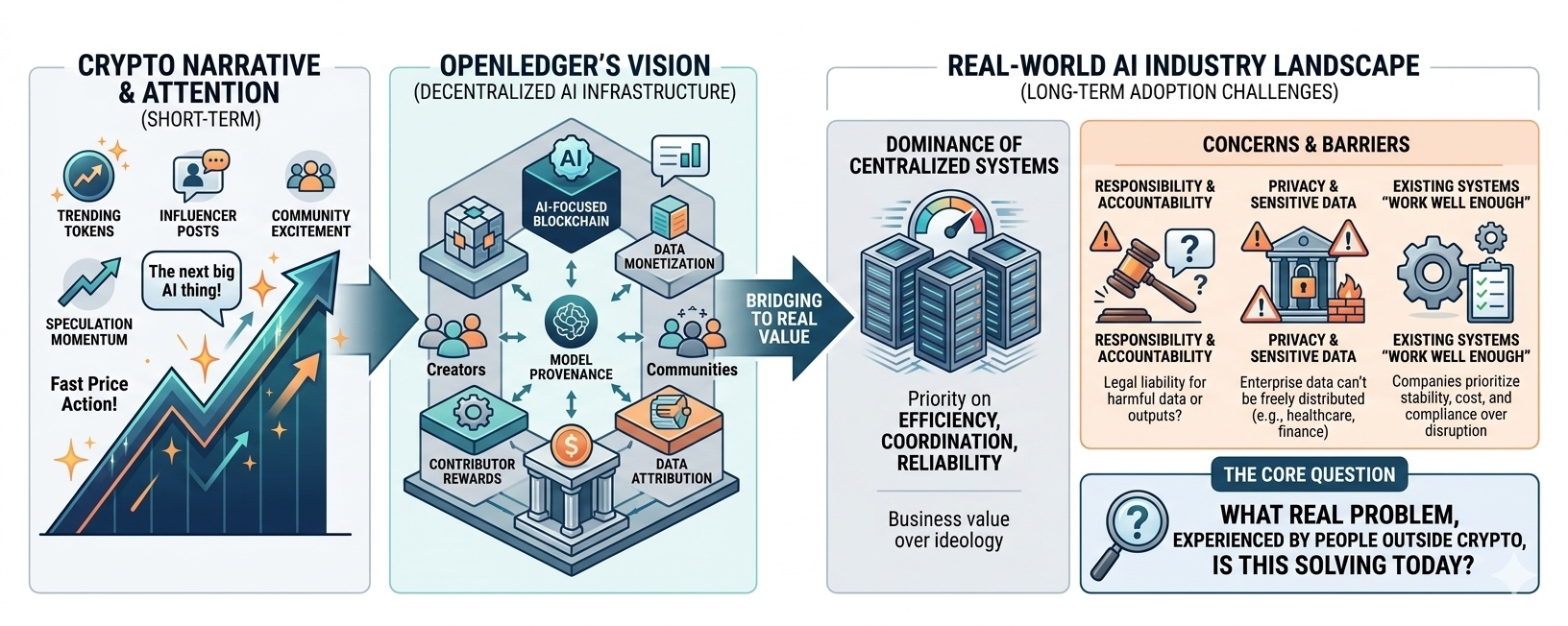

I’ve spent enough time around crypto to notice a pattern that never really changes. Markets move fast, narratives move even faster, and people often confuse excitement with usefulness. A token starts trending, influencers begin posting charts, communities become louder overnight, and suddenly everyone talks as if the future has already been decided.
But experience teaches you to slow down.
Some of the biggest projects in crypto once looked unstoppable. Many disappeared quietly after the hype faded. That’s probably why I’ve become more cautious whenever a new story dominates the market, especially when it combines blockchain with artificial intelligence. Right now, almost anything connected to AI can attract attention within hours.
That was part of the reason I started looking into OpenLedger and its token OPEN. The project talks about creating an AI-focused blockchain where data, models, and autonomous systems can be monetized more openly. On paper, it sounds like a serious idea because it touches a real issue that people rarely discuss properly.
Modern AI systems are becoming extremely powerful, but the ownership around them is still concentrated. Huge amounts of data are collected from users, creators, and communities, yet most contributors receive nothing back. So when a project starts talking about attribution, contributor rewards, and decentralized AI infrastructure, it naturally sounds important.
Still, I’ve learned that sounding important and being necessary are not always the same thing.
Instead of following social media excitement, I tried looking at the situation from outside the crypto bubble. I wanted to understand whether the industries connected to AI actually feel the same urgency that crypto investors do.
The answers were mixed.
Some people working around machine learning systems found the idea interesting. One developer described attribution systems as something the AI industry may eventually need, especially if governments begin demanding more transparency around training data and generated outputs. Another person believed contributors could one day expect compensation when their data helps train profitable systems.
Those points made sense to me.
But almost every positive opinion came with hesitation.
A few engineers explained that centralized systems continue dominating AI development for one simple reason. They are fast. Large companies care about efficiency, coordination, and reliability. Adding decentralized infrastructure sounds attractive philosophically, but businesses usually prioritize performance over ideology.
Others raised concerns that had nothing to do with technology itself.
One of the biggest issues was responsibility. If decentralized AI systems use problematic data or produce harmful outputs, who becomes accountable? Blockchain records may track activity, but regulation still tends to fall on identifiable organizations. That creates a difficult balance between decentralization and legal control.
Privacy concerns came up repeatedly too.
A lot of companies building AI tools rely on internal or sensitive information. Financial firms, healthcare systems, logistics companies, and enterprise platforms often cannot openly distribute their data across decentralized environments. Even if token incentives exist, many organizations still prefer keeping their infrastructure closed and controlled.
What stood out to me most was something much simpler.
Several people basically felt existing systems already work well enough.
That matters more than crypto investors sometimes realize.
The crypto industry often assumes older industries are waiting for disruption, but most businesses are not looking for philosophical upgrades. They care about cost, speed, reliability, compliance, and operational stability. If their current systems already handle those things effectively, convincing them to adopt blockchain infrastructure becomes extremely difficult.
This is where I think many crypto projects struggle.
They sometimes build solutions around imagined future problems rather than current painful ones.
Inside crypto itself, blockchain succeeded because it solved issues that crypto users genuinely experienced. Decentralized exchanges removed dependence on centralized trading platforms. Wallets improved digital ownership. Stablecoins made moving value easier across global markets. Those products solved immediate problems for people already inside the ecosystem.
Outside crypto, the situation changes.
Most industries already have functioning systems, established workflows, and infrastructure they trust. Even if blockchain offers theoretical improvements, companies rarely rebuild their operations unless the advantage becomes impossible to ignore.
That’s the real challenge for OpenLedger.
The project doesn’t only need an interesting vision. It needs proof that businesses and developers actually need this infrastructure more than the systems they already use.
And that’s a much harder task than creating market excitement.
The market itself often ignores this distinction. Token prices can rise long before real adoption appears. Narratives move faster than utility. Speculation creates momentum. Communities create belief. Sometimes people buy stories long before they buy products.
I’ve watched this happen many times.
Entire sectors once reached huge valuations based mostly on future expectations. In some cases, those expectations eventually became reality. In many others, adoption never arrived at the scale investors imagined.
That doesn’t automatically mean OPEN lacks potential. It simply means the token represents possibility more than proven demand right now.
Buying the token today feels less like purchasing access to an active system and more like making a long-term bet that decentralized AI coordination could eventually become necessary.
Maybe that future comes.
Maybe centralized companies continue dominating AI infrastructure for much longer than crypto expects.
That uncertainty is what makes projects like this interesting to watch.
After years in this market, I’ve stopped asking whether a project sounds revolutionary. Most of them do during strong narratives. The better question is much simpler and usually much harder to answer honestly.
What real problem, experienced by people outside crypto, is this solving today?