
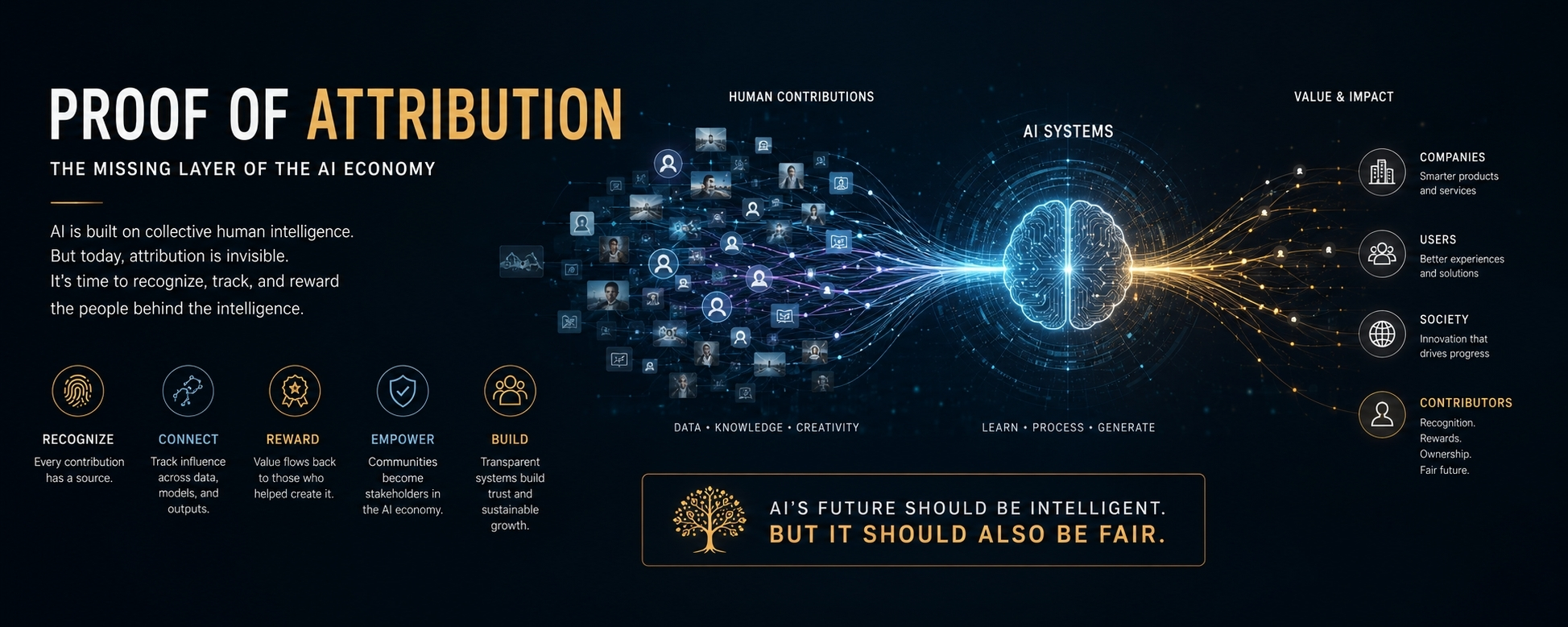

There’s something strange about the way AI is evolving right now that people still don’t fully sit with long enough.
Everybody talks about intelligence itself.
Smarter models. Faster agents. Bigger infrastructure. More automation. Better outputs.
The entire conversation feels obsessed with what AI can do.
But honestly… I think one of the biggest missing layers underneath AI is not intelligence.
It’s attribution.
And the weird part is that most people barely notice that gap yet.
Because once AI outputs become impressive enough, people stop asking where the intelligence actually came from in the first place.
That’s the part that keeps pulling my attention back toward something like OpenLedger and its idea around Proof of Attribution.
Not because it sounds flashy.
Actually the opposite.
Because it feels like one of those quiet infrastructure ideas that could become extremely important later if AI keeps scaling the way it is now.
The internet trained AI long before people started calling it “AI.”
That’s the strange truth underneath everything.
Forums trained it. Communities trained it. Artists trained it. Writers trained it. Memes trained it. Arguments trained it. Tutorials trained it. Questions trained it. Human behavior trained it.
Millions of people spent years leaving behind tiny fragments of intelligence online without thinking much about it.
And over time, those fragments stacked together into training data.
That’s why modern AI systems feel less like machines created in isolation… and more like giant mirrors built from collective human activity spread across the internet.
But somewhere during that process, visibility disappears.
The contribution disappears.
The attribution disappears.
And once attribution disappears, value usually centralizes.
That pattern happens almost everywhere online.
People create. Platforms absorb. Systems scale. Then eventually the original contributors become invisible underneath the infrastructure they helped build.
I think that’s the deeper tension slowly forming underneath the AI economy now.
Not just “Who builds the smartest model?”
But: Who shaped the intelligence? Who improved the system? Who provided useful data? Who corrected mistakes? Who influenced outputs? Who deserves value when AI products generate billions?
Those questions become uncomfortable very quickly.
Because AI is starting to expose something the internet never solved properly in the first place.
The internet became very good at extracting human contribution. Not very good at tracking it.
And honestly, maybe that was manageable when social media mostly revolved around attention and advertising.
But AI changes the atmosphere.
Because now human traces are not only creating engagement anymore.
They are actively shaping machine intelligence itself.
That changes the economic weight of contribution completely.
And I think that’s why Proof of Attribution feels interesting to me conceptually.
Not as a marketing phrase.
As a structural idea.
The idea that maybe AI systems eventually need memory around contribution itself.
Not only memory around outputs.
That’s a very different direction.
Because if attribution becomes native inside AI systems, behavior across the internet could slowly start changing too.
People may begin treating data differently.
Communities may begin understanding their knowledge differently.
Contributors may stop seeing themselves as random users and start seeing themselves as economic participants inside intelligence systems.
That psychological shift alone could become massive over time.
Right now most people still interact online casually.
Posting thoughts. Sharing opinions. Teaching strangers. Uploading content. Correcting information.
But almost nobody thinks: “This may eventually train intelligence systems.”
Even fewer think: “What happens if those systems generate huge value later?”
That disconnect becomes harder to ignore as AI gets bigger.
Especially because AI models are increasingly becoming dependent on massive layers of human refinement underneath them.
The scary thing is that without attribution systems, AI economies naturally drift toward opacity.
And opaque systems usually concentrate power upward.
The people closest to infrastructure capture most of the value while the people underneath become harder to see.
That imbalance may quietly become one of the biggest tensions in AI over the next decade.
Because intelligence is not appearing from nowhere.
It is emerging from collective contribution at scale.
Which creates a strange philosophical problem too.
If intelligence becomes collective… Should ownership stay centralized?
That question becomes difficult very fast.
And honestly, I don’t even think Proof of Attribution is easy to build.
Actually it sounds incredibly difficult.
Tracking contribution across AI systems sounds messy, political, technical, and probably imperfect for a long time.
How do you measure meaningful contribution? How do you separate noise from useful signal? How do you reward people fairly? How do you stop gaming? How do you track influence across multiple layers of models and data?
None of this feels simple.
But sometimes the hard problems end up mattering most.
Especially infrastructure problems.
Because infrastructure usually looks boring right before it becomes essential.
And I think that’s partly why attribution feels underestimated right now.
Most people are still focused on visible AI products.
But invisible coordination layers often become more important than the products themselves later.
Search engines changed the internet. But ranking systems underneath them became even more powerful.
Social media changed communication. But recommendation systems underneath them became the real infrastructure.
AI may follow a similar path.
The visible layer gets attention first.
The hidden accounting layer becomes important later.
That’s why Proof of Attribution keeps standing out to me conceptually.
It feels less like adding a feature to AI…
And more like attempting to solve missing economic memory inside intelligence systems.
Almost like AI needs a way to remember where value actually came from.
Because without memory, contribution dissolves.
And when contribution dissolves, ownership slowly narrows upward.
That may work short term.
But long term I’m not sure societies stay comfortable with systems built from collective human activity while only a tiny number of entities capture most of the upside.
Especially once people fully realize how much of AI came from humanity itself quietly feeding the machine over time.
Maybe that realization changes behavior.
Maybe it changes policy.
Maybe it changes how future AI systems are designed from the beginning.
Or maybe none of this happens quickly at all.
Could take years.
But still…
I can’t shake the feeling that attribution may eventually become one of the most important layers in the entire AI economy.
Not because it makes AI smarter.
But because it changes who remains visible once intelligence starts scaling beyond human comprehension.