
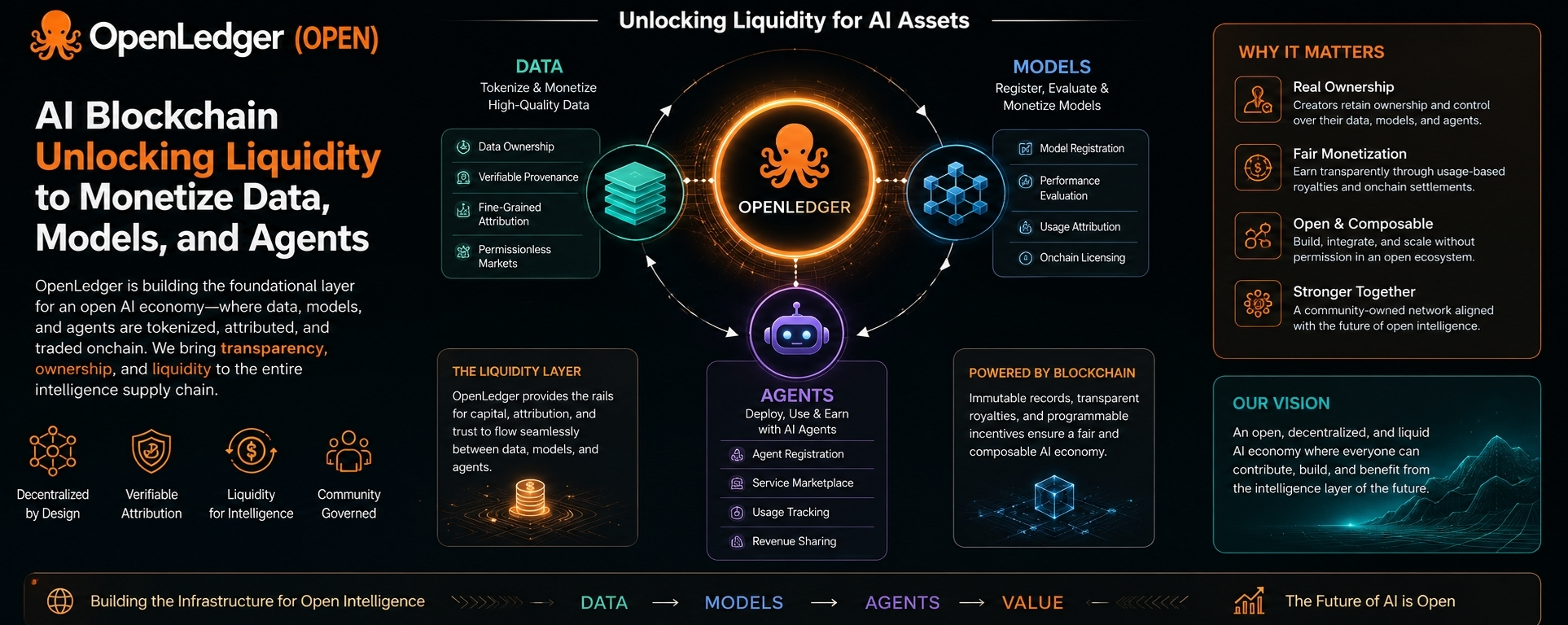

I’ve been watching crypto long enough to recognize when a project is trying to build around a real structural problem instead of simply reacting to whatever narrative the market happens to reward for a few months. Most systems in this industry eventually expose their true priorities through their architecture. You can learn more from incentive design than from any roadmap or marketing campaign. Over time, I stopped paying attention to the language projects use to describe themselves because every cycle recycles the same vocabulary in different forms. Decentralization, scalability, community, AI, ownership, coordination. The words evolve, but the underlying behavior often doesn’t. What matters to me now is whether a system understands where digital economies actually break under pressure. And when I look at OpenLedger, I keep coming back to the same thought: this project feels less interested in creating another speculative AI narrative and more interested in questioning who should economically benefit from intelligence as it becomes one of the dominant forces shaping the internet.
The deeper I look at AI systems, the more obvious it becomes that modern intelligence infrastructure is developing around a massive imbalance. Intelligence today is increasingly collective in how it is formed, but highly concentrated in how it is owned. Millions of people continuously generate data, context, interactions, behavioral patterns, refinements, and informational signals that feed modern models, yet the economic upside created from that process usually accumulates into a very small number of centralized entities. The internet has quietly turned human participation into raw material. Most users don’t notice it because the systems feel convenient, but structurally the imbalance is enormous. Data flows upward. Ownership stays upward. Contribution becomes invisible once it enters the machine. And I think OpenLedger is one of the few crypto-native systems that seems to recognize this as a coordination problem rather than just a technology problem.
That distinction matters more than people realize. Crypto spent years building financial coordination layers while largely avoiding the harder question of productive coordination. Markets became extremely efficient at pricing narratives, liquidity, and volatility, but much weaker at connecting actual contribution to long-term ownership. At the same time, AI evolved in almost the opposite direction. AI systems became incredibly productive but structurally closed. The models improved rapidly because centralization accelerated execution, but the economics surrounding those systems remained heavily concentrated. What OpenLedger appears to be exploring is whether blockchain infrastructure can become an economic layer for intelligence itself — not merely by tokenizing AI products, but by creating liquidity and attribution around the actual components that generate intelligence over time.
I think the reason this idea feels important is because data, models, and agents are no longer passive digital assets. They are becoming active economic participants. Models generate decisions. Agents interact autonomously. Data continuously shapes future outputs. The old internet was mostly built around content and transactions. The next phase of the internet will likely revolve around intelligence systems interacting with each other at scale. And once that happens, ownership frameworks start mattering much more than people currently understand. If intelligence becomes foundational infrastructure while remaining economically closed, then the internet slowly evolves into a system where participation and ownership become increasingly disconnected from one another. OpenLedger seems to be approaching this problem from the perspective that intelligence itself should remain economically composable and accessible instead of disappearing into centralized silos.
What I personally find interesting is how the project frames liquidity. Most people hear the word liquidity and immediately think about trading depth or financial markets, but I think OpenLedger is approaching liquidity in a broader structural sense. Historically, intelligence has been economically illiquid. Contributions disappear into platforms without preserving clear attribution pathways. Data becomes difficult to trace once aggregated. Models become proprietary systems with opaque ownership structures. Agents operate inside closed ecosystems controlled by whoever owns the infrastructure layer underneath them. OpenLedger seems to be trying to create a network where intelligence can circulate economically without losing visibility around contribution itself. And honestly, that is a much harder problem than simply building decentralized infrastructure.
The reason it is difficult is because intelligence systems behave differently from traditional crypto systems. Most blockchain architectures were designed around transferring fixed units of value between addresses. Intelligence doesn’t function that way. Intelligence evolves relationally. It compounds through interaction, refinement, iteration, and context accumulation. That means the economic systems surrounding intelligence cannot rely purely on static transactional logic. They need mechanisms for attribution, continuity, reputation, persistence, and adaptive coordination between participants. This is where I think many decentralized AI projects will eventually struggle. They assume AI can simply inherit existing crypto mechanics without fundamentally redesigning how coordination works. But intelligence networks require deeper behavioral alignment because low-quality participation eventually degrades the intelligence layer itself.
After watching multiple market cycles unfold, I’ve become increasingly convinced that most crypto failures originate from incentive failures rather than technical limitations. Technology problems can usually be solved with time. Misaligned incentives become cultural problems that spread throughout the network. Once participants realize extraction is more profitable than contribution, systems slowly hollow themselves out from the inside. Metrics continue growing while actual value quietly deteriorates underneath. You see it happen repeatedly across the industry. Liquidity mining turns into mercenary participation. Governance becomes symbolic theater. Communities become dependent on emissions instead of conviction. OpenLedger interests me because the architecture appears aware of this risk from the beginning. The system seems less focused on maximizing short-term participation and more focused on building sustainable relationships between contributors, intelligence assets, and long-term ownership.
There’s also something psychologically important about the timing of this project. AI is rapidly becoming embedded into nearly every layer of the internet, but the ownership structures surrounding it still resemble early industrial monopolies more than open digital economies. A handful of organizations increasingly control the most powerful intelligence infrastructure in existence. In the short term, this concentration probably accelerates innovation because coordination becomes faster inside centralized systems. But over longer horizons, concentration creates fragility. It creates dependency. It creates asymmetry between those generating value and those capturing value. Crypto was originally supposed to challenge these kinds of asymmetries, but somewhere along the way much of the industry became trapped inside recursive financial abstraction instead of productive infrastructure development. OpenLedger feels like part of a broader shift back toward building systems around actual economic coordination rather than endless speculative recursion.
The more I think about it, the more I realize the real challenge for projects like this isn’t technical execution alone. It’s behavioral sustainability. Can the network maintain meaningful incentives once scale arrives? Can contribution remain visible as participation increases? Can intelligence stay open without becoming chaotic? Can ownership remain distributed without reducing coordination efficiency? These are incredibly difficult design problems because human behavior naturally exploits weak incentive structures over time. Systems fail where their assumptions about people become naive. And that’s why I find OpenLedger more interesting as an architectural experiment than as a market asset. The project seems to understand that the future of digital economies may depend less on who owns platforms and more on who owns the intelligence flowing through them.
I’ve also noticed that the projects trying to solve real structural problems often look less immediately exciting because the market struggles to price long-term coordination systems correctly in the beginning. Speculation prefers simplicity. Real infrastructure usually looks slower, more uncertain, and harder to explain cleanly. But durability often emerges from architectures that understand economic behavior deeply enough to survive beyond hype cycles. OpenLedger gives me that feeling. Not certainty, because certainty in crypto usually means someone is ignoring complexity, but a sense that the project is operating closer to where the internet is actually heading.
And maybe that’s ultimately why I keep returning to it mentally. Beneath all the volatility, narratives, and noise, crypto still occasionally produces systems attempting to rethink ownership at the protocol level rather than merely financializing attention. OpenLedger feels connected to that quieter layer of the industry — the part still trying to figure out how digital coordination should function once intelligence becomes a native economic primitive of the internet itself. Whether the project succeeds or not is impossible to know right now. Most systems fail somewhere between architecture and human behavior. But I think the underlying direction reflects a more mature understanding of the next phase of digital economies. A world where intelligence is no longer just a tool, but an active economic layer requiring entirely new models of participation, attribution, and ownership. And after spending years watching crypto repeat the same cycles around speculation and extraction, even seeing a protocol ask those questions seriously feels increasingly rare.