
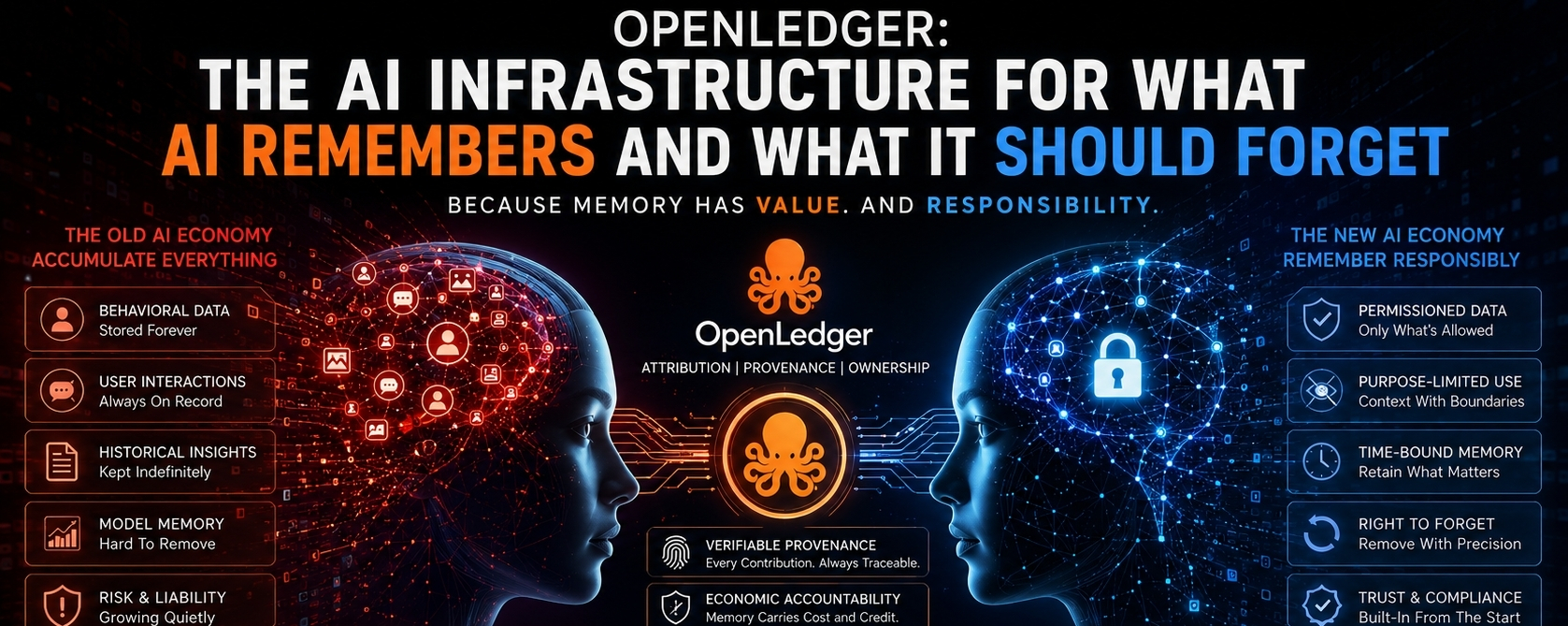
When i first started researching , i honestly expected another familiar crypto-AI narrative built around data monetization, attribution systems, and tokenized incentives. On the surface, the story looked simple enough. Contributors provide valuable data, developers use that data to improve models, attribution gets tracked transparently, and $OPEN becomes the coordination layer connecting the ecosystem together. It sounded efficient, logical, and easy for the market to understand. But the more time i spent thinking about the structure behind these systems, the more i realized the real issue may not be about how AI learns. I increasingly think the deeper issue is about how AI remembers, how long it remembers, and who ultimately carries responsibility for the intelligence those systems retain over time.
What keeps bothering me is that the entire AI industry still behaves as if memory is automatically valuable. More historical context improves personalization. More behavioral information improves recommendations. More retained interactions improve prediction accuracy. Every major platform is competing to build systems that can absorb larger amounts of human activity because retention has traditionally been treated as an advantage. For years, that assumption made sense. But i think the logic becomes much more dangerous once AI systems stop acting like simple software tools and start operating closer to financial infrastructure, enterprise operations, healthcare systems, autonomous agents, and decision-making environments where mistakes carry real economic consequences. At that point, memory stops being a harmless feature and starts becoming a liability surface.
I think most people outside technical circles still imagine deletion in outdated ways. Humans naturally think of memory like storage. Delete a file, remove a document, clear a database, and the problem disappears. But machine intelligence does not work that cleanly anymore. Once information influences embeddings, inference pathways, recommendation systems, fine-tuned behavior, or autonomous decision logic, separating learned influence from stored information becomes incredibly messy. Data no longer exists in one isolated place. It spreads across the system in ways that even developers may struggle to fully trace later. That is why conversations around machine unlearning feel so important to me now. Not because forgetting is a trendy research topic, but because the industry quietly discovered that teaching machines is much easier than forcing them to forget with precision.
The more i think about it, the more i believe AI is heading toward the same contradiction crypto discovered years ago. Early blockchain culture treated permanence almost like a moral breakthrough. Immutable ledgers sounded revolutionary because people assumed permanent records automatically created trust and transparency. But over time, reality became more complicated. Privacy concerns emerged. Ownership disputes appeared. Regulatory pressure increased. Suddenly, systems designed to remember everything forever stopped feeling universally positive. I think AI may now be approaching its own version of that collision. Useful memory and dangerous memory often look identical until circumstances change. A company updates compliance standards. A client revokes permissions. A regulator changes policy. An enterprise realizes old interactions are still influencing active outputs in ways nobody anticipated. In those moments, memory becomes expensive.
That is the point where OpenLedger became genuinely interesting to me. Most people describe it as infrastructure for attribution and AI data coordination, which is technically true, but i think attribution systems do something much deeper than the market currently understands. They make intelligence traceable. Once intelligence becomes traceable, retained memory starts carrying accountability attached to it. Ownership history becomes visible. Compensation expectations become visible. Regulatory responsibility becomes visible. Suddenly, retention is no longer free infrastructure quietly operating in the background. It becomes an economic object with consequences attached to every layer of its existence.
I also think the market still underestimates how important responsibility may become inside the AI economy. Right now, investors remain obsessed with intelligence itself. Bigger models, smarter reasoning, larger context windows, faster agents, and more automation dominate almost every conversation. But intelligence is scaling rapidly across the industry. Every few months, another breakthrough appears. Another model becomes cheaper. Another capability becomes accessible. I increasingly think responsibility may become scarcer than intelligence itself. The systems that win long term may not simply be the systems that know the most. They may be the systems trusted to manage memory, attribution, and permission structures responsibly while operating under growing legal and economic pressure. #openledger
That does not mean OpenLedger automatically solves these problems. I think people in crypto often jump too quickly from interesting architecture to inevitable success. Tracking provenance is easier than solving meaningful machine forgetting. Economic coordination sounds elegant until real operational friction appears. Enterprises may still prefer private infrastructure over transparent attribution systems if simplicity becomes more valuable than ideological purity. Those risks are real. But i also think the broader market is still underestimating how structurally important these conversations may become once AI systems start touching more sensitive parts of economic life. $OPEN
The longer i study this space, the less convinced i become that the future AI race is only about building smarter intelligence. I think we are slowly moving toward a world where the more important question becomes whether institutions, governments, enterprises, and users can trust the way intelligence remembers in the first place. And if that shift happens, projects like OpenLedger may end up sitting much closer to the center of the next AI infrastructure debate than most people currently realize. @OpenLedger