

AI trading tools are evolving quickly. Most platforms are moving toward one clear goal: full automation. The idea sounds simple enough. Remove human involvement, let the AI execute trades instantly, and maximize efficiency.
But there is one major problem with that approach.
AI systems are still capable of making mistakes.
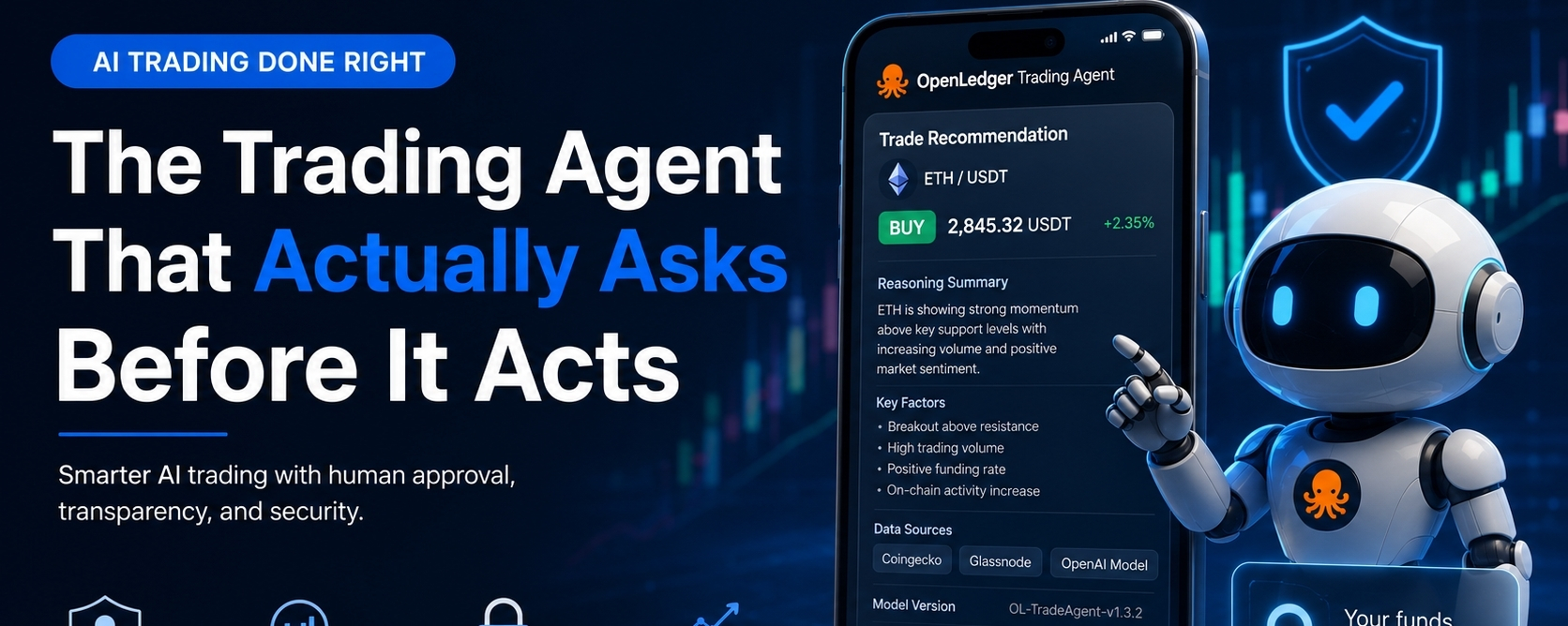
That is why the approach behind the OpenLedger Trading Agent stands out. Instead of giving the AI unlimited authority over your funds, the system requires user approval before any transaction is executed.
At first glance, that might sound less advanced than fully autonomous trading. In reality, it may be the smarter long-term solution.
Why Fully Autonomous AI Trading Can Be Risky
The crypto market moves fast, and AI tools are designed to react faster than humans ever could. But speed alone does not guarantee accuracy.
There have already been situations where AI systems:
Misread market conditions
Executed trades based on incorrect data
Reacted to manipulated signals
Generated flawed trading logic
Hallucinated information that did not exist
When an AI agent operates without supervision, even one mistake can result in significant losses before the user notices what happened.
That is the hidden risk of complete autonomy.
Many platforms focus heavily on removing friction, but fewer are focusing on accountability.
The OpenLedger Trading Agent Takes a Different Approach
Instead of replacing the trader entirely, OpenLedger designed its trading agent to function more like an intelligent assistant.
The AI handles the complex work:
Analyzing market conditions
Monitoring positions
Suggesting strategies
Identifying unusual activity
Summarizing opportunities in plain English
But before any trade is finalized, the system asks for your approval.
That single step changes the entire relationship between the user and the AI.
Rather than handing over full control, users stay involved in the decision-making process while still benefiting from automation and advanced analysis.
Human Approval Creates an Important Safety Layer
One of the biggest advantages of this model is risk reduction.
Human approval acts as a checkpoint between analysis and execution. If something looks suspicious, confusing, or overly risky, the user can simply reject the trade.
This creates several benefits for beginner traders:
Better Understanding of Trades
Instead of blindly trusting an algorithm, users can review recommendations before acting.
Over time, this can help traders learn how strategies work and improve their understanding of market behavior.
Reduced Emotional Trading
The AI still handles research and analysis, which helps remove emotional reactions from the process.
But because the user gives final approval, there is less chance of catastrophic automated mistakes.
Greater Confidence
Many beginners feel uncomfortable giving an AI unrestricted access to their funds.
The approval system creates a balance between automation and personal control, making the experience feel safer and easier to trust.
Proof of Attribution Adds Transparency
Another interesting feature behind the OpenLedger system is its Proof of Attribution layer.
This means every recommendation generated by the AI can be traced back to:
The data sources used
The model version involved
The reasoning behind the suggestion
That level of transparency matters.
Most AI trading systems simply produce an output and expect users to trust the result. OpenLedger appears to focus on explainability instead.
Users can review why a recommendation was made instead of relying on a black-box decision.
For beginners, this can make AI-powered trading feel far less intimidating.
Security Still Matters
Security is another area where the platform seems carefully designed.
Private keys and transaction histories remain stored on the user’s device instead of being unnecessarily exposed elsewhere.
This approach suggests that transparency and security are being treated as connected priorities rather than separate features.
In crypto, that distinction matters a lot.
AI Trading Should Assist, Not Replace, Human Judgment
There is a growing assumption in the industry that the future of AI trading means removing humans from the process completely.
But recent AI failures across multiple industries suggest that fully autonomous systems still carry significant risks.
The smarter question may not be:
“How much control can we give AI?”
Instead, it may be:
“How can AI help us make better decisions while keeping humans informed and protected?”
That is where the OpenLedger Trading Agent appears different.
It does not eliminate the human role. It strengthens it.
Final Thoughts
AI trading technology is becoming more powerful every year, but power without oversight can quickly become dangerous.
The OpenLedger Trading Agent introduces a more balanced model by combining AI-driven analysis with human approval and transparent reasoning.
For beginner traders especially, that balance could be far more valuable than full automation.
As AI tools continue evolving, systems that prioritize accountability, explainability, and user control may ultimately earn more trust than those focused only on speed.
What Do You Think?
Would you trust a fully autonomous AI to manage your trades without approval, or do you prefer having the final say before transactions are executed?
Share your thoughts and experiences in the comments below.
