
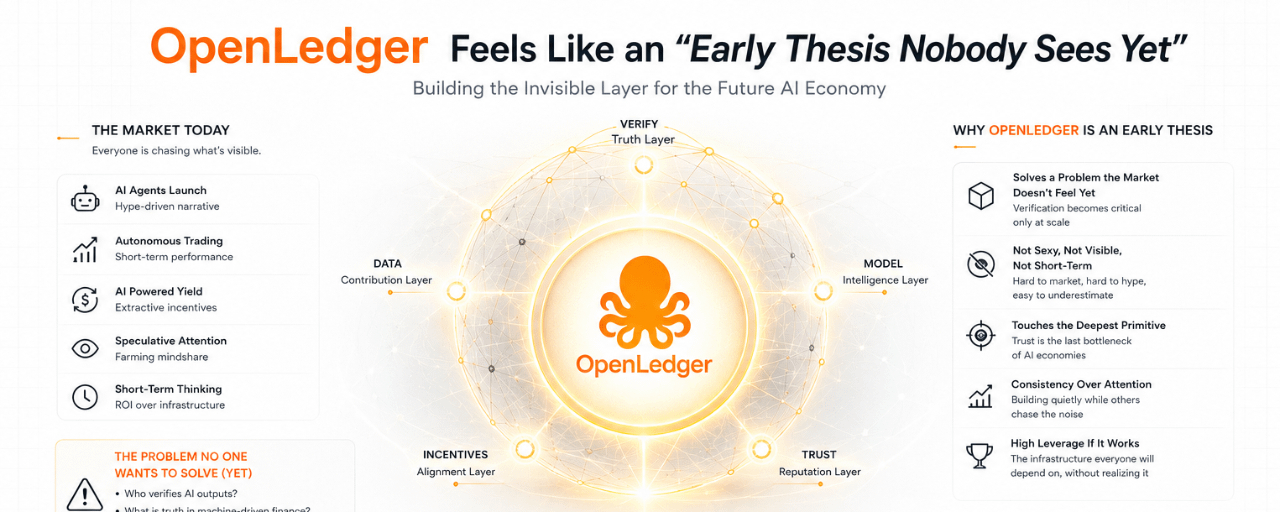
One thing I’ve noticed over multiple crypto cycles is that the biggest shifts rarely appear obvious at first. They usually seem vague, difficult to explain clearly, and sometimes the market doesn’t even have the language to properly describe what’s emerging. OpenLedger gives me that exact feeling — an early thesis hiding in plain sight.
Not because the product is already perfect or because adoption is massive today, but because it seems positioned around a problem the AI economy will eventually be forced to solve: verification.
Most of the current AI narrative is centered around intelligence production. Faster models, cheaper inference, larger context windows, autonomous agents, AI-driven finance — nearly everything focuses on generating more output. But historically, the internet never struggled because of a lack of information. It struggled because it couldn’t reliably determine which information could actually be trusted.
I think AI evolves toward the same problem.
As AI begins generating most online content, automating interactions, and eventually coordinating economic activity itself, scarcity starts to shift. Intelligence becomes abundant. Verification becomes scarce.
That’s why OpenLedger feels less like a standard AI project and more like an attempt to build a verification economy. The important question may not be which AI chain produces the strongest models, but whether the internet can create a trust layer for synthetic intelligence.
The market doesn’t seem to fully price this in yet because verification infrastructure is naturally less visible than generation infrastructure. Users notice AI outputs long before they notice the systems validating them — similar to how the early internet focused on websites and apps while largely ignoring TCP/IP or cloud infrastructure.
That’s where the “early thesis” feeling comes from. These ideas usually don’t scale with attention in the beginning; they scale with the inevitability of the problem they address.
What OpenLedger appears to be exploring is the idea of making verification an economic primitive for the AI-native economy — not only verifying data, but also model behavior, contribution quality, historical reliability, and eventually the trustworthiness of autonomous agents themselves.
AI-native DeFi likely won’t function sustainably on liquidity and automation alone. It will eventually require verified intelligence.
If an autonomous trading agent consistently outperforms, the real question won’t just be performance metrics. It will be: what data shaped that intelligence, how reliable has it historically been, who contributed to the feedback loops, and whether the system can be trusted long enough for capital to continue flowing into it.
At that point, AI finance starts looking surprisingly similar to institutional finance. Traditional finance scales not only because of capital efficiency, but because of layered trust systems — audits, reputation, ratings, compliance, historical records, and verification frameworks that reduce information asymmetry.
The AI economy will likely need something similar.
Crypto has always been excellent at transparency, but transparency alone doesn’t equal verification. Blockchains can record events perfectly while still being unable to determine whether the intelligence driving those events is trustworthy.
That gap feels central to what OpenLedger is trying to address.
If viewed through that lens, OpenLedger looks less like an application and more like infrastructure for a future economy. And infrastructure layers often appear unnecessary before the ecosystem built on top of them fully emerges.
Cloud infrastructure once looked like niche backend tooling before internet applications exploded. Ethereum once looked experimental before DeFi created demand for programmable liquidity. Foundational systems rarely appear exciting in their earliest stages because demand for them hasn’t fully materialized yet.
The difficult part is that verification economies are harder to bootstrap than generation economies. Users naturally gravitate toward fast AI outputs, while invisible trust architecture tends to be ignored until systems become large enough to break without it.
But eventually every AI market may run into the same issue: once synthetic content surpasses human content, autonomous agents interact at scale, and machine-driven finance becomes normalized, the economy will need mechanisms to distinguish reliable intelligence from statistical noise.
At that point, verification stops being optional. It becomes a survival layer.
And if that future unfolds the way many expect, then OpenLedger may be building something the market will need later rather than something the market rewards today.
That’s why I think it’s worth watching.
Not because the narrative is already massive, but because some of the most important theses emerge long before the market has enough context to fully recognize them.
Maybe the more important question isn’t whether OpenLedger succeeds.
Maybe it’s whether the AI economy can truly scale without a strong verification layer underneath it.
I’m not sure the answer is yes.