
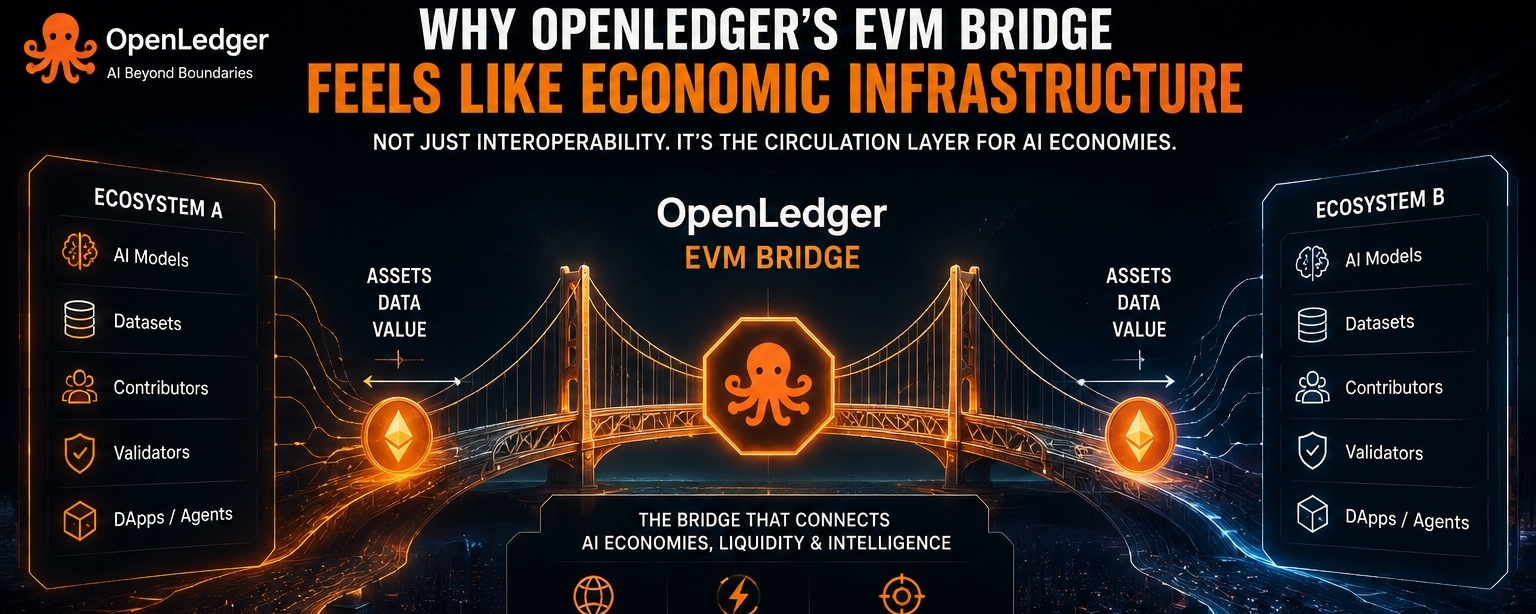

At first I assumed OpenLedger’s EVM bridge was mostly technical. Just another interoperability layer connecting assets between ecosystems.
But the deeper I went into the architecture, the more that assumption started breaking apart.
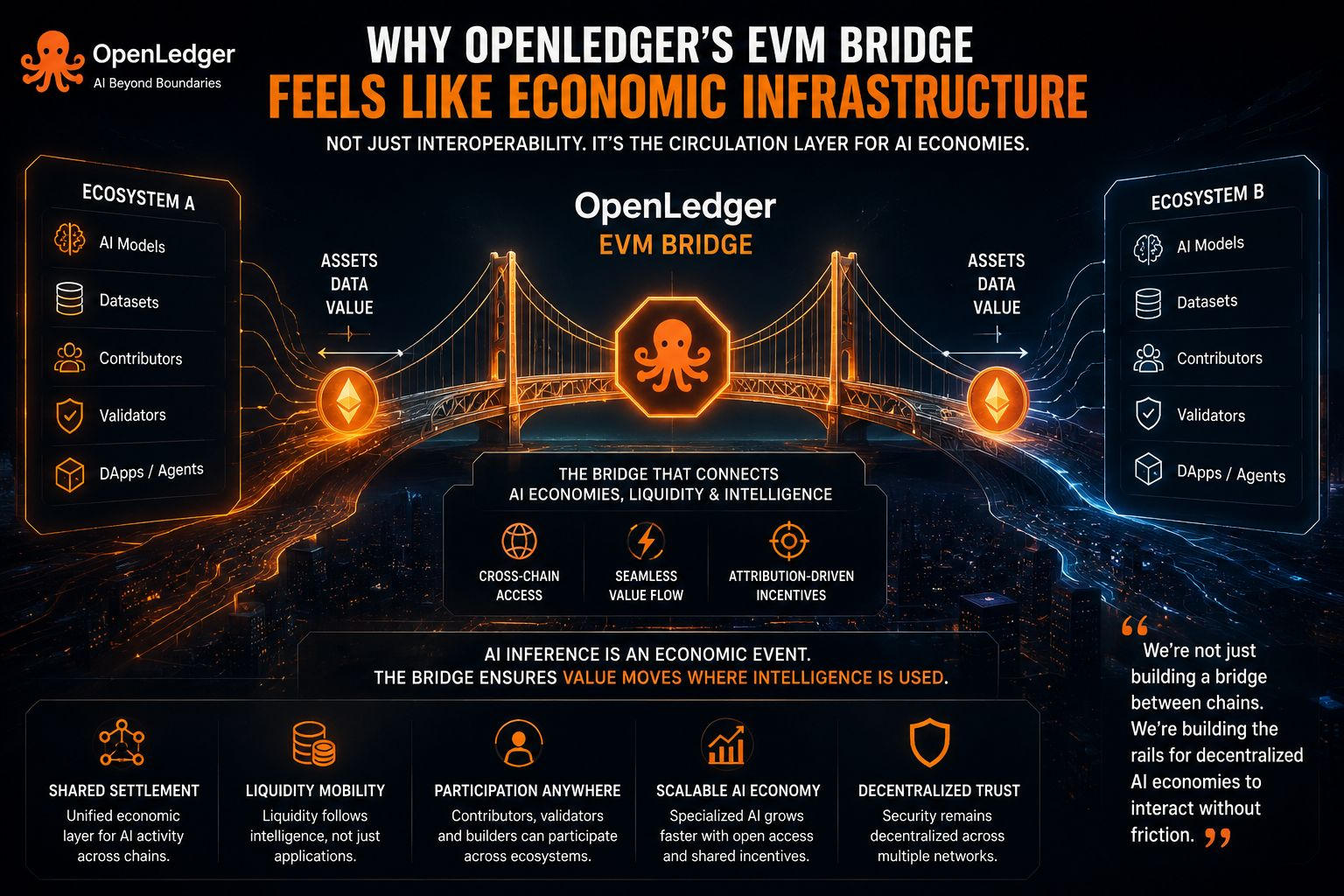
Because OpenLedger doesn’t really position AI as isolated software. It treats intelligence like an economy. Models generate value. Datasets influence outcomes. Validators secure activity. Contributors participate in the lifecycle of inference itself.
And suddenly the bridge stops looking like a normal bridge.
It starts feeling more like economic infrastructure.
Most blockchain bridges move liquidity from one network to another. But OpenLedger’s structure hints at something broader. If AI agents, specialized models, and decentralized applications eventually operate across multiple ecosystems, then value cannot stay trapped inside closed environments.
The bridge may quietly become the circulation layer that allows AI economies to interact.
That part stayed in my mind longer than I expected.
Because specialized AI only becomes scalable when access, incentives, and liquidity move freely alongside intelligence. Otherwise every ecosystem becomes its own isolated machine with limited economic reach.
What makes OpenLedger interesting is that the bridge doesn’t feel separated from the AI layer. It feels connected to attribution, participation, and cross-chain utility itself. Almost like infrastructure designed not only for transferring assets, but for transferring economic activity generated by intelligence.
And honestly, the strange thing is most people may look at the bridge and only see interoperability.
I think OpenLedger might be aiming at something much deeper than that.
