
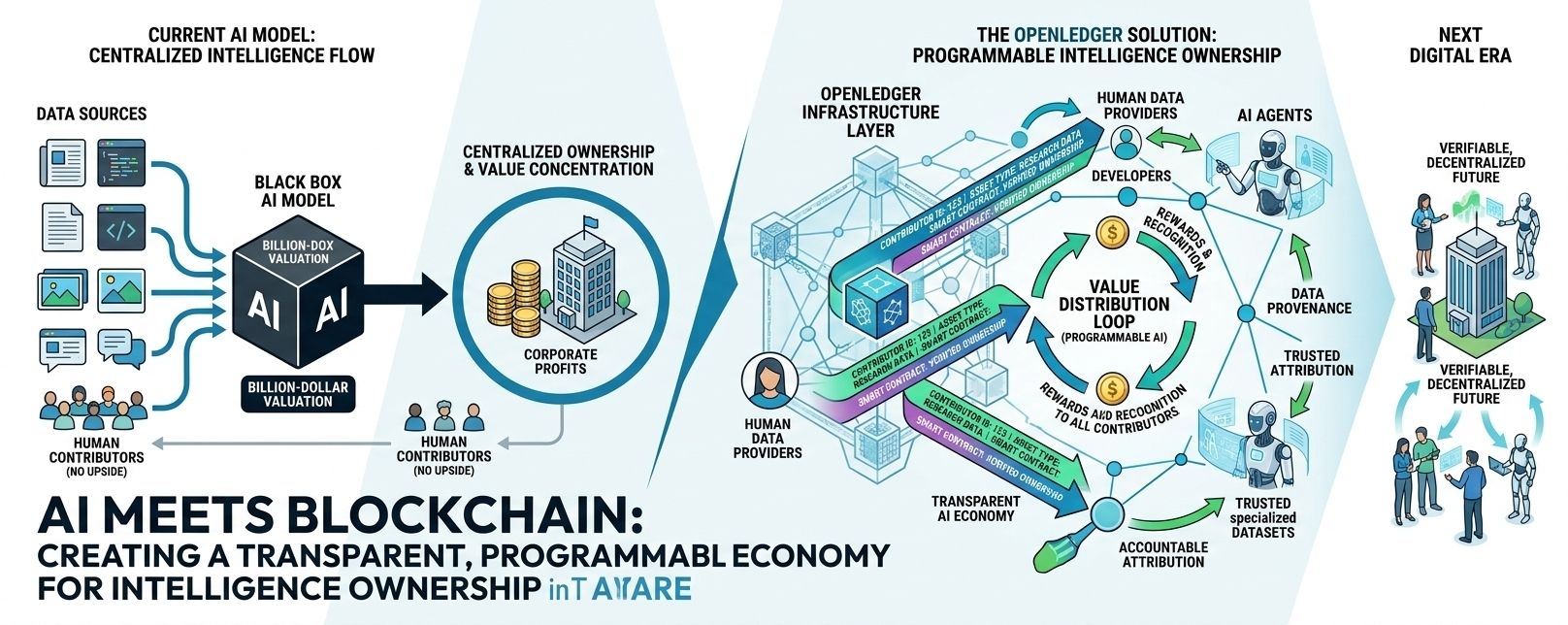
@OpenLedger I’ve been watching the AI industry evolve at a pace that honestly feels unreal. Every few weeks there’s another breakthrough model, another billion-dollar valuation, another announcement claiming artificial intelligence will completely redefine the future of work, finance, media, and human productivity. But the more I study this space, the more I realize that the real story isn’t just about how powerful AI is becoming. The real story is about ownership.
Who actually owns the intelligence being created right now?
That question sits at the center of everything happening in the AI economy, and I believe most people still underestimate how important it is going to become over the next few years.
Every modern AI system is built on top of human contribution. It learns from articles, research, conversations, code, videos, designs, online communities, social behavior, and years of collective digital activity created by millions of people across the internet. Yet once that data enters the training pipeline, the connection between the contributor and the value being created usually disappears completely. The intelligence becomes centralized. The economic upside becomes concentrated. And the people helping power these systems are left outside the value loop.
I think this is one of the biggest structural problems in artificial intelligence today.
The internet already showed us what happens when platforms capture most of the value while users generate the actual engagement, culture, and content. Social media transformed ordinary people into the fuel powering trillion-dollar ecosystems, yet only a tiny percentage of creators truly benefited at scale. AI has the potential to amplify this imbalance even further because artificial intelligence doesn’t just distribute human content. It absorbs human intelligence itself.
That’s exactly why OpenLedger immediately caught my attention.
Unlike many AI projects chasing hype cycles or trying to launch another flashy model, OpenLedger is focused on something much deeper. It’s building infrastructure designed to create a transparent and economically accountable AI ecosystem where contributors, developers, data providers, and autonomous AI systems can interact inside programmable frameworks.
What makes this vision powerful is that it addresses the layer of AI most people ignore. Everyone talks about intelligence generation, but very few are talking seriously about intelligence ownership.
OpenLedger is.
And honestly, I think that changes everything.
The more I explored the project, the more I realized OpenLedger isn’t simply trying to decentralize AI as a narrative. It’s attempting to redesign the economic architecture surrounding artificial intelligence itself. Instead of treating data as disposable fuel for centralized systems, OpenLedger approaches intelligence like a traceable and economically connected asset where contribution can actually be measured and rewarded.
That idea might sound technical on the surface, but the implications are massive.
Right now, most AI systems operate like black boxes. Human knowledge flows into the model. Intelligence comes out. Somewhere in between, attribution disappears. A researcher may unknowingly help improve a commercial AI system worth billions without ever receiving recognition. An artist’s style may influence generative models globally while remaining economically disconnected from the outputs being produced. Entire communities can contribute niche expertise that strengthens machine intelligence while receiving absolutely nothing in return.
OpenLedger is building toward a future where that relationship changes.
I think this becomes even more important as high-quality data evolves into one of the most valuable resources in artificial intelligence. Early AI development relied heavily on broad internet scraping, but the industry is already discovering that quantity alone isn’t enough anymore. The next generation of AI systems will depend heavily on trusted, specialized, rights-cleared datasets with transparent provenance and reliable ownership structures.
That creates a huge opportunity for infrastructure capable of coordinating attribution and economic participation properly.
This is where OpenLedger starts looking less like a crypto narrative and more like foundational infrastructure for the next phase of AI.
One of the most fascinating ideas behind the project is the concept of payable AI. Traditional AI systems absorb contribution without maintaining any long-term economic relationship with the people behind the data. OpenLedger introduces the possibility of AI ecosystems where contribution remains visible and value distribution becomes programmable.
Personally, I think this is one of the smartest directions emerging in decentralized AI right now because it aligns incentives instead of extracting from them.
Imagine a future where researchers, creators, developers, analysts, and online communities don’t simply feed intelligence into centralized systems for free. Instead, their contributions become productive digital assets capable of generating ongoing economic participation inside the AI economy.
That completely changes the relationship between humans and artificial intelligence.
And honestly, the timing feels incredibly important.
The AI industry is entering a phase where transparency, copyright, licensing, and data provenance are becoming impossible to ignore. Governments are paying closer attention to how models are trained. Enterprises deploying AI systems need stronger compliance guarantees. Creators are becoming increasingly vocal about ownership rights. Legal pressure surrounding AI training practices continues expanding across the industry.
OpenLedger feels strategically positioned for this exact environment because it’s building accountability directly into the infrastructure layer rather than treating transparency as an afterthought.
What also makes the project stand out to me is its understanding of where AI is actually heading next.
Most people still interact with AI through chatbots and content generation tools, but the future of artificial intelligence will likely revolve around autonomous agents capable of executing tasks, managing workflows, conducting transactions, and coordinating across digital ecosystems independently.
That shift is going to create entirely new infrastructure demands.
How do autonomous AI systems identify themselves?
How do they interact financially?
How are permissions enforced?
How do enterprises audit machine-driven execution?
How can ownership and accountability exist inside autonomous digital economies?
Traditional internet infrastructure wasn’t really designed for that reality.
OpenLedger appears to recognize this early. Its architecture is built around the idea that AI systems should operate inside transparent programmable environments where actions, ownership, and interactions can be verified rather than hidden behind centralized systems.
This is also why I believe the convergence between AI and blockchain is becoming much more important than many people realize.
For years, blockchain and artificial intelligence were treated like separate technological movements competing for attention. But the deeper I look at both industries, the clearer it becomes that they solve complementary problems. AI provides intelligence and automation. Blockchain provides verification, ownership, transparency, and economic coordination.
When combined properly, they create the foundation for machine-native economies where humans and intelligent systems can interact openly without depending entirely on centralized intermediaries.
OpenLedger is positioning itself directly at the center of this transformation.
And I think that positioning matters a lot.
The projects that survive long term in AI won’t necessarily be the loudest or the most hyped. They’ll be the ones solving structural problems the industry eventually cannot ignore. Trust. Provenance. Ownership. Economic participation. Accountability. Transparent coordination between humans and autonomous systems.
Those are infrastructure problems.
And infrastructure is where long-term value is usually built.
Another reason I find OpenLedger compelling is because it feels aligned with larger shifts happening across the digital economy itself. Users increasingly want ownership over digital assets and identities. Creators want monetization systems that reduce dependence on centralized platforms. Enterprises want verifiable compliance frameworks. Developers want composable infrastructure that can integrate across ecosystems.
Artificial intelligence intensifies all of these demands simultaneously because AI depends fundamentally on human-generated knowledge.
OpenLedger understands that the future of AI is not only about building smarter models. It’s about building sustainable economic systems around intelligence itself.
That distinction is powerful.
Of course, none of this means success is guaranteed. Building decentralized infrastructure at scale is extremely difficult. Centralized AI companies still dominate capital, compute power, and distribution networks. Regulation remains uncertain. User adoption takes time. Many ambitious blockchain projects have failed trying to solve coordination problems that looked easier on paper than they were in reality.
But even with those challenges, I believe the core issue OpenLedger is addressing is absolutely real.
Artificial intelligence cannot scale forever on invisible contribution and opaque economic structures without eventually creating major pressure around ownership and accountability. As AI becomes more deeply integrated into finance, enterprise systems, media, governance, and digital infrastructure, these questions will only grow louder.
Who owns the intelligence?
Who benefits from it?
Who gets rewarded for helping build it?
OpenLedger is one of the few projects I’ve seen approaching these questions from an infrastructure-first perspective instead of simply using them as marketing narratives.
And honestly, that’s why I think it deserves serious attention.
The future of AI will not only be shaped by the companies building the most powerful models. It will also be shaped by the systems determining how value flows through the intelligence economy itself. Platforms capable of creating trust, transparency, programmable ownership, and economic accountability may ultimately become just as important as the intelligence being generated.
I believe OpenLedger understands that better than most.
It’s not just building for today’s AI market.
It’s building for a future where humans, autonomous agents, decentralized systems, and programmable economies all interact together inside a transparent intelligence network.
And if that future arrives the way many people expect, infrastructure like this could become one of the most important layers of the next digital era.
