
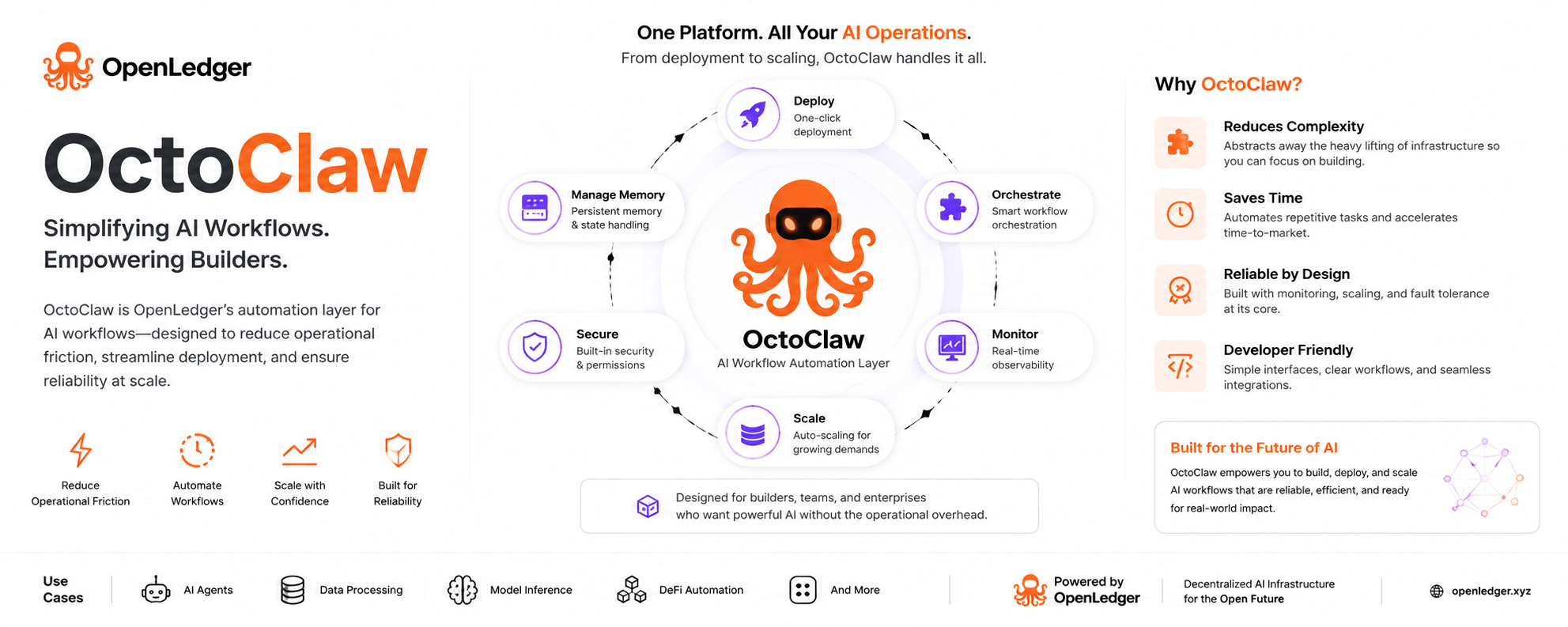

Why I Think OctoClaw Matters for OpenLedger
The more I look at the AI space, the more I feel like there’s a gap between what projects promise and what users actually experience.
Everyone talks about automation now. Autonomous agents, intelligent workflows, decentralized AI — the ideas sound impressive. But when you actually use many of these systems, you realize how much manual work still exists behind the scenes.
You’re still setting things up yourself. Still checking whether workflows failed somewhere. Still managing tools, deployments, APIs, and infrastructure manually.
At some point, it stops feeling like automation and starts feeling like maintenance.
That’s honestly why OctoClaw stood out to me.
Not because it’s trying to create another huge AI narrative. The market already has plenty of those. Every cycle introduces a new “future of AI” story, and most of them disappear as quickly as they arrive.
What feels different here is that OpenLedger seems to be focusing on a more practical problem — making AI systems easier to actually run.
And I think that matters more than people realize.
A lot of infrastructure products fail because they focus too much on technical power and not enough on user experience. The system may work, but if people constantly need to babysit it, the product never really feels reliable.
That’s the part many teams underestimate.
The strongest infrastructure usually becomes successful quietly. Not because it creates hype, but because it removes friction people deal with every day.
You can see that pattern across tech history. AWS changed how companies handled servers because it simplified deployment. Stripe grew because it removed unnecessary complexity from payments. The biggest breakthroughs often come from making difficult things feel manageable.
From what I’ve seen so far, OctoClaw seems to move in that direction.
It doesn’t feel like OpenLedger is trying to oversell some distant AI future. The focus appears more grounded: helping users spend less time managing infrastructure and more time actually building or using AI workflows.
That may sound simple, but simplicity is usually harder to build than complexity.
Of course, it’s still early. Every infrastructure product looks good during launch week. The real test comes later when real users push the system under pressure.
Can it stay reliable at scale?
Does it actually reduce operational headaches over time?
Will developers continue using it once the excitement fades?
Those are the questions that really matter.
But even with those uncertainties, I still think the launch of OctoClaw is an important moment for OpenLedger because it feels focused on solving a real operational problem instead of just selling another trend.
And honestly, in both crypto and AI, that’s probably where long-term value gets built.
