
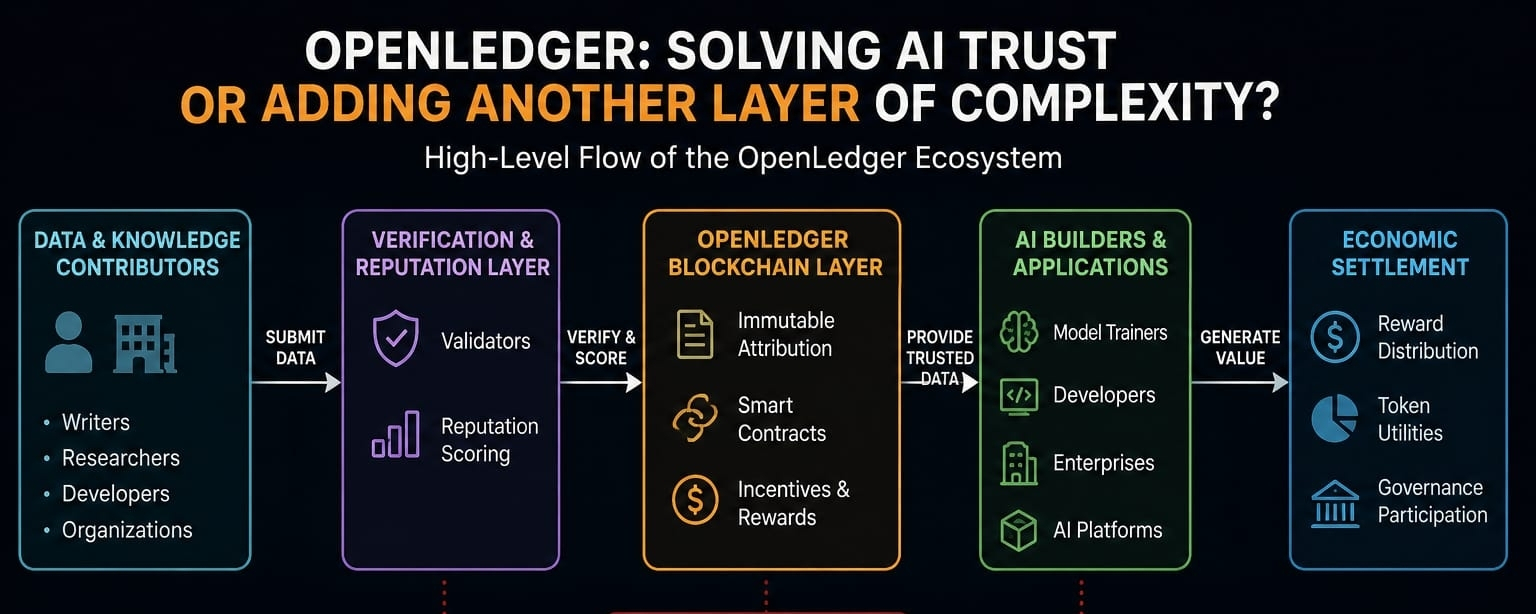
Look, I understand why projects like OpenLedger are suddenly getting attention.
The AI market right now is chaotic. Models are swallowing data from every corner of the internet. Nobody really knows where half the training material came from anymore. Writers are angry. Developers are nervous. Enterprises are terrified of feeding sensitive information into black-box systems owned by giant corporations. And somewhere in the middle of all this confusion, blockchain startups smell opportunity.
That’s the pitch.
AI has a trust problem. OpenLedger claims it can fix it with decentralized coordination, attribution systems, economic incentives, and blockchain-based verification layers.
It sounds tidy. On paper, at least.
But I’ve seen this movie before.
The tech industry has a habit of taking one complicated problem and “solving” it by stacking three additional layers of infrastructure on top of it until nobody can tell where the original issue ended and the new mess began. Crypto did this constantly. So did enterprise software in the 2000s. So did cloud middleware companies that promised to simplify IT while quietly creating entire new departments just to manage the simplification.
OpenLedger risks walking straight into the same trap.
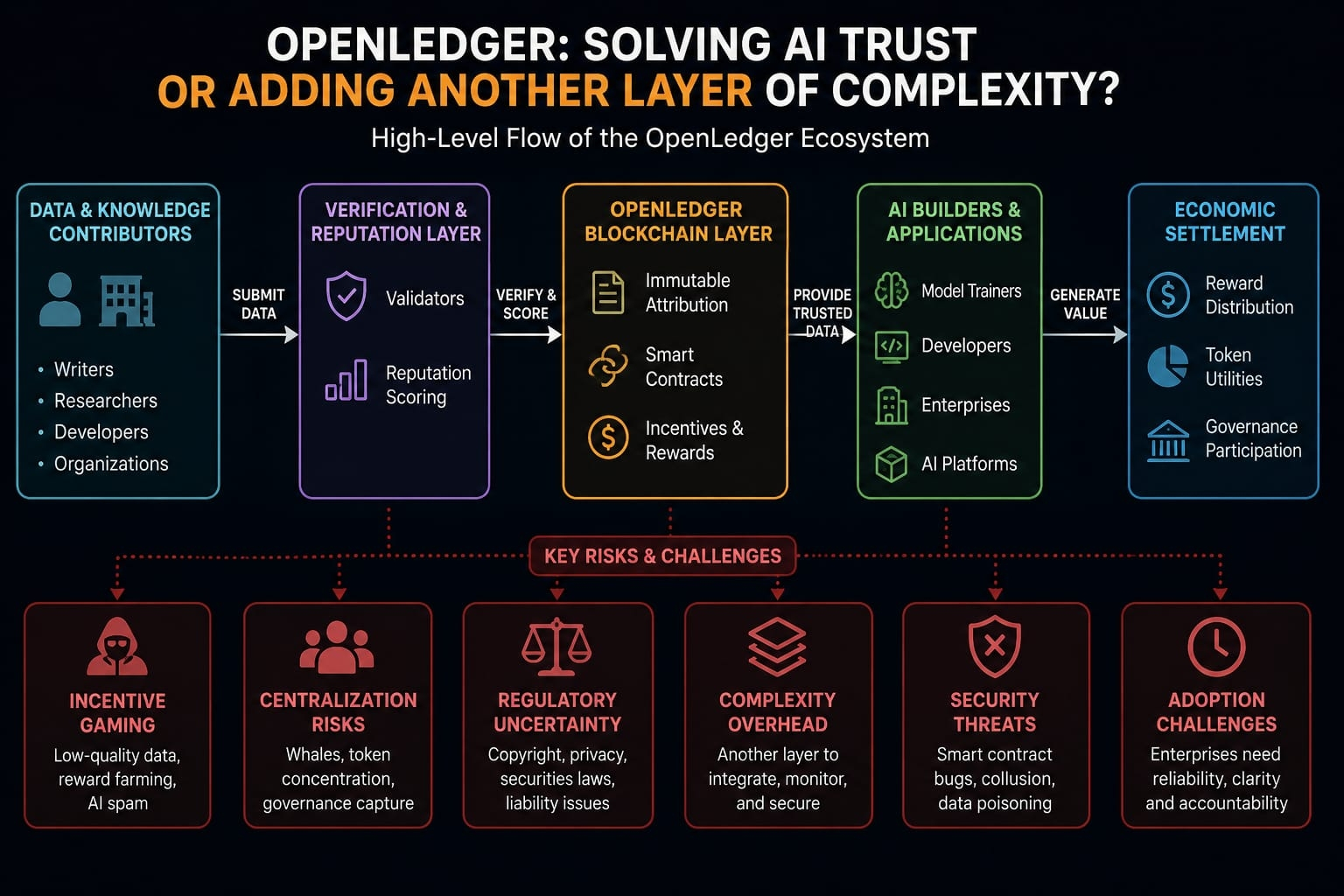
The core problem they claim to solve is not fake. That part matters. AI systems today are becoming increasingly opaque. Data provenance is murky. Attribution barely exists. Human contributors create value while centralized platforms capture most of the money. Meanwhile, AI-generated content is starting to flood the internet so aggressively that future models may end up training on synthetic garbage produced by earlier models.
That is a real concern.
If enough low-quality machine output contaminates future training pipelines, the entire ecosystem starts eating its own exhaust fumes. Researchers already worry about this privately. Most executives just avoid discussing it publicly because the current AI boom depends heavily on maintaining the illusion that scale automatically equals progress.
So OpenLedger steps in and says: fine, we’ll create a system where contributions can be tracked, verified, rewarded, and coordinated across a decentralized network.
Sounds reasonable.
Until you start asking the uncomfortable questions.
Because the second you attach money to information, human behavior changes immediately. People stop optimizing for truth and start optimizing for rewards. That is not theory. That is history. Every incentive system eventually gets gamed because human beings are extremely creative when free money appears on the table.
Crypto already proved this repeatedly.
Yield farming became extraction theater. Play-to-earn gaming turned into inflation machines. “Decentralized social media” became bot farms farming engagement tokens. Everybody talks about incentives like they are magical alignment tools. In practice, incentives often corrupt the very thing they are supposed to improve.
Now apply that same dynamic to AI data contribution.
What happens when users flood the network with low-quality material just to collect rewards? What happens when AI-generated content pretends to be human-created expertise? What happens when validators collude? What happens when large token holders quietly control governance while the marketing department keeps repeating the word “decentralized” like a prayer?
Because let’s be honest. Most blockchain governance systems are not democracies. They are shareholder systems wearing hoodies.
The people with the biggest bags usually end up steering the network. That’s the dirty little secret underneath a huge percentage of crypto infrastructure projects. Decentralization often stops right around the point where real economic control begins.
And then there’s the infrastructure question itself.
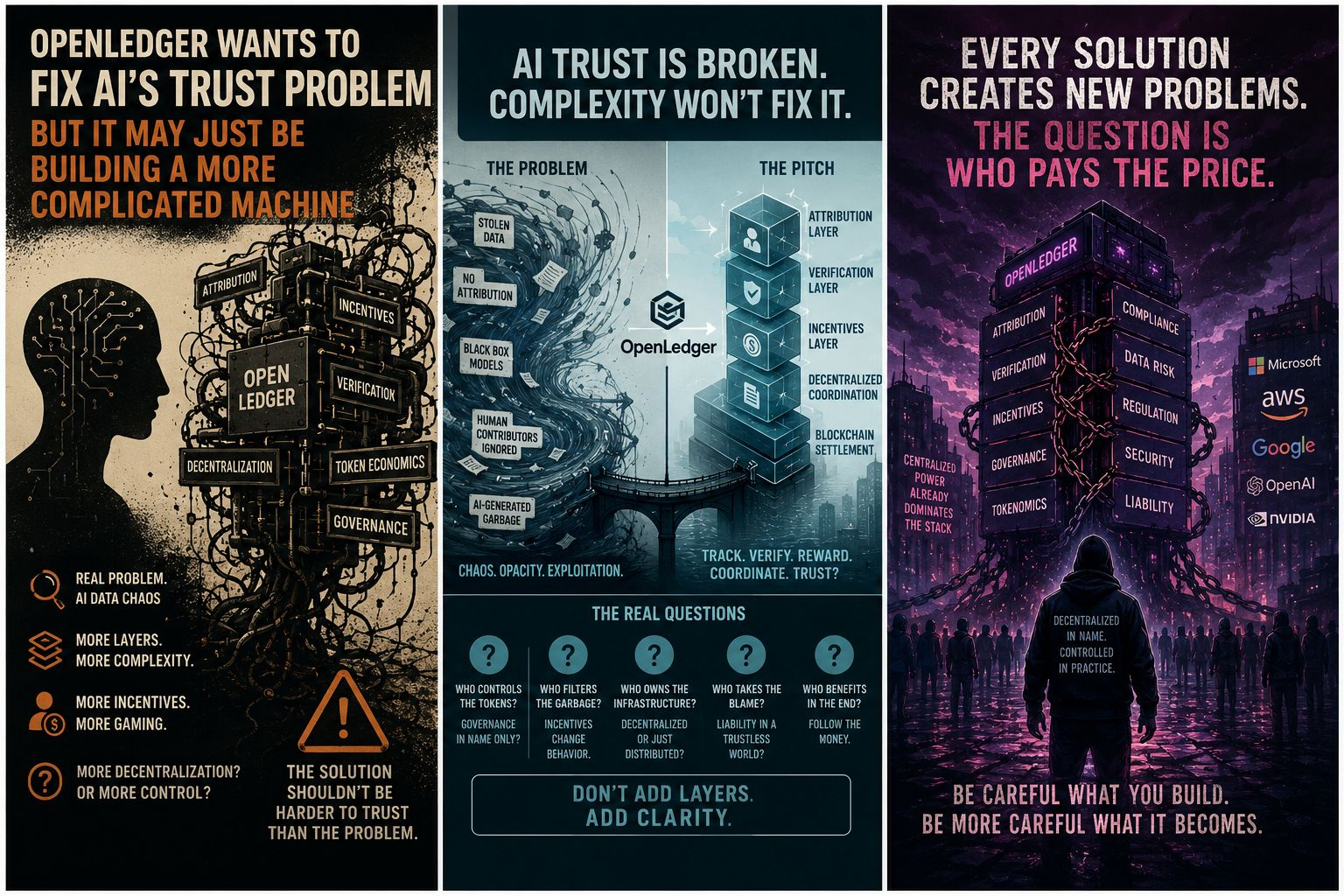
OpenLedger talks about decentralized AI coordination. Fine. But AI infrastructure is already becoming one of the most centralized industries on earth. Compute power is concentrated inside a handful of companies with massive capital reserves and access to industrial-scale GPU clusters. NVIDIA controls the hardware layer. Microsoft and Amazon dominate cloud infrastructure. OpenAI and Google control model distribution at enormous scale.
That centralization is not happening because nobody thought of decentralization first. It is happening because advanced AI systems are brutally expensive to build and maintain.
So when a project claims it will decentralize parts of the AI economy, the first thing I ask is simple: which parts exactly?
Because there is a huge difference between decentralizing governance rhetoric and decentralizing actual industrial power.
OpenLedger seems less naive than some earlier projects in this space. To its credit, it does not appear to be pretending blockchain will somehow replace frontier AI labs entirely. The architecture seems more focused on attribution and coordination layers rather than raw computation itself.
That’s smarter.
But it also reveals the catch.
The project may not actually reduce complexity for enterprises or developers. It may simply relocate complexity into another operational layer that companies now have to integrate, monitor, secure, regulate, and legally account for.
That matters because enterprises hate uncertainty more than they hate inefficiency.
People in crypto circles love talking about “trustless systems.” Real businesses do not. Real businesses want someone to sue when things break. They want service guarantees. They want regulatory clarity. They want predictable liability structures. Blockchains are famously awkward at all of those things.
And that brings us to the part the marketing teams rarely emphasize.
Regulation.
Everybody loves decentralization right up until governments start asking who is responsible for the outputs.
What happens if copyrighted data enters the system? What happens if private medical information gets embedded somewhere inside distributed training coordination layers? What happens if AI-generated financial recommendations create legal liability? What happens if regulators decide the token structure looks suspiciously like a security?
Suddenly the cheerful infrastructure diagrams stop looking so clean.
Look, I’m not saying OpenLedger is fake. Actually, the opposite may be true. It appears to be trying to build something operationally serious, which already separates it from half the AI-crypto sector.
But serious infrastructure projects face serious problems.
The market right now rewards narrative velocity. Infrastructure requires patience, reliability, compliance work, developer adoption, and years of surviving hostile conditions without collapsing. Those are completely different skill sets.
And here’s the thing I keep coming back to.
The entire pitch behind systems like OpenLedger assumes that adding blockchain-based coordination layers will increase trust inside AI ecosystems. Maybe it will. Maybe not. But history suggests every additional layer of infrastructure also creates new attack surfaces, new governance disputes, new operational burdens, and new economic incentives that eventually distort user behavior.
That is the part investors love ignoring during hype cycles.
Technology systems rarely become simpler as they scale. They become more fragile, more political, and more dependent on whoever quietly controls the infrastructure underneath.
The glossy presentations never spend much time talking about that part.


