
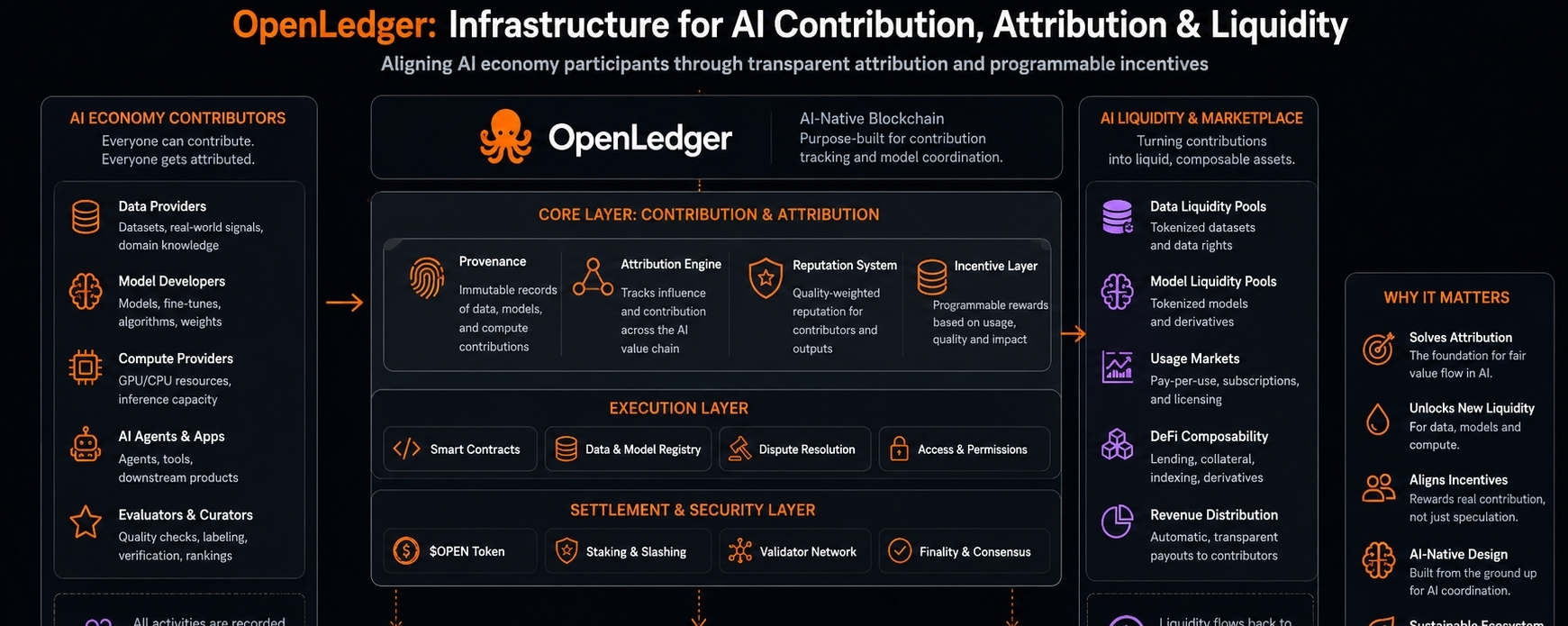
OpenLedger is one of those projects that, at first glance, almost feels assembled out of every narrative that has passed through crypto in the last two years. AI. Data ownership. Agents. Liquidity layers. Decentralized infrastructure. You read the homepage once and your brain almost auto-completes the rest before you finish the sentence. That’s not even really their fault anymore. The industry trained people to react that way. Every new Layer 1 now arrives carrying ten different promises because just being “fast” stopped working as a story a while ago.
Still, after sitting with it for a bit, OpenLedger does feel slightly different in tone. Not dramatically. Not enough to declare some major shift. But enough that you notice it. The project seems less obsessed with becoming a universal computer for everything on earth and more focused on one uncomfortable reality that AI keeps running into: nobody really knows how value flows back to the people or systems providing useful data and models. Everyone talks endlessly about intelligence. Almost nobody talks about attribution in a way that survives contact with actual markets.
And honestly, that’s probably the first thing that made me pay attention for more than five minutes.
Because most AI-chain projects feel weirdly detached from how messy AI actually is. They speak about autonomous agents like they’re already normal consumer products instead of fragile demos running behind API credits and investor patience. OpenLedger, at least from the outside, seems more interested in the plumbing. Who contributed what. Who gets paid. How liquidity forms around datasets or models that are usually trapped inside closed systems.
That’s a more grounded place to start, even if the execution challenge is brutal.
The thing with new Layer 1s now is that nobody evaluates them in isolation anymore. People pretend they do, but they don’t. Every chain launches into the shadow of chains that already survived real pressure. And crypto has this habit of forgetting that infrastructure only reveals itself when conditions become ugly. Testnets mean almost nothing. Carefully managed benchmarks mean even less. Traffic is the test. Congestion is the test. Bad behavior is the test.
A blockchain can look elegant for two years and then completely lose composure the moment actual demand arrives from somewhere unexpected.
You can see this across the industry already. Solana is probably the obvious example because when it works well, it genuinely feels good to use. Fast. Cheap enough that users stop thinking about transaction cost every few seconds. That matters more than people admit. But it also showed what happens when a chain becomes culturally successful before the underlying coordination problems are fully settled. The strain becomes visible. Not constantly. But enough to remind everyone that performance charts and lived network conditions are two different things.
That’s why I have a hard time reacting emotionally to new Layer 1 announcements anymore. I’ve watched too many cycles where people spoke about throughput like they were discussing destiny. Then six months later the conversation quietly changed into bridge risks, validator concentration, dead apps, ghost liquidity, or users simply not caring enough to migrate.
Because migration is the real problem now. Not technology.
Crypto already has functioning places to trade, speculate, borrow, mint, gamble, and automate things. They’re imperfect, but they exist. Which means OpenLedger is not entering an empty market looking for infrastructure. It’s entering a crowded city where everyone already has habits. Liquidity has gravity. Developers have routines. Users barely want to switch wallets, let alone move into an entirely new ecosystem because a chain claims it understands AI better.
That friction matters more than whitepapers usually admit.
And I think OpenLedger quietly understands this, at least partially. The project doesn’t seem to frame itself purely as “another faster chain.” It appears to assume that AI-native economic activity might eventually require infrastructure designed around contribution tracking and model coordination from the beginning instead of awkwardly stapling those systems onto existing networks later.
That’s probably the real bet underneath all of this.
Not that OpenLedger becomes the dominant Layer 1. Honestly, I doubt anyone becomes dominant in the clean, simplified way people imagined during earlier cycles. The industry feels too fragmented now. Too many regional ecosystems. Too many specialized environments. Too many incentives pulling in different directions. The future might genuinely look more like interconnected clusters rather than one settlement layer swallowing everything.
Although even that idea gets romanticized sometimes.
Interoperability sounds elegant in theory until you actually use cross-chain systems for extended periods. Then you remember how exhausting fragmented liquidity can become. Bridges fail. Standards drift apart. Users lose patience. Developers duplicate effort across ecosystems. Everyone talks about modular futures while secretly hoping their own chain becomes the center anyway.
So when OpenLedger talks about unlocking liquidity around data and models, the important question isn’t whether the idea sounds intelligent. It does. The question is whether enough participants behave consistently enough for that liquidity to become real instead of theoretical.
That’s harder.
Especially because AI itself is still unstable territory economically. We still don’t fully know what becomes commoditized and what remains valuable. Models improve quickly, then plateau, then leap again unexpectedly. Open-source communities undercut commercial assumptions every few months. Data quality matters enormously, but pricing quality is still messy and subjective. Most people in crypto underestimate how difficult it is to build durable marketplaces around assets whose value changes this fast.
And yet, despite all of that, there’s something mildly refreshing about a project trying to structure incentives around contribution rather than pure speculation velocity.
That might sound obvious, but crypto rarely does it well.
Usually the industry creates systems where capital arrives first and utility gets invented later under pressure. OpenLedger seems to be attempting the reverse order conceptually. Build rails for AI participation first, then hope liquidity forms around useful activity afterward. That’s riskier in some ways because it requires patience, and crypto historically has very little patience.
You can also see the trade-offs in the architecture choices and positioning. OpenLedger appears willing to narrow its focus instead of pretending to optimize for every use case simultaneously. That can be smart. General-purpose chains often become vague enough that nobody knows what they’re actually good at besides existing. Specialization at least creates identity.
But specialization also limits flexibility. If AI coordination narratives cool off for a while, does the chain still matter? If the broader market decides centralized AI platforms are “good enough,” does decentralized attribution infrastructure remain attractive outside ideological circles? Those questions don’t have clean answers yet.
And honestly, a lot of crypto founders underestimate how often convenience defeats philosophy.
Users repeatedly choose systems that are simpler, faster, and familiar even when they dislike the underlying power structures. We’ve already seen this happen across exchanges, custody, social platforms, even governance. Decentralization wins culturally long before it wins behaviorally.
That’s another reason I stay cautious around projects like this.
Not because the ideas are bad. Some of the ideas are actually pretty reasonable. But because the distance between “reasonable architecture” and “sustained ecosystem activity” is enormous. Entire graveyards of technically competent chains already proved that.
Still, I can’t completely dismiss OpenLedger either.
There is a real possibility that AI-native markets eventually need infrastructure designed with provenance, attribution, and programmable incentives at the base layer rather than treated as optional middleware. And if that shift happens gradually instead of explosively, smaller focused ecosystems might have more room than people expect right now.
A lot depends on whether the team can avoid getting trapped inside its own narrative. AI hype destroys clarity fast. The moment every sentence starts sounding like synthetic destiny and exponential intelligence, people stop thinking critically. Good projects disappear under their own marketing language all the time.
OpenLedger will probably need restraint more than excitement.
And maybe that’s the strange part. The older this industry gets, the less convincing certainty becomes. I trust projects slightly more when they seem aware of the difficulty ahead instead of pretending adoption is automatic once the tech exists.
OpenLedger doesn’t fully escape the usual Layer 1 ambitions. No project really does. But beneath the familiar language, there does seem to be an attempt to solve a narrower, more tangible coordination problem tied to AI economics instead of just chasing abstract scale numbers.
Whether that becomes meaningful is another question entirely.
It might work. Or nobody shows up.