
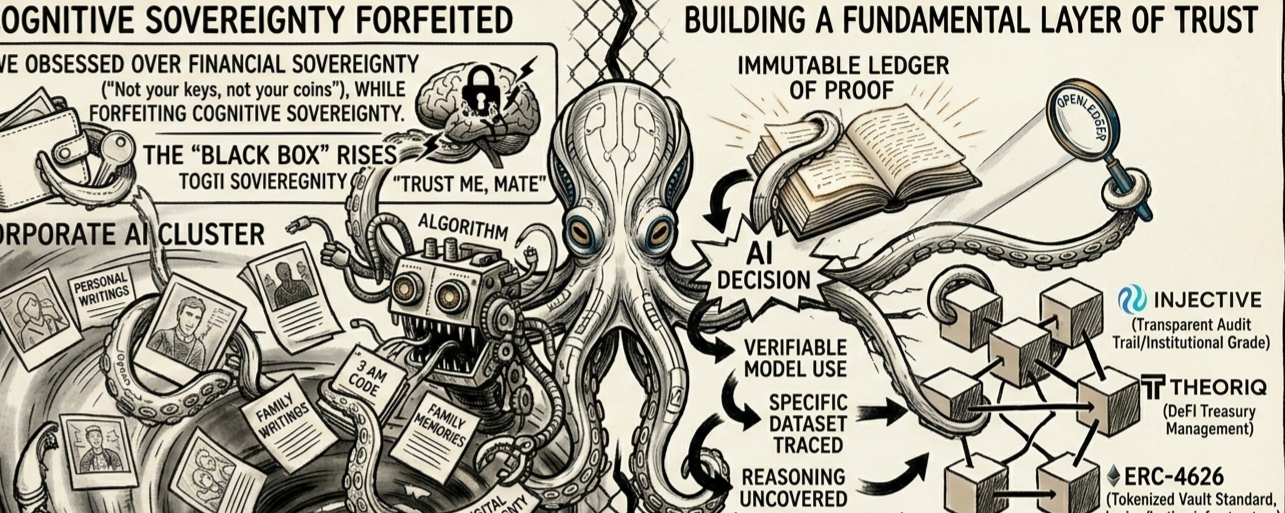

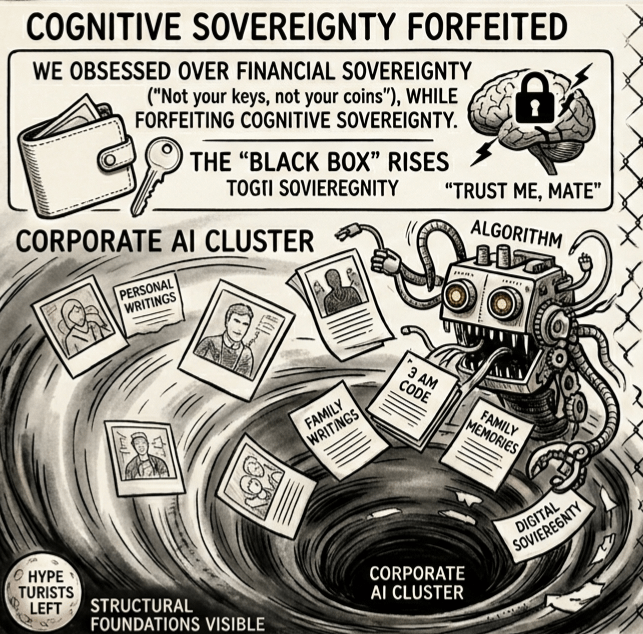
I was scrolling through an old digital family photo album the other night, and this proper heavy, haunting thought just hit me straight in the chest. Every single one of those memories—our personal photos, every article we ever poured our hearts into, every single line of code we stayed up until 3 AM pushing—it’s all already been chewed up, swallowed, and digested by some massive corporate AI cluster. And the maddening part? We didn't even notice the heist because it happened with total compliance. We just clicked "Accept." In crypto, we’re absolute zealots about ownership, yeah? "Not your keys, not your coins"—that’s our literal religion. Yet, when it came to our data, the actual fuel of the next digital age, we just handed it over without so much as a scrap. We obsessed over financial sovereignty while completely forfeiting our cognitive sovereignty. We protected the wallet, but gave away the mind.
That’s exactly why my whole view on the space flipped when I stopped looking at OpenLedger as just another hyped-up, buzzword-heavy "AI project" and started analyzing it as a fundamental layer of trust.
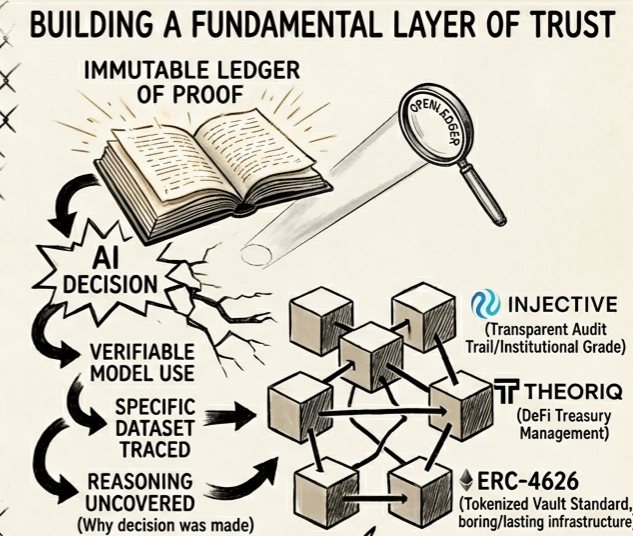
To me, the core thesis here isn’t about building flashier AI agents or chasing speculative trading bots to make a quick buck. The real crisis in AI right now is the "Black Box." When an algorithm executes a massive financial trade or shifts deep liquidity, it demands blind faith. It tells you, "Just trust me, mate." OpenLedger shifts that entire paradigm from "trust me" to "here is the immutable proof." By forcing AI behaviors to be verifiable, traceable, and strictly accountable, we finally get to look under the hood. We see exactly which model was used, what specific dataset it relied on, and precisely why a decision was made. No hiding.
When I look at their recent integrations, I don’t see superficial marketing fluff to pump a token; I see the quiet construction of an institutional-grade ecosystem. Take their partnership with Injective. It brings AI agents on-chain with a completely transparent audit trail. Now, that is exactly what regulators and institutional treasuries actually care about. They don’t give a toss about "moonshot" algorithms promising 1000% returns; they care about compliance, auditability, and legal survival. They want to know they won't get wiped out by a lawsuit tomorrow.
The same goes for their work with Theoriq to manage DeFi treasuries, and their implementation of the ERC-4626 tokenized vault standard. It’s incredibly dry, boring stuff to read about, honestly. It’s the kind of tech that makes retail investors fall asleep. But that’s exactly what I love about it. Genuine, lasting infrastructure doesn't move on hype; it moves on boring, composable standards that allow completely different systems to talk to each other securely without breaking.
However, the most philosophically profound piece of this puzzle is their collaboration with Story Protocol to tackle data provenance via a "Proof of Attribution." When I first clocked that concept, it hit me hard. For the first time, a regular user’s contribution to an AI’s lifecycle becomes visible and legally bound. OpenLedger enforces the licensing terms while Story tracks the actual IP ownership. We are looking at the early scaffolding of a true data property economy. The legal gray area for AI training is shrinking fast, and OpenLedger is positioning itself right at the boundary.
Let's be real, though—the project’s social engagement numbers have cooled down massively recently. A lot of the retail tourists and moon-boys have packed up and left. But as a critic, that actually gives me way more confidence. The noise is clearing out, leaving only the structural foundations. You can finally see the bricks.
Does blockchain magically fix the systemic exploitation of human data? Absolutely not. I don't believe in that utopia, and anyone selling you that is lying. What it actually does is act as a cold, hard mirror—it timestamps the asymmetry of power. It makes the corporate exploitation visible, and therefore, impossible to ignore. It forces us to confront the ultimate ethical question: Are we willing to slow down the terrifying speed of AI progress just enough to claim what is rightfully ours?
I suspect the world has already made its choice—it's chosen speed over sovereignty. We've run blindly into the future. But at least now, because of this tech, we have a ledger to prove exactly what we lost along the way.

