
A quiet transformation is taking shape at the intersection of artificial intelligence and blockchain. While most attention stays on visible breakthroughs like smarter models and faster outputs, the deeper shift is happening in how value is created and shared. On-chain AI economies are emerging as a new layer where data, intelligence, and financial systems connect in a more open and participatory way. This is not just a technical evolution, it’s a structural change in how digital economies operate.
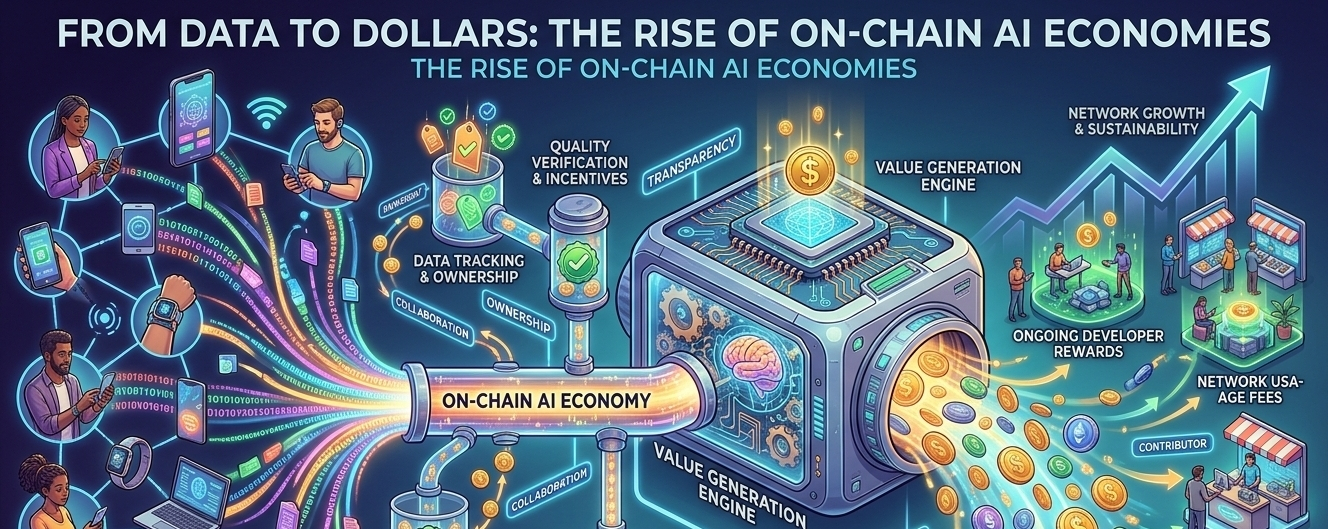
For years, data has been the foundation of AI, yet its value has been captured by a small number of centralized platforms. Individuals generate massive amounts of information every day, but rarely see direct economic benefit from it. At the same time, AI systems are trained on this data, refined behind closed doors, and monetized at scale. On-chain systems begin to rebalance this dynamic by introducing transparency and ownership. Data can now be tracked, verified, and exchanged in a way that allows contributors to participate in the value they help create.
This shift turns data into an active asset. Instead of being invisible, it becomes something that can be priced, shared, and rewarded. Contributors can provide datasets, improve quality through labeling, or even offer computing resources, all while earning through tokenized incentives. The process is more visible and more aligned. You can trace how data flows through a system and how outcomes are generated, which builds trust and creates stronger economic feedback loops.
AI models themselves are also evolving in this environment. Rather than existing only as proprietary tools, they can become part of open networks where development is collaborative. Builders, researchers, and users can contribute to improving models and receive ongoing rewards tied to real usage. This creates a system where innovation is not limited to a single organization but distributed across a network of participants who are aligned through shared incentives.
The economic layer is what drives momentum. Tokens act as both rewards and coordination tools, helping bootstrap ecosystems and encourage high-quality contributions. When designed effectively, these systems can attract a wide range of participants and sustain growth over time. Value does not remain concentrated, it circulates within the network, creating a more balanced and resilient model.
There are still challenges to solve. Maintaining data quality in open systems requires strong validation mechanisms. Scalability remains a technical hurdle, especially for resource-intensive AI workloads. Questions around privacy, consent, and ethical use of data are becoming more important as monetization becomes more explicit. These are not small issues, but they are part of the process of building a more transparent system.
What’s becoming clear is that intelligence is no longer just a tool, it is becoming an economic layer. Data flows into AI systems and returns as measurable value that can be shared across contributors. This creates a more inclusive model where participation is not limited by access to capital or infrastructure. It opens the door for broader innovation and more diverse contributions.
From data to dollars is no longer a concept, it’s an emerging reality. On-chain AI economies are setting the foundation for a future where value is more open, ownership is more distributed, and intelligence operates within a system that rewards those who help build it.


