
For years, the global financial establishment viewed Pi Network as a digital curiosity—a simple routine where millions of users tapped a lightning bolt on their smartphones to watch an isolated counter climb. Critics dismissed it as a social experiment devoid of an exit strategy.
Fast forward to May 2026, and the narrative has undergone a tectonic shift. We are no longer observing a mere social gimmick; we are witnessing an aggressive commercial invasion of the U.S. capital markets. The transition from "mobile mining" to institutional execution is now a reality. This is the moment where liquidity fragmentation is being cured by Tier 1 order book consolidation, bridging the gap between isolated digital assets and global capital.
Here are the five surprising realities of Pi Network’s emergence as a professionalized, institutional-grade asset.
The US Exchange Fortress Has Been Breached
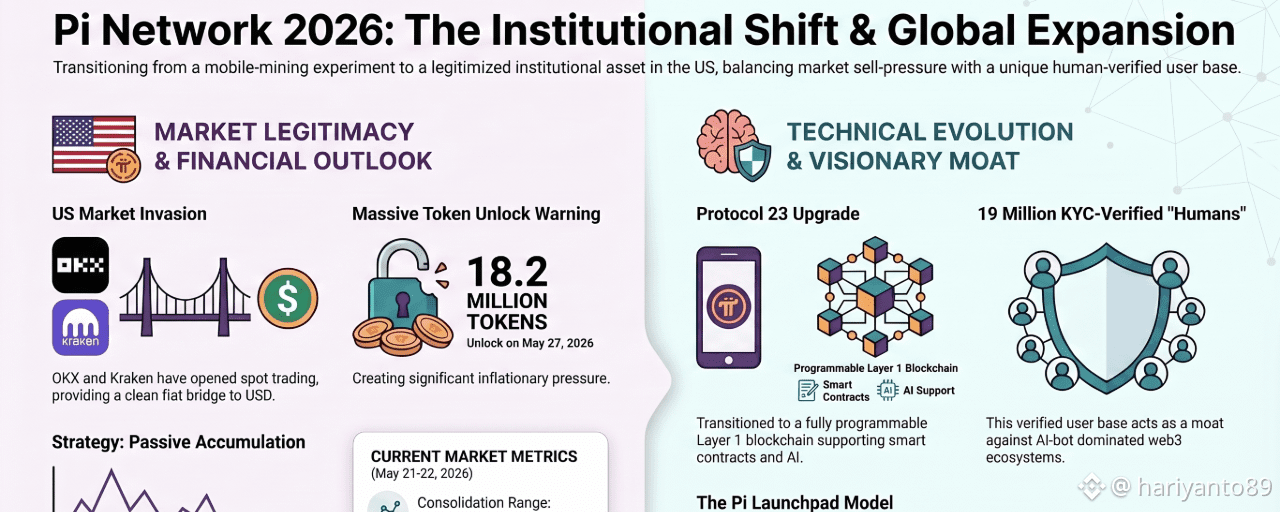
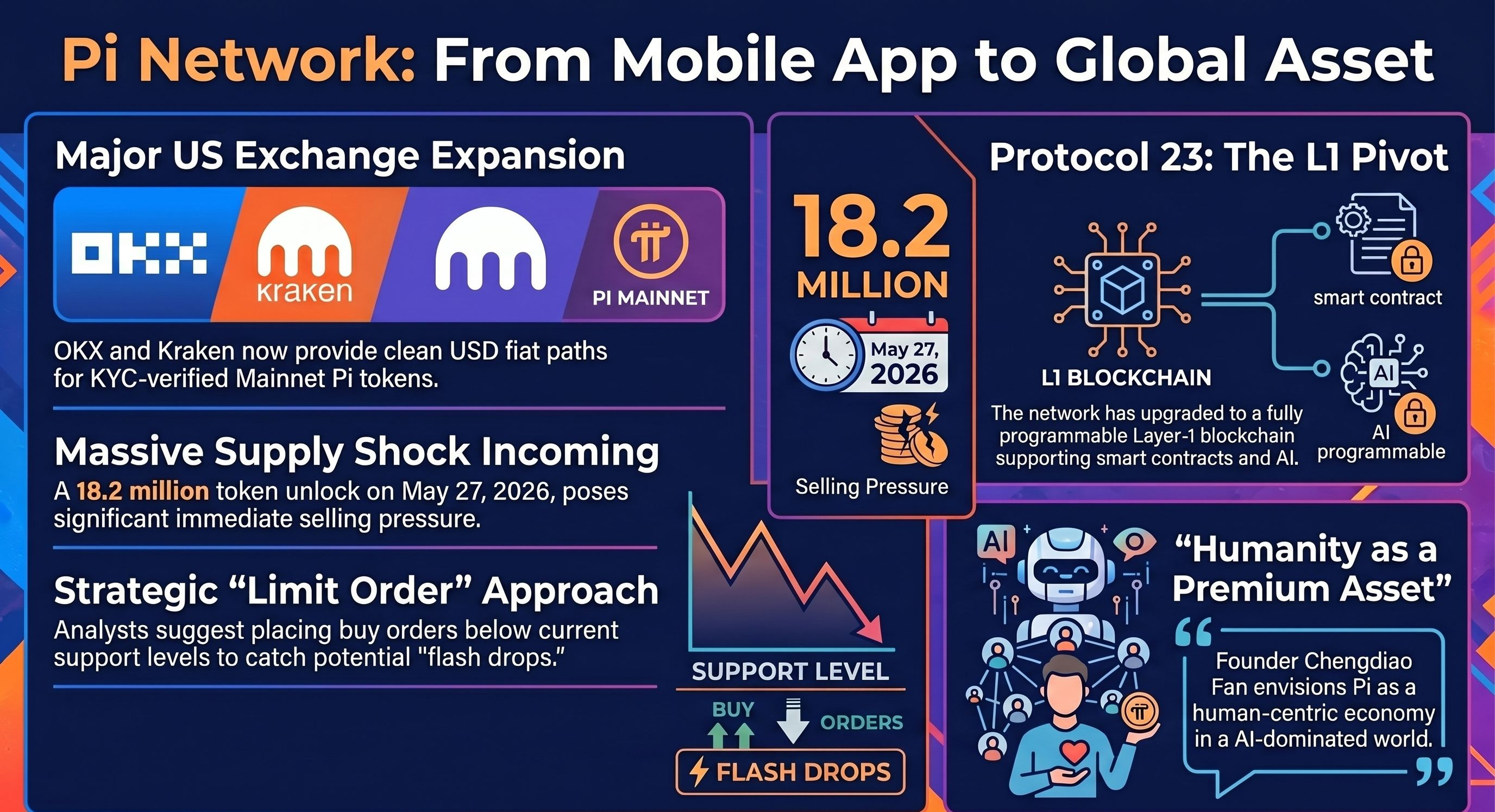
The most undeniable signal of Pi’s maturation is its breach of Tier 1 liquidity centers. While Kraken pioneered the Spot Pi-to-USD gateway in March, the floodgates have opened. OKX, Bitget, Gate.io, and MEXC have now established clean fiat and stablecoin pathways, providing millions of users with a direct link to global capital.
This shift matters far beyond simple trading volume. It is about the "legitimacy of the order book." By migrating from decentralized obscurity to these massive exchanges, Pi has effectively professionalized its liquidity profile.
"Liquidity that was once isolated is now permanently connected to global capital."
The Institutional Standard: It is critical to note that this "Invasion" applies exclusively to "Real Mainnet" tokens. This liquidity represents only those assets that have cleared KYC (Know Your Customer) protocols and migrated to one of the 16.5 million Mainnet wallets. This is not the realm of speculative IOUs or the "dark market" P2P transactions that previously clouded the project’s reputation; this is verified, on-chain telemetry.
Why the Giants (Binance & Coinbase) Are Still Waiting
Despite the momentum at OKX and Kraken, the industry’s "Big Two"—Binance and Coinbase—remain in a holding pattern. Their absence acts as a temporary ceiling on Pi’s maximum liquidity potential, driven by two specific structural barriers:
a. Binance and the "Black Box" Problem: Binance’s listing committee demands absolute architectural transparency. Currently, a significant portion of the Pi blockchain remains closed-source. Until the Network undergoes a line-by-line independent security audit of its consensus code, Binance views it as an unquantifiable risk.
b. Coinbase and the "Regulatory Shield": Operating under the direct gaze of the SEC, Coinbase avoids any asset with the potential to be labeled an unregistered security. Because Pi’s distribution model—mobile mining—lacks a definitive legal precedent in the U.S., Coinbase is prioritizing regulatory safety over listing fees.
The Invisible "Unlock" Storm and the $0.15 Sideways Trap
On-chain data from May 21–22, 2026, presents a paradox. While Pi holds a formidable market cap of IDR 28.69 trillion (approx. $0.1532 per token), the price is currently paralyzed in a narrow consolidation range between IDR 2,681 and IDR 2,710.
Our on-chain telemetry from P Scan reveals a brutal bearish signal: 1.23 million tokens were recently moved from private Mainnet wallets to centralized exchanges, signaling that holders are positioning for exit-side volatility. The network is entering a period of massive inflationary pressure:

Strategist’s Alert: At current prices, the May 27th unlock represents roughly $2.7M to 2.9M in potential sell pressure hitting the market in a single 24-hour window. Given that daily volume currently hovers around Rp168.5 billion (10M), this sudden influx of supply could easily overwhelm current buy walls.
The Strategy: Avoid aggressive buying at current levels. The recommended play is to set "price nets"—limit orders positioned significantly below the IDR 2,680 support level—to capitalize on "flash drops" triggered by panic selling during the peak unlock.
Protocol 23: Turning a Mobile App into an AI Engine
On May 18, 2026, the network finalized the "Protocol 23" upgrade. While the move to Ubuntu 24 and PostgreSQL 16 may seem like routine maintenance, it is the technical equivalent of replacing a standard sedan engine with a high-performance F1 engine.
The upgrade to PostgreSQL 16 is particularly strategic, providing the database architecture required to handle high-frequency Real World Asset (RWA) transactions and sophisticated Web3 identity tools. This positions Pi as a Layer 1 blockchain capable of hosting Smart Contracts and AI-driven applications using tools like Codex and Cursor.
The "Human Moat": In an era where AI can generate code in seconds, the ultimate commodity is no longer software—it is verified human participation. Pi’s competitive advantage lies in its "Human Infrastructure": 60 million active users, with 18–19 million being KYC-verified humans. This is already being proven; the source confirms that 1 million people recently collaborated to complete 526 million micro-tasks for AI training. This scale of human-in-the-loop data is exactly what AI developers are starving for.
The "Pi Launchpad" and the Death of the Quick Exit
At Consensus 2026, Dr. Chengdiao Fan delivered a blistering critique of the traditional crypto "Extraction Model," where founders pull massive capital from retail without delivering a functional product. Her solution is the Pi Launchpad, a "Shark Tank in Reverse" model designed for accountability.
Under this framework:
a. Locked Liquidity: Developer funds are permanently locked in liquidity pools.
b. Operational Mandate: Projects must be 100% functional before they are permitted to launch.
c. Utility Over Hype: Projects are forced to create tokenized utility rather than "burning cash" on user acquisition.
"Instead of burning cash for ads, projects must create tokenized utility. If the product is poor, users leave, and the valuation drops."
This represents a vision of a "Post-Labor" economy where the ownership of assets and the verification of human identity replace traditional hourly wages.
Humanity as a Premium Asset?
The evolution of Pi Network suggests a fundamental shift in the global economy: the transition from a "paycheck economy" to one based on asset ownership and data participation. In this future, your verified identity is not just a credential; it is a financial asset.
However, as we move toward an era of "Agent-to-Agent" commerce—where AI agents negotiate and trade in milliseconds—we face a looming paradox: Will a verified human identity be the ultimate "VIP Pass" to the global economy, providing the only data that machines cannot replicate? Or will human participation eventually be viewed as a "bottleneck of friction" that is simply too slow for the speed of the machines?
As you monitor the charts and set your limit orders, remember: we aren't just trading a token; we are witnessing the construction of a "Human Zoo" for AI to operate within, or perhaps, the first genuine economy for the post-labor age. Begin your positioning accordingly.