
I recently caught myself doing something most of us do without thinking. I asked an AI tool a complicated question, got a surprisingly detailed answer in seconds, copied part of it into my notes, and moved on with my day. The whole interaction took less than a minute.
Later, another thought popped into my head.
Where did that answer actually come from?
Not which company built the model. Not which website I used. I mean the deeper question. Who created the knowledge behind it? Who collected the data? Who organized it? Who spent years researching the topics the model learned from? And perhaps most importantly, who benefited financially when that knowledge helped generate value?
The more artificial intelligence becomes part of everyday life, the harder these questions become to ignore. AI is often presented as a technological achievement, but underneath the technology sits an enormous network of human contributions. Researchers publish papers. Developers write code. Communities create content. Specialists contribute expertise. Businesses generate datasets. Millions of people indirectly shape the intelligence that modern AI systems rely on.
Yet the economic relationship between those contributors and the value created by AI remains surprisingly unclear.
That is the space OpenLedger wants to explore.
After spending time researching OpenLedger, what stood out to me wasn't another blockchain promising to revolutionize everything. We've all seen enough of those over the years. What caught my attention was that the project is focused on a problem that genuinely exists: the disconnect between AI value creation and the people who contribute to it.
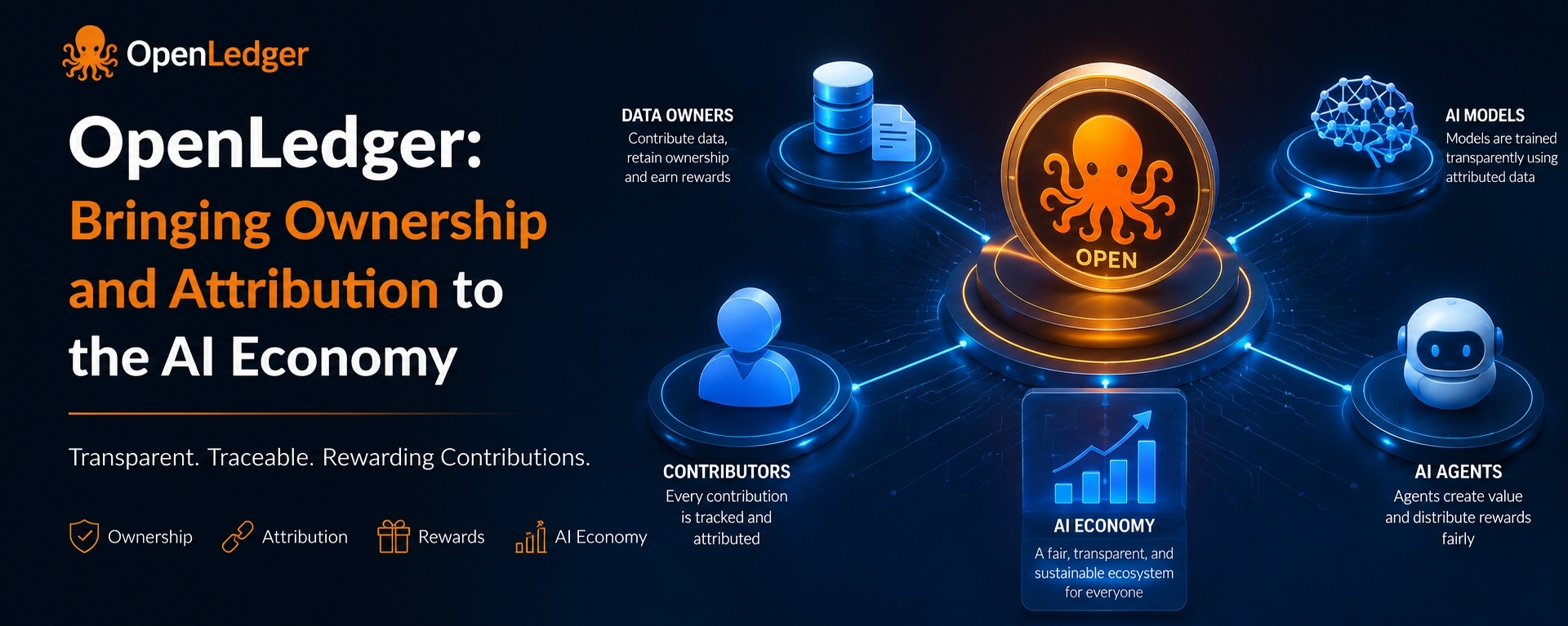
OpenLedger positions itself as an AI-focused blockchain designed to unlock liquidity around data, models, and AI agents. On paper, that description sounds technical. In practice, the idea is fairly straightforward. The project wants data and AI contributions to become traceable, measurable, and potentially monetizable instead of disappearing into systems where ownership and attribution become difficult to track.
Whether that vision succeeds is another conversation entirely. But the problem itself is real.
For years, data has been treated almost like a raw material that gets consumed during model training. Once information enters the training process, the connection between contributors and future outcomes often becomes difficult to see. The people creating value at the beginning of the chain rarely have visibility into how that value evolves over time.
OpenLedger is built around the belief that this model should change.
One of the concepts at the center of the project is something called Proof of Attribution. Normally, when I encounter new blockchain terminology, I approach it with a healthy amount of skepticism. The industry has a habit of creating impressive-sounding phrases that don't always translate into practical value. But attribution is actually an interesting topic because it addresses a challenge that extends far beyond crypto.
The idea behind Proof of Attribution is that contributions to AI systems should be identifiable and connected to future value creation. If data helps train a model, there should be a mechanism to recognize that contribution. If a model generates economic activity later, contributors should potentially participate in that value rather than remaining invisible.
That sounds logical in theory.
The difficulty lies in implementation.
Modern AI systems are extraordinarily complex. Models learn from huge collections of information, often involving billions of parameters interacting in ways that even researchers struggle to fully explain. Determining exactly how much influence a specific dataset had on a particular outcome is not a simple accounting exercise.
In fact, attribution remains one of the most challenging problems in machine learning.
This is where OpenLedger becomes interesting. The project isn't pretending the challenge doesn't exist. Instead, it is attempting to create infrastructure that moves attribution from an afterthought to a core feature of AI development.
Another aspect that deserves attention is the project's approach to data itself.
Most technology discussions treat data as an input. OpenLedger treats it more like an asset.
That distinction may seem small, but it changes the way incentives work.
If contributors believe their expertise can generate future value, participation starts looking different. A medical professional contributing specialized healthcare knowledge is no longer simply donating information. A financial analyst sharing expertise becomes part of an ecosystem where contributions may have measurable economic significance.
Whether those incentives become powerful enough to attract meaningful participation remains to be seen, but the logic is easy to understand. People tend to invest more effort when they have a stake in long-term outcomes.
The concept becomes even more interesting when looking at OpenLedger's Datanets. Instead of relying solely on centralized organizations to gather and manage information, Datanets are designed as collaborative knowledge networks where contributors participate in building and maintaining datasets.
This approach reflects something many people in AI already understand.
The future challenge is not necessarily finding more data.
The internet already contains staggering amounts of information.
The real challenge is finding better data.
Accurate data.
Verified data.
Specialized data.
Data created by people who actually understand the subject matter.
A mediocre dataset containing millions of entries may ultimately be less useful than a carefully curated collection created by genuine experts.
OpenLedger appears to recognize that quality may become more valuable than quantity as AI continues to mature.
What I find particularly compelling is that the project focuses on economics as much as technology.
The AI conversation often revolves around capabilities. People discuss model performance, reasoning ability, context windows, and benchmark scores. Those metrics matter, of course, but economics often determines whether ecosystems survive in the long run.
History provides plenty of examples.
Open-source software transformed the technology industry, yet many contributors struggled to capture proportional value from their work.
Social media platforms generated enormous wealth, while the users creating content frequently received little direct participation in the upside.
Data-driven businesses built billion-dollar enterprises using information contributed by countless individuals who never shared in those outcomes.
OpenLedger is effectively asking whether AI development can evolve differently.
Can contributors participate in value creation rather than simply supplying inputs?
Can ownership become more transparent?
Can incentives align more closely with contribution?
These are difficult questions, but they are important ones.
Of course, optimism should be balanced with realism.
OpenLedger faces substantial obstacles.
Building attribution systems is hard.
Creating sustainable token economies is hard.
Attracting developers is hard.
Competing in the rapidly evolving AI landscape is hard.
Doing all of those things simultaneously may be harder than any technical challenge the project faces.
The AI sector moves at incredible speed. Large technology companies possess enormous resources, established user bases, and vast infrastructure advantages. New projects must demonstrate clear value rather than relying on vision alone.
OpenLedger's future will depend less on ideas and more on execution.
Still, there is something refreshing about a project trying to solve a structural problem rather than simply chasing the latest trend.
Artificial intelligence is becoming one of the defining technologies of our era. As that happens, questions about ownership, attribution, compensation, and transparency will become increasingly important. The systems we build today could shape how value is distributed across the AI economy for years to come.
OpenLedger is betting that blockchain technology can provide part of that foundation.
Maybe it succeeds.
Maybe it doesn't.
Technology history is full of ambitious ideas that failed despite addressing genuine problems.
But after looking closely at OpenLedger, I came away with the impression that it is focused on an issue worth solving. In a world where AI increasingly depends on collective human knowledge, creating better ways to recognize and reward contributions feels less like a luxury and more like a necessity.
The biggest question is no longer whether AI will create value. It already does.
The question is who gets to participate in that value once it exists.
That is the question OpenLedger is trying to answer, and regardless of where the project ultimately ends up, it is a conversation the industry needs to have