
In DeFi, most users don’t lose money because they’re careless.
They lose money because the system doesn’t fully show them what they are interacting with at first glance.
That gap between what is visible and what is real is where most mistakes happen.
The illusion of familiarity
The Token Looked Legitimate. The Name Was Familiar. The Logo Matched. It Wasn't Real.
This is not a hypothetical.
It happens every day across DeFi to experienced participants and complete beginners alike.
A token appears in a search result carrying a name you recognize. The ticker looks right. The logo matches what you've seen before. Nothing feels obviously wrong.
Until it is.
Fake tokens are designed specifically for that moment of confidence. The split second where familiarity overrides caution and you interact before asking the right questions.
And in DeFi that split second can be expensive.
Why this problem exists
The reality of an open blockchain is simple:
Anyone can deploy a token.
No verification. No approval process. No authority checking whether a new token is legitimate before it appears on chain.
That openness is fundamental to what DeFi is but it also creates a serious UX challenge.
Fake tokens, honeypots, hidden fee structures, and impersonations exist in the same environment as legitimate assets. And visually, they often look identical at first glance.
Most users don’t realize this until after they’ve already interacted.
The real issue is not just scams it’s information asymmetry
“In DeFi, the most dangerous scams rarely look suspicious at first glance. They look familiar.”
This is the core UX problem.
The system assumes users will:
- verify contracts
- understand token behavior
- detect subtle contract risks
But in reality, most users rely on:
- name recognition
- logo familiarity
- UI presentation
That mismatch is where risk begins.
What STON.fi approach highlights
STON.fi built a system around a simple idea:
Users shouldn’t have to discover risk the hard way.
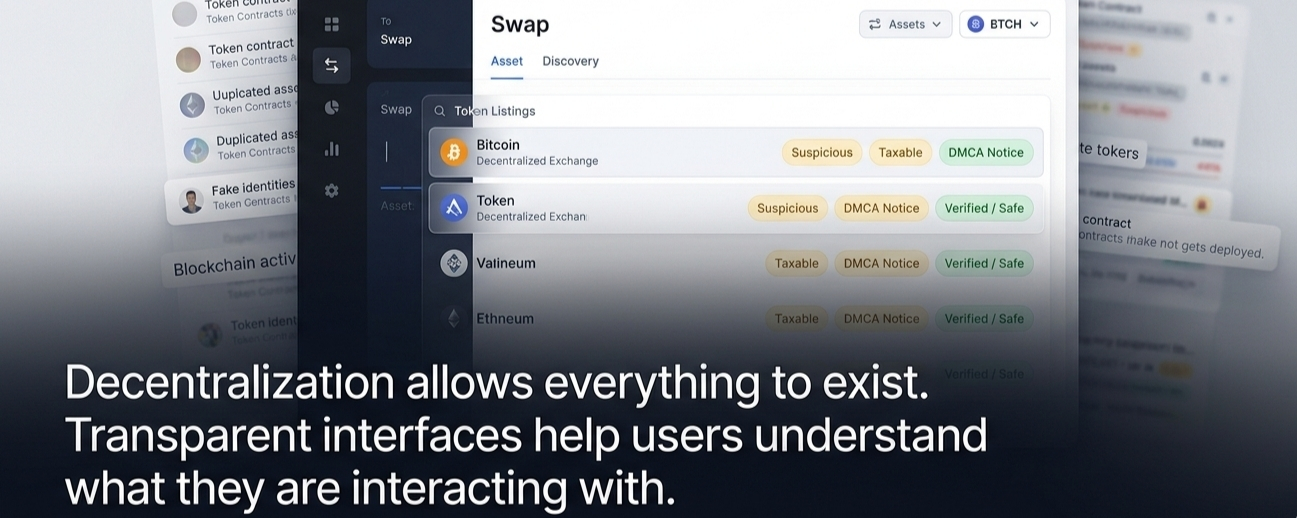
Instead of relying on blind interaction, tokens are categorized into clear labels based on observed behavior, complaints, and contract-level signals.
Fake: tokens impersonating known assets
Honeypot: tokens that trap funds after purchase
Taxable: hidden fee structures beyond expected trading costs
Suspicious: tokens with unclear or questionable signals
DMCA Notice: tokens flagged for intellectual property concerns
Each label changes how users interact before they make a decision.
Why labeling matters
Every flagged token can only be accessed through deliberate action not accidental discovery.
That friction is intentional.
It ensures that interaction is no longer passive.
It becomes a conscious decision.
In the most severe cases (Fake and Honeypot), interaction is fully blocked even with contract access.
The bigger shift in DeFi UX
STON.fi doesn’t change what exists on-chain.
It changes what users understand before they interact.
“Open blockchains give everyone the freedom to build including bad actors. The challenge was never openness itself, but helping users navigate it safely.”
The future of DeFi security is not restricting what exists on-chain. It’s giving users enough transparency to understand what they’re interacting with before they click.
Final thought
The token that looks familiar is not always the token you think it is.
And in DeFi, that difference is everything.
Because most losses don’t happen from complexity.
They happen from incomplete information at the exact moment of action.
Now you know what to look for before you find out the hard way.