
A few years ago, “AI infrastructure” meant one thing: more GPUs, bigger clusters, faster tokens. Everyone chased raw horsepower like it was the only bottleneck that mattered. I bought into that story too — until I started watching how real decisions get made with AI.
Because here’s the uncomfortable truth: the moment AI stops writing poems and starts influencing loans, flagging compliance issues, screening identities, or helping move capital, nobody asks how fast it ran. They ask a much uglier question:
 Who the hell is responsible if this goes wrong?
That question is strangely missing from most crypto-AI conversations. Projects get hyped on compute narratives, model access, or “decentralized intelligence.” OpenLedger gets lumped into the same bucket — “AI infrastructure” — and technically that’s correct. But I think it misses the more interesting angle.
OpenLedger is building something closer to a liability map than just another rewards machine.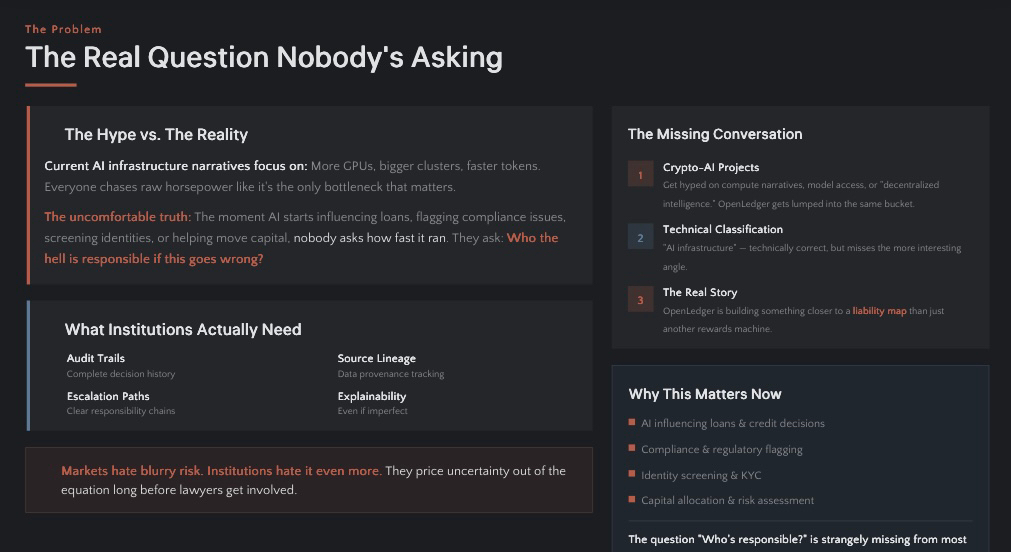
The Real Shift: From Intelligence to Consequence Management
Traditional software was messy but clear: a company shipped the code, and accountability (however imperfect) had a visible home. AI is different. Data comes from one place, fine-tuning from another, inference hosting from somewhere else, orchestration layers on top, and retrieval systems injecting context mid-process. By the time an output reaches the user, responsibility is smeared across a dozen actors.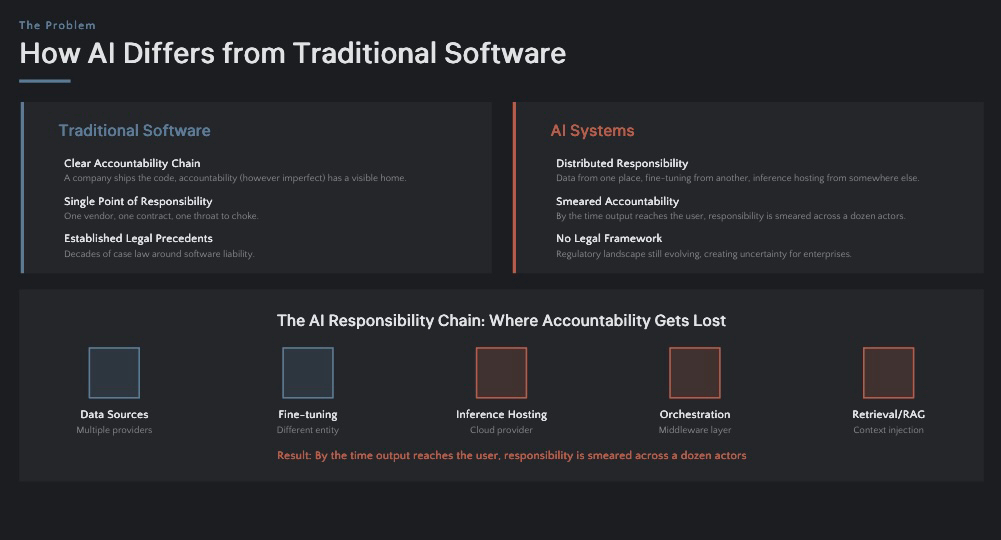
Markets hate blurry risk. Institutions hate it even more.
Banks, insurers, and regulated companies don’t buy “vibes.” They want audit trails, source lineage, escalation paths, and some form of explainability — even if it’s imperfect. They price uncertainty out of the equation long before lawyers get involved.
That’s where OpenLedger’s Proof of Attribution (PoA) becomes quietly powerful. Instead of treating attribution as a cute “pay the contributors” marketing feature, it’s building verifiable provenance into the system itself — on-chain records of which data influenced which outputs. It turns “who contributed” into something closer to “who shaped this decision,” which is exactly what enterprises actually need to operationalize AI without losing their minds in a compliance review.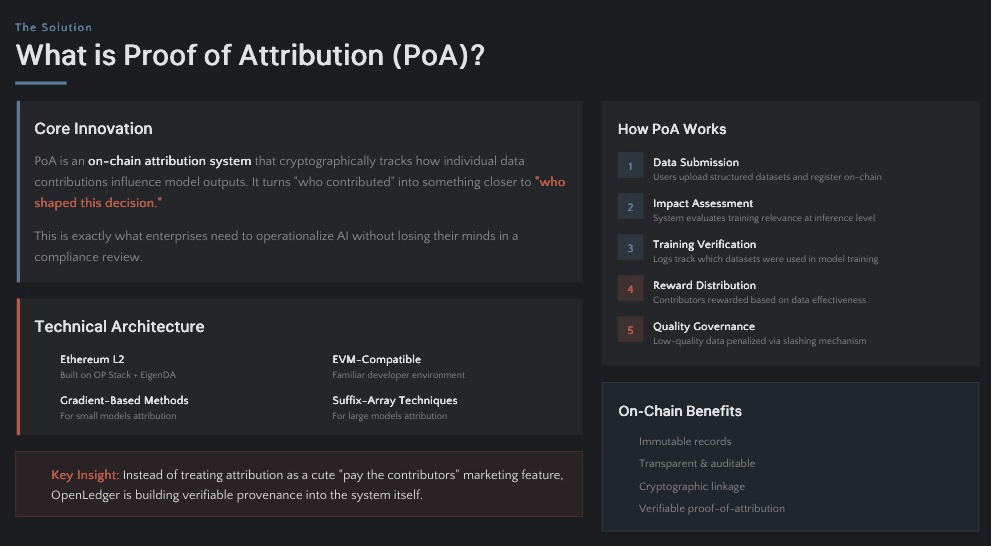
The Economic Angle Most People Miss
Right now $OPEN sits with a market cap around $45-60M (depending on the day), circulating supply roughly 220M out of a 1B max. Nothing insane, but the token isn’t priced on pure hype — it’s the gas, the reward mechanism, and the coordination layer for this entire attribution economy.
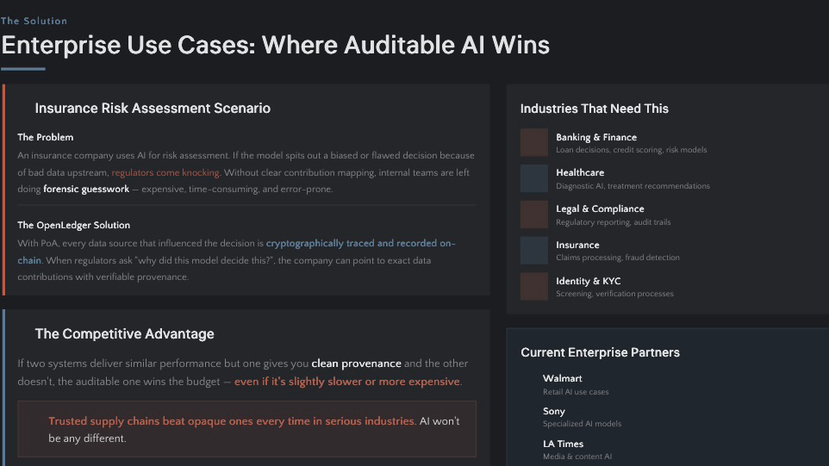
Think about it practically. Imagine an insurance company using AI for risk assessment. If the model spits out a biased or flawed decision because of bad data upstream, regulators come knocking. Without clear contribution mapping, internal teams are left doing forensic guesswork. That’s expensive.
If two systems deliver similar performance but one gives you clean provenance and the other doesn’t, the auditable one wins the budget — even if it’s slightly slower or more expensive. Trusted supply chains beat opaque ones every time in serious industries. AI won’t be any different.
This isn’t glamorous “moon mission” language. It’s boring infrastructure language — the kind that actually lasts.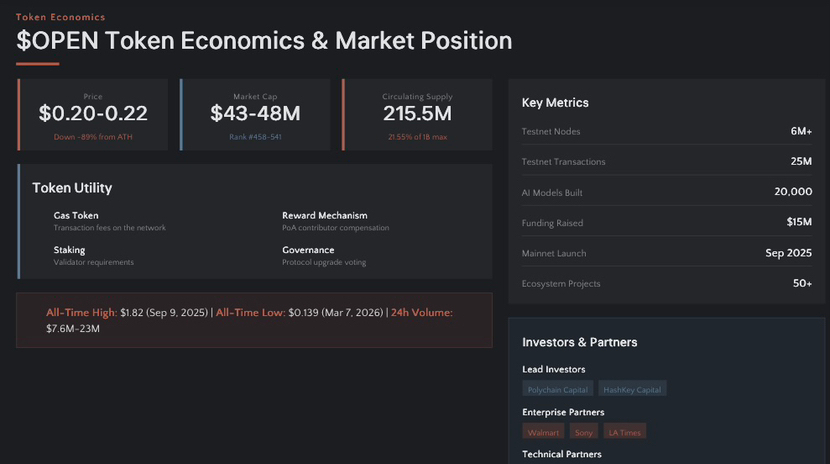
The Skeptical Part (Because Crypto)
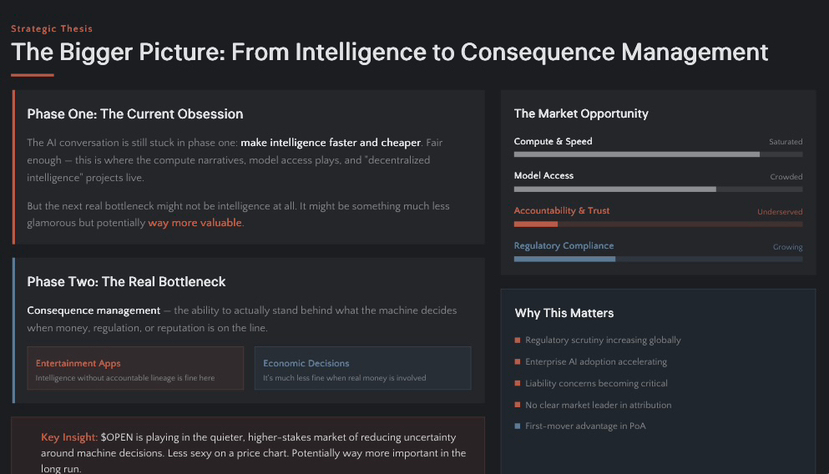
None of this is easy. Attribution in AI is genuinely hard — training effects are diffuse, signal blending is messy, and perfect tracing is probably impossible at scale. Badly implemented “accountability” can be worse than honest opacity.
Crypto incentives make it even trickier. Attach real money to attribution and you instantly get spam datasets, manufactured contributions, sybil attacks, and reputation gaming. The system has to survive adversarial behavior, not just friendly demos.
And there’s a deeper cultural question: do enterprises even want decentralized accountability? Some might prefer one centralized vendor with one contract and one throat to choke. Distributed responsibility can feel like bureaucratic chaos if the UX isn’t excellent.
OpenLedger’s real challenge isn’t technical — it’s making distributed attribution feel operationally useful to people who run real businesses, not just crypto natives.
 The Bigger Picture
The AI conversation is still stuck in phase one: make intelligence faster and cheaper. Fair enough. But the next real bottleneck might not be intelligence at all. It might be consequence management — the ability to actually stand behind what the machine decides when money, regulation, or reputation is on the line.
Intelligence without accountable lineage is fine for entertainment apps.
It’s much less fine when real economic decisions are involved.
That’s why I see $OPEN differently from most of the market. It’s not competing purely in the compute or model access category. It’s playing in the quieter, higher-stakes market of reducing uncertainty around machine decisions.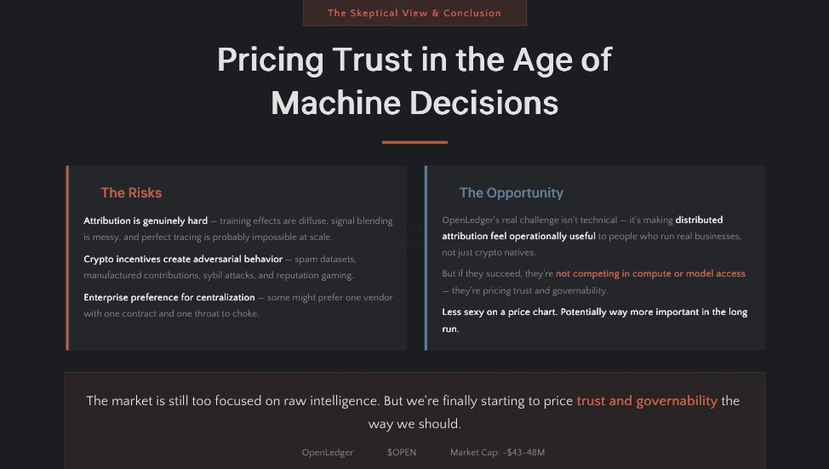
Less sexy on a price chart.
Potentially way more important in the long run.
What do you think — is the market still too focused on raw intelligence, or are we finally starting to price trust and governability the way we should?
Would love to hear your take.
