
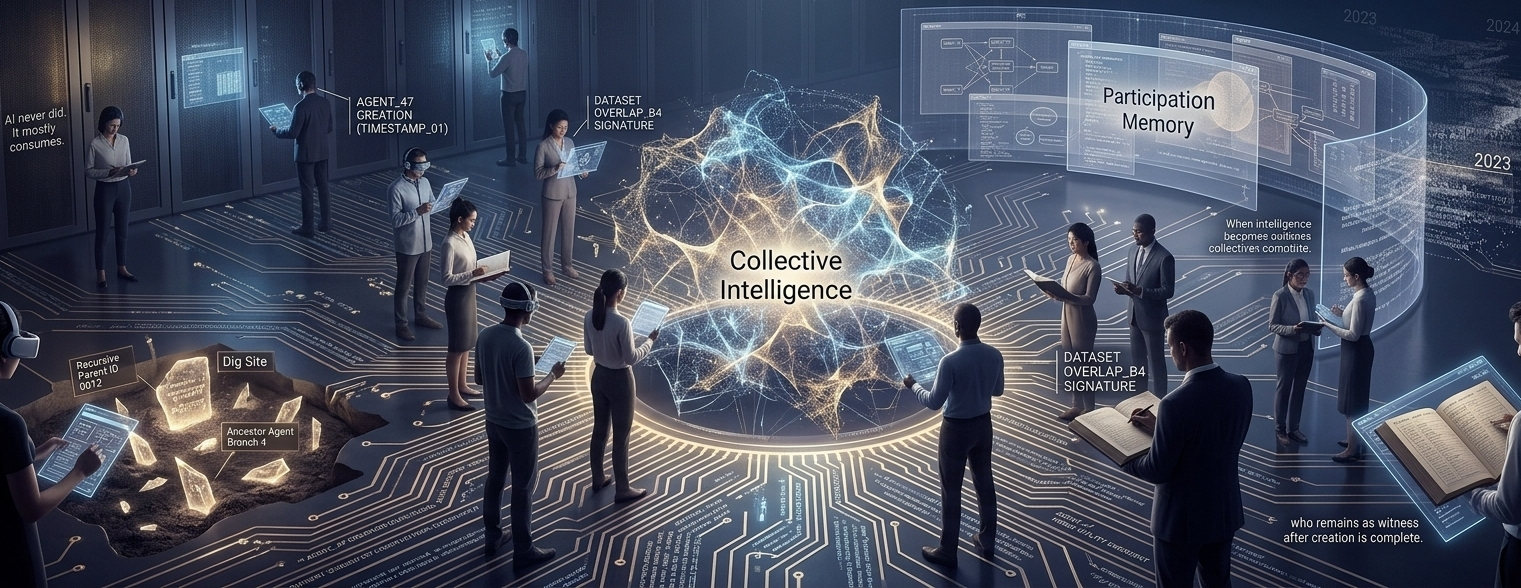
A question kept bothering me while looking through OpenLedger because the project talks about monetizing data models and agents yet none of those words explain the tension I kept seeing underneath. What happens when intelligence becomes so collective that nobody can prove who was present during its creation.
That is where my attention stayed.
OpenLedger describes an AI blockchain designed to unlock liquidity around data models and agents through attribution mechanisms. Most interpretations stop at incentives. Mine did too at first. Then I started thinking about witness systems.
Strange angle.
But stay with it.
Every advanced intelligence network eventually becomes crowded. Datasets overlap. Models inherit prior work. Agents interact with outputs generated by other agents. Utility compounds through layers. The final result looks intelligent but the path behind it becomes blurry.
Modern AI has a memory problem.
Not storage memory.
Participation memory.
OpenLedger appears to challenge that absence by treating contribution as something that should remain visible after intelligence has already moved forward. That changes the role of attribution completely. It stops being payment logic and starts becoming historical infrastructure.
Different lens.
Because witness systems do not exist to reward people. They exist to preserve sequence. To answer who arrived first. Who shaped what. Who left traces before value emerged.
Human civilization already built versions of this. Archives. Citations. Ledgers. Registries.
AI never did.
It mostly consumes.
That is why OpenLedger feels more interesting when viewed as a witness architecture rather than an economic layer. The protocol is indirectly asking whether collective intelligence can preserve participation history before scale destroys it.
Hard challenge.
Because abundance creates erasure.
The more contributors enter a system the easier it becomes for individual impact to dissolve into aggregate output. Models improve while origins disappear. Agents become useful while history compresses. Networks gain intelligence and lose visibility at the same time.
OpenLedger pushes against that tradeoff.
Yet this introduces a hidden behavioral tension. Once visibility gains value participants may begin optimizing for traceable contribution instead of meaningful contribution. Data becomes shaped for recognition. Agent actions become easier to record. Utility risks bending toward measurability.
That changes incentives.
Quietly.
Long term systems always struggle here. They reward what survives documentation rather than what created hidden value. OpenLedger will eventually face the same pressure because witness systems are not neutral. They shape behavior by deciding what deserves memory.
That is power.
Another question appears.
If autonomous agents eventually generate models which create new agents then attribution chains become recursive. One output could inherit thousands of invisible ancestors. Witnessing intelligence then stops looking like accounting and starts looking like archaeology.
Digging backward.
Forever.
The market keeps framing AI blockchains as monetization engines. I think that misses the more uncomfortable possibility. OpenLedger may actually be building historical infrastructure for machine economies.
Not a place where intelligence gets sold.
A place where intelligence leaves evidence.
That distinction matters because intelligence scales faster than memory. It always has. Human systems proved this repeatedly. Contribution expands. Recognition shrinks.
OpenLedger seems to resist that collapse.
The project may succeed. It may fail. Too early to know.
But I keep returning to the same question.
When intelligence becomes collective who remains as witness after creation is complete.