

I keep asking myself a simple question when I look at where AI is heading.
If intelligence becomes one of the most valuable digital resources in the world, who actually owns it?
Yeah... The more I research this space, the more I feel people underestimate this question. Most conversations around AI focus on bigger models, faster inference, and lower costs. That makes sense because performance is easy to measure. People can see benchmark numbers and compare outputs.
But when I checked how these systems are actually built, I noticed something deeper.
Every useful AI model depends on data. Not just random data, but highly specialized information shaped by real human activity. Research papers, public discussions, problem-solving patterns, expert knowledge, behavior signals, niche communities, and millions of digital contributions quietly become part of machine intelligence.
And yet, most contributors never know how their input is used.
This is one of the biggest structural problems in modern AI.
The people creating value often remain invisible, while the systems monetizing that value become increasingly centralized.
I have watched this happen across multiple waves of technology. Early participation creates excitement, systems scale quickly, and only later do people start asking who captured the long-term value.
AI feels like it is entering that same moment.
Current systems are incredibly efficient at collecting intelligence, but far less efficient at attributing it.
That sounds like a technical problem, but I think it is actually an economic one.
If contributors cannot prove ownership of their data, they cannot capture future value from it. If attribution cannot be verified, incentives eventually weaken. And when incentives weaken, contribution quality usually declines over time.
This is where I started paying attention to OpenLedger.
What interested me was not just that it combines AI and blockchain. A lot of projects say that.
What made me stop and look deeper was the specific problem it is trying to solve.
OpenLedger approaches AI infrastructure with a different assumption: intelligence should be traceable, attributable, and economically connected to the people who help create it.
The idea sounds simple at first, but it changes everything.
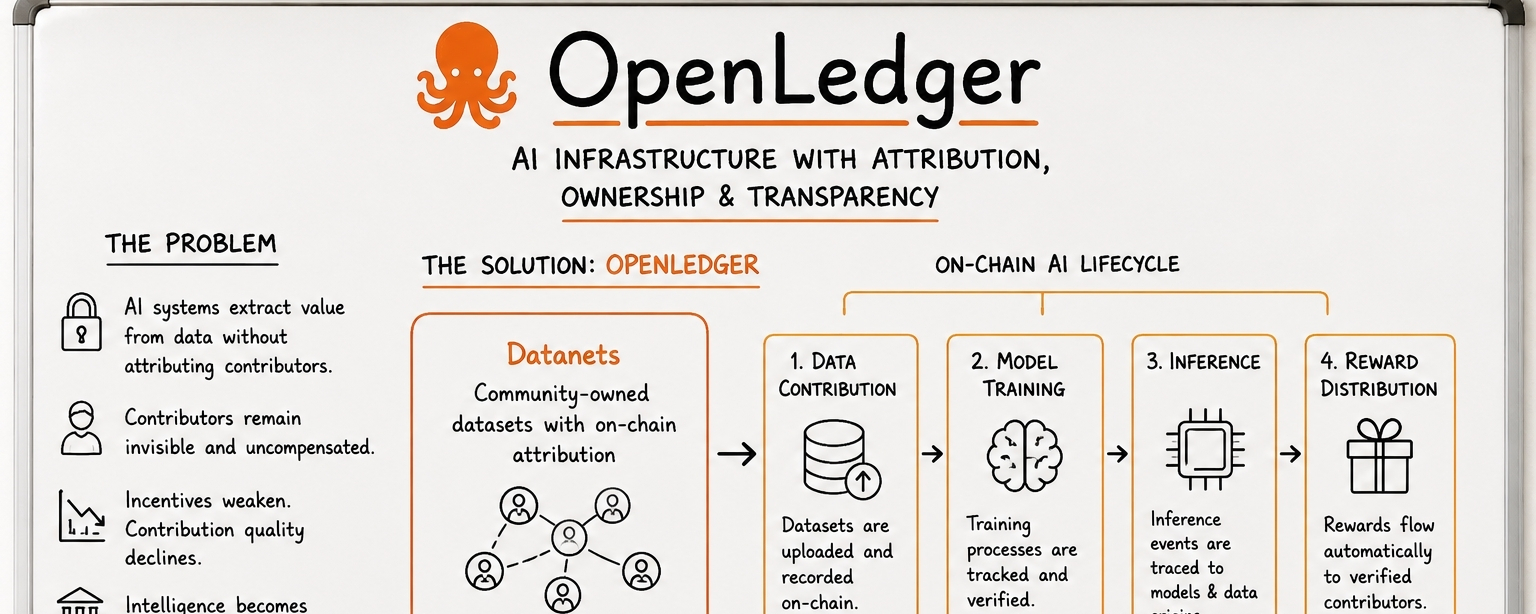
Instead of treating datasets as hidden assets controlled by closed systems, OpenLedger introduces what it calls Datanets. I spent time reading through how this works, and the concept is interesting because it treats datasets as transparent, community-owned infrastructure.
People can create Datanets, contribute to existing ones, and have those contributions verified directly on-chain.
That means data contributions are not vague participation metrics or invisible backend actions. They become recorded, provable inputs tied to value creation.
I think this matters more than many people realize.
The biggest challenge in decentralized AI is not just building models. It is building trust around who contributed what and how rewards should flow when those models generate value later.
OpenLedger tries to solve this by connecting the entire lifecycle of AI activity on-chain.
Dataset uploads are recorded.
Model training actions are tracked.
Inference events can be traced back to specific models and their training origins.
Reward distribution happens through transparent attribution rather than assumptions.
When I looked into this architecture, I saw something that feels more important than token mechanics or short-term network activity.
It introduces accountability into AI production.
That changes incentives.
Imagine an ecosystem where researchers contribute specialized knowledge, developers fine-tune models, communities improve datasets, and every future inference can recognize and reward those contributions automatically.
This turns AI from a closed extraction model into an open participation economy.
From what I researched, OpenLedger also supports efficient decentralized training design, allowing multiple specialized models to operate more effectively without requiring wasteful infrastructure duplication.
That matters because decentralized AI often struggles with efficiency.
People talk about decentralization as if openness alone solves everything, but if systems are too expensive or too slow, adoption stalls.
The more practical these systems become, the more realistic large-scale adoption looks.
What I find most interesting is what happens if this model works at scale.
It could reshape how digital intelligence is owned.
Today, most people interact with AI as consumers.
In systems like this, people could become contributors, governors, and long-term participants in the value their data helps create.
That is a very different economic relationship.
I think this could influence industries far beyond crypto.
Healthcare datasets, legal intelligence systems, educational models, enterprise-specific automation, scientific research networks all of these depend heavily on trust, attribution, and transparent contribution records.
Without clear ownership layers, scaling collaboration becomes difficult.
With programmable attribution, collaboration becomes economically sustainable.
Of course, there are still open questions.
Can decentralized attribution remain efficient as usage grows?
Will contributor incentives stay aligned once systems mature?
Can governance evolve fast enough for an industry moving this quickly?
These are the questions I keep thinking about when I study OpenLedger.
Because in my experience, infrastructure projects are rarely judged by early excitement.
They are judged by whether their design still makes sense when real usage arrives.
After researching this space, I think the real opportunity here is not simply decentralizing AI.
It is redefining who gets recognized when intelligence creates value.
And that feels like one of the most important unsolved problems in this entire industry.
If AI becomes part of everyday life, should its economic value stay concentrated in closed systems?
Or should intelligence become something communities can help build, govern, and benefit from together?
I keep coming back to that question.
And honestly, I think how projects like OpenLedger answer it may shape the next phase of both AI and blockchain.
What do you think?
Is attribution-based AI infrastructure necessary for the future?
Could systems like this change how we define ownership in the age of machine intelligence?
Or will centralized models remain too efficient to challenge?