
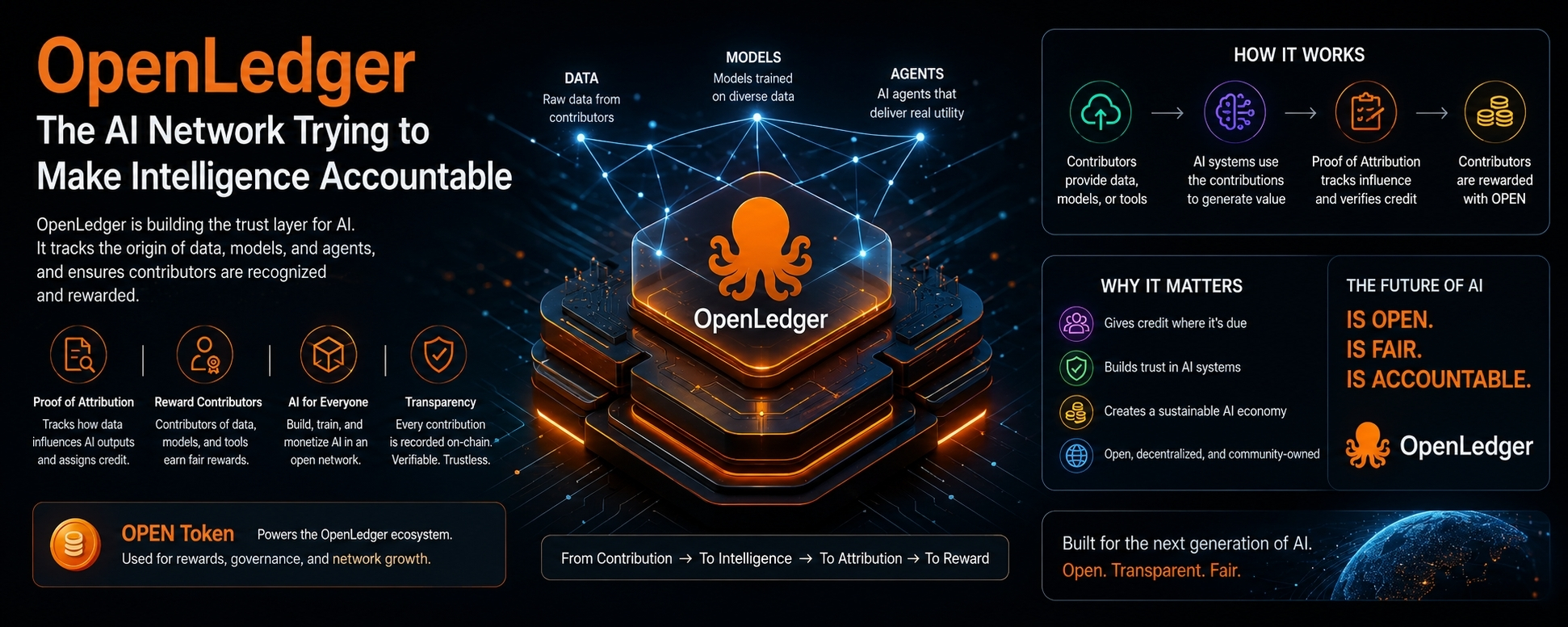
I’m watching OpenLedger with a different kind of attention because it sits right in the middle of one of the biggest questions in AI: who gets trusted, who gets paid, and who gets remembered when intelligence becomes a network?
That question feels simple.
But it is not.
AI is moving fast enough that most people are still distracted by the surface.
The polished answers.
The agents.
The demos.
The models that seem to know everything.
But underneath all of that, there is a deeper problem nobody can ignore for much longer.
Most AI does not clearly show where its intelligence comes from.
It gives you the output.
It hides the trail.
It benefits from data, communities, creators, researchers, builders, and niche experts, but the value often flows upward into closed systems.
OpenLedger is interesting because it is not trying to decorate AI with crypto language.
It is trying to solve the missing layer beneath AI.
Attribution.
That word may sound small, but it carries a massive idea.
If data helps a model become smarter, that data should not vanish.
If a contributor improves the intelligence of a network, that contribution should not be forgotten.
If AI creates value from human knowledge, the system should be able to trace that value back.
This is where OpenLedger starts to feel less like another project and more like infrastructure for the next phase of AI.
Because the future will not only need smarter models.
It will need models people can trust.
And trust does not come from a clean interface.
Trust comes from proof.
Proof of origin.
Proof of contribution.
Proof of ownership.
Proof that the intelligence being used has a real history behind it.
OpenLedger is building around that idea.
It gives AI a memory layer.
Not memory in the emotional sense.
Economic memory.
A way to recognize the data and people behind machine intelligence.
That matters because AI without attribution can easily become extraction.
It takes from the world, learns from the world, improves from the world, and then gives very little back to the world.
OpenLedger challenges that pattern.
It suggests a different future.
One where data is not just fuel.
One where contributors are not invisible.
One where models are not black boxes floating above everyone else.
One where intelligence can be traced, verified, and rewarded.
That is a powerful shift.
Crypto has always been strongest when it makes invisible value visible.
Bitcoin made digital scarcity visible.
Ethereum made programmable ownership visible.
DePIN made physical infrastructure visible on-chain.
OpenLedger is trying to make AI contribution visible.
And if AI becomes as important as everyone believes, then the systems that track contribution may become just as important as the systems that produce output.
This is the part that feels early.
Most people still look at AI and ask, “What can it do?”
OpenLedger is asking, “Where did it come from?”
That second question may end up mattering more.
Because when AI starts making decisions, building agents, powering markets, supporting businesses, and shaping culture, people will want more than a good answer.
They will want confidence.
They will want transparency.
They will want to know that the network behind the intelligence is fair, traceable, and not controlled by a few silent giants.
OpenLedger is not selling a fantasy of AI.
It is working on the trust layer AI will eventually need.
And that is why the project deserves attention.
Not because it is loud.
Not because it is chasing hype.
But because it is looking at the part of the AI economy that most people are still ignoring.
The value behind the output.
The people behind the data.
The proof behind the intelligence.
OpenLedger feels important because it understands that the AI race is not only about who builds the smartest machine.
It is also about who builds the most trustworthy network around it.
And in the long run, that may be the real moat.
Because intelligence will become common.
Agents will become common.
AI tools will become common.
But trusted AI networks with real attribution, real ownership, and real economic memory will be rare.
That is where OpenLedger has its opening.
It is not just building for the AI moment we are in.
It is building for the AI economy that comes after the excitement settles.
The one where trust becomes expensive.
The one where data becomes an asset.
The one where contribution finally needs a ledger.
And maybe that is the simplest way to understand OpenLedger.
It is trying to make sure that when AI becomes powerful, the value behind that power does not disappear.