
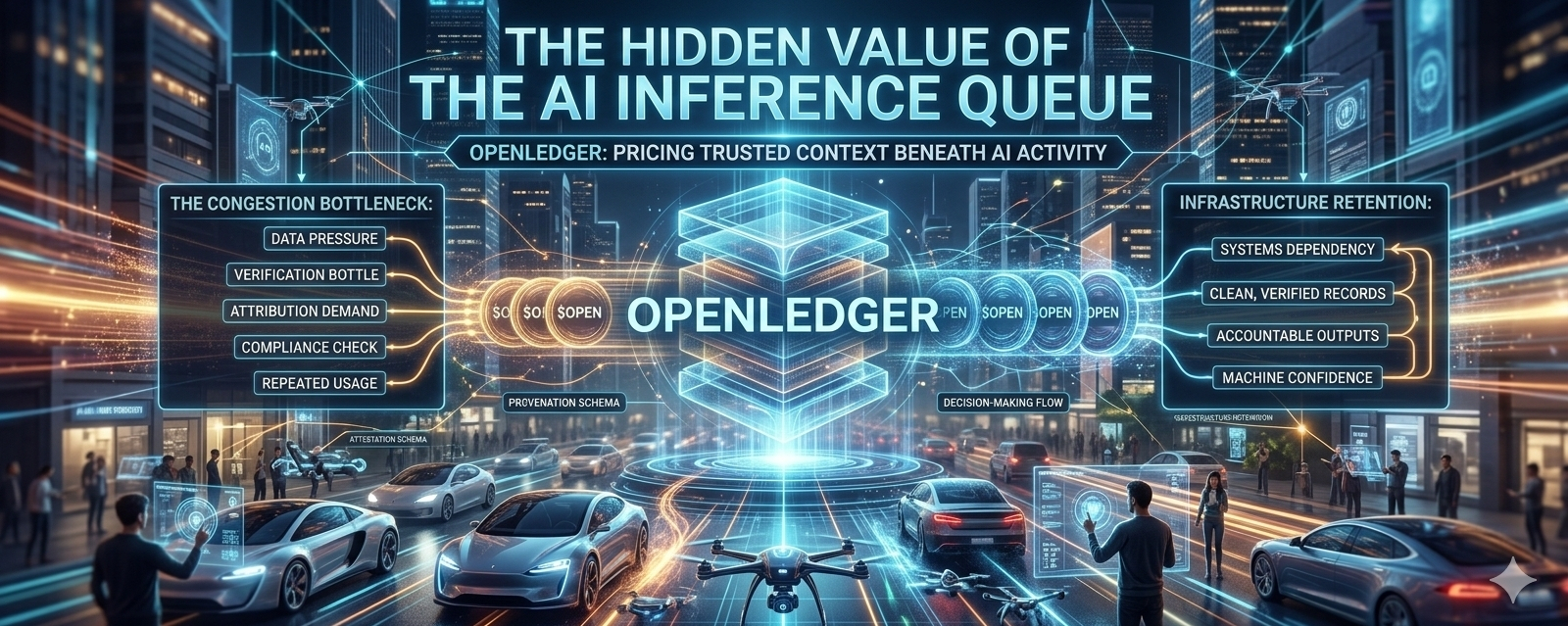
I usually start paying attention to a system when it does not fully break, but it begins to feel heavy. A page still opens, but not as quickly as it should. A transaction still moves, but it waits longer than expected. A dashboard still shows activity, but the result that actually matters arrives with a delay. That small delay often says more than it first appears to. It is not always failure. Sometimes it is pressure building inside a system that more people, machines, or applications are trying to use at the same time. Markets usually ignore this kind of pressure in the beginning because it looks ordinary, almost invisible. Then one day, someone figures out that the pressure itself can be priced. That is the angle that makes OpenLedger interesting to me. From the outside, it can easily be placed in the usual AI infrastructure category, with words like data, provenance, attribution, contributor tracking, and verified information around it. But the deeper question is whether open is only another AI infrastructure token, or whether it is trying to sit closer to a more valuable bottleneck: the crowded moment where AI systems need trusted context before they can produce useful answers.
Inference sounds simple when people explain it casually. A prompt goes in, an answer comes out, and the process looks clean. But once AI moves beyond casual chat and begins touching finance, compliance, trading, research, business automation, identity, or autonomous decision-making, inference becomes much heavier. The answer is no longer just an answer. It carries questions behind it. Which data shaped it? Where did that data come from? Can the source be trusted? Was the information duplicated, manipulated, or polluted? Who contributed it? Can the output be defended later if something goes wrong? A casual chatbot can guess and move on, but a financial agent, compliance tool, or autonomous trading assistant cannot live on guesses forever. That is where OpenLedger’s framing begins to matter. If the network helps organize which information is trusted, which contributors deserve attribution, which records are reused, and which proof sits behind an output, then the value of open may not come from simple activity alone. It may come from becoming part of the layer AI systems depend on when they need cleaner, accountable, reusable intelligence.
This is also where volume and real demand separate from each other. In crypto, activity can be manufactured very easily. Campaigns can bring users. Rewards can bring submissions. Incentives can make dashboards look alive. But activity is not the same as dependency. Real demand appears when removing a system would make other systems weaker, slower, riskier, or less useful. If people contribute data once because there is a reward, that is participation. If AI models, agents, or applications keep coming back to certain verified records because those records improve results, reduce risk, or unlock trusted execution, that becomes something much more serious. That is retention at the infrastructure level. For OpenLedger, the stronger story is not just that users submit information. The stronger story would be that machines repeatedly return to that information because it helps them act with more confidence. If that pattern develops, open starts looking less like a token attached to an AI narrative and more like an asset connected to repeated usage of verified context.
The interesting part is that inference congestion may not look like the kind of congestion crypto traders are used to. It may not always appear as a visible gas spike or a dramatic queue of transactions. It may be quieter and more hidden. It could happen when many agents, models, applications, and users are all competing for the same trusted inputs. Which record should be used? Which source should be believed? Which contributor should be credited? Which dataset should be ignored? Which proof makes an output acceptable when the result has financial or operational consequences? These decisions sound boring, but boring coordination layers often become valuable when systems begin relying on them again and again. In a world where almost anything can be generated, copied, claimed, or remixed, the scarce thing may not be intelligence by itself. Models will keep improving, compute will keep getting optimized, and outputs will become easier to produce. The scarce thing may be clean, trusted, accountable context at the exact moment an AI system needs to act.
That is why OpenLedger’s attribution angle feels more important than it may look at first. Attribution is easy to think of as something that happens after the fact, like giving credit once the work is already done. But in a serious AI economy, attribution may become part of the decision-making process before the answer is even generated. A model may need to know not just what information exists, but whether that information has structure, whether the contributor has reputation, whether the source has been verified, and whether there is a signed claim behind it. A schema is simply a structure that helps the system understand what kind of information it is handling. An attestation is a signed claim that something is true, came from a certain source, or meets a certain condition. These are not exciting words, but many valuable systems are built on things that sound boring until they become unavoidable. If AI applications begin depending on these proofs to decide what counts as usable information, then attribution stops being a decorative reward feature and starts becoming part of inference routing itself.
Crypto has already shown this pattern in different forms. Blockspace was not valuable simply because transactions existed. It became valuable when users needed settlement during moments of pressure. Storage was not valuable only because files could be uploaded. It became meaningful when permanence, access, and verification mattered. AI may create its own version of this, but in a stranger way. The bottleneck may not only be compute, and it may not only be data. The bottleneck may be confidence. Who can prove that the context being used is clean? Who can show where the information came from? Who can track whether useful data is being reused? Who can make attribution, trust, and priority part of the machine decision process? If OpenLedger can answer those questions in a way that AI systems actually use, then $OPEN’s role could move beyond simple access or speculation. It could become tied to the settlement and pricing of trusted intelligence inside repeated inference flows.
There is still a major risk, and it should not be ignored. Crypto markets often give tokens big stories before the real demand is visible. AI is one of the easiest narratives to sell because everyone understands that AI is growing, but not everyone can separate real infrastructure from attention-driven speculation. $OPEN could be treated as another AI trade if the market only focuses on the theme and not the dependency. The real test is whether OpenLedger can show organic repetition. Are users only contributing because incentives exist, or are applications actually coming back to the same verified records because those records make outputs better? Are attestations just a feature on paper, or do they become part of how agents choose what to trust? Are contribution records passive entries, or do they become reusable assets that machines depend on again and again? These are the questions that matter because charts can show participation, but only repeated reliance proves that a network is becoming necessary.
The contradiction inside AI is that everyone talks about abundance as if it solves everything, but abundance usually creates a filtering problem. More models, more data, more agents, more content, more automation, and more outputs do not automatically create trust. In many cases, they create more confusion. When everything can be produced instantly, copied cheaply, and claimed easily, the valuable layer shifts toward deciding what should be accepted. Proof becomes more important when generation becomes cheap. A system saying “this information exists” is no longer enough. The market begins asking harder questions. Is it usable? Is it verified? Is it attributable? Is it clean? Is it worth relying on when money, reputation, or operations are involved? That is where OpenLedger could become more than another data network if it can turn verified contribution records into something AI systems actually need during inference.
So for me, the better way to think about OpenLedger is not only as AI infrastructure, but as a possible attempt to price the pressure around trusted inference. The crowded moment is not just where a model produces an answer. It is where data, proof, attention, attribution, priority, and trust all collide. If that moment becomes scarce, then the value is not only in participation. The value is in the queue. Maybe $OPEN ends up as only another AI narrative token if real demand does not develop. That possibility is always there. But if OpenLedger can prove that AI systems repeatedly return to verified context because they need it to produce better, safer, more accountable outputs, then the conversation changes completely. It stops being about whether people submitted data. It becomes about whether machines depended on that data when it mattered.
