
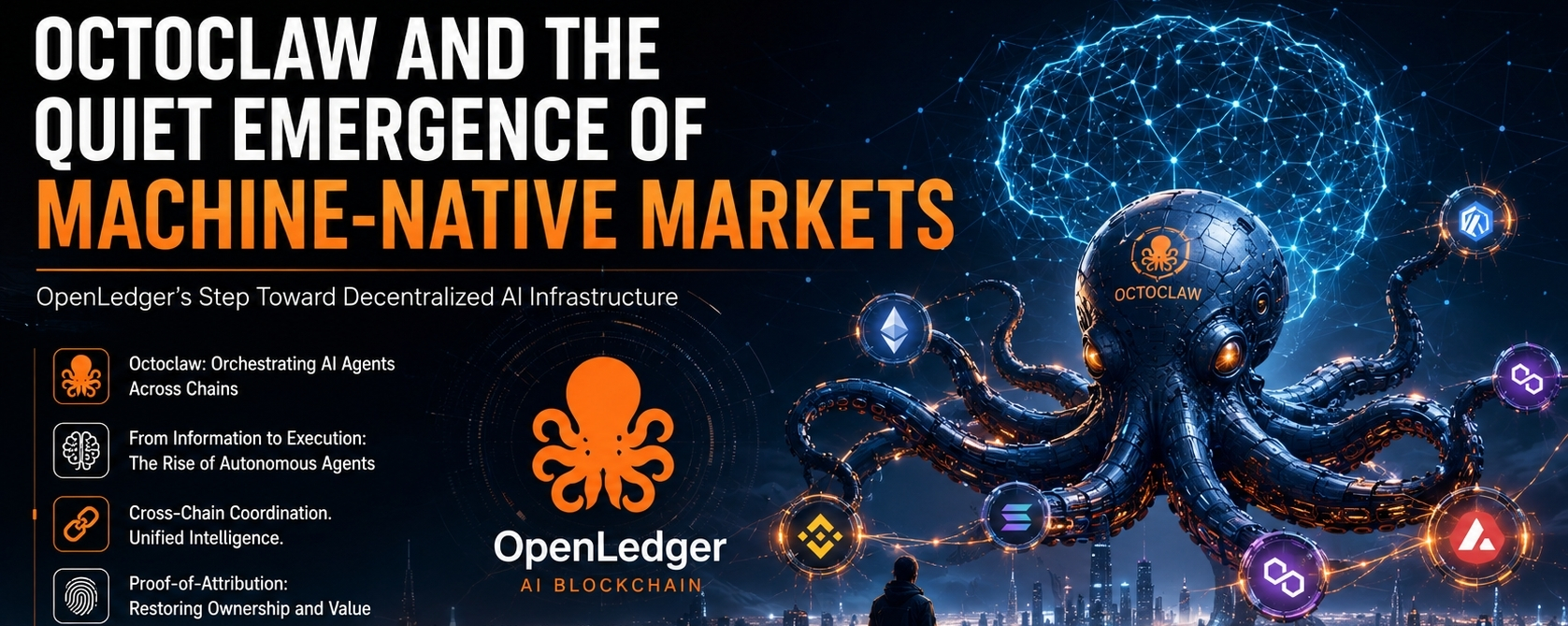
There’s a strange feeling that starts to emerge after spending enough time around both crypto markets and AI systems. At first, they seem like completely different worlds. One is obsessed with liquidity, volatility, execution, and capital rotation. The other revolves around intelligence, data, prediction, and automation. But eventually the boundaries begin to dissolve, and you realize both industries are actually wrestling with the same underlying question: who controls the infrastructure layer of intelligence in a digitally native economy?

That’s the backdrop against which OpenLedger and its Octoclaw launch become interesting. Not because another protocol introduced another tokenized AI narrative. Crypto has already gone through multiple waves of superficial “AI x blockchain” branding cycles, most of which collapsed under the weight of empty architecture and speculative excess. What makes this particular moment worth examining is that OpenLedger appears to be positioning itself less like a consumer-facing AI product and more like coordination infrastructure for autonomous systems, data economies, and machine-driven execution environments.
And honestly, that shifts the entire perspective.
Because once AI agents stop behaving like passive assistants and start functioning like autonomous economic actors, the conversation changes entirely. We are no longer talking about chatbots generating text. We are talking about systems capable of holding assets, coordinating actions across chains, consuming data feeds, executing strategies, managing risk parameters, interacting with smart contracts, and eventually optimizing themselves against market conditions in real time.
That’s where things start to get interesting.
For years, crypto traders built edges around latency, information asymmetry, and execution speed. Entire fortunes were made by people who understood order flow better than the market. But AI agents fundamentally alter that landscape because they compress reaction time toward zero. Once intelligent agents can monitor thousands of variables simultaneously across multiple ecosystems, the advantage no longer belongs to the fastest human trader. The advantage shifts toward whoever designs the best systems, the best datasets, the best incentive structures, and the most resilient coordination architecture.
Most people underestimate what’s happening at the infrastructure layer.
The market is still largely focused on surface-level AI applications — image generation, copilots, consumer assistants, productivity tools — while the deeper structural transition is unfolding underneath. The real transformation may not be AI replacing individual tasks. It may be AI becoming native to digital economic systems themselves.
That distinction matters.
Because blockchains, despite all their flaws, are one of the few environments where autonomous software systems can actually own assets, verify execution, and interact economically without requiring centralized intermediaries. Traditional AI systems remain deeply dependent on centralized infrastructure stacks controlled by a small cluster of corporations with near-monopolistic access to compute, data pipelines, and model distribution. In many ways, modern AI resembles the early internet before open protocols matured: powerful, transformative, but increasingly concentrated.
The OpenAI versus open-source debate was only the beginning of that tension. The deeper conflict revolves around ownership and attribution. Who owns the data used to train models? Who captures the economic value generated by autonomous agents? Who receives compensation when models derive intelligence from distributed datasets contributed by millions of users?
This is where OpenLedger’s broader thesis begins to emerge.
The concept of an “AI Blockchain” sounds almost meaningless at first because the term has already been diluted by marketing departments across the industry. But if you strip away the buzzwords and examine the infrastructure implications carefully, the positioning becomes more nuanced. OpenLedger does not appear to be arguing that blockchains should replace AI systems. Instead, the argument seems to be that decentralized infrastructure may become necessary for coordinating ownership, incentives, provenance, attribution, and execution in increasingly autonomous AI economies.
That’s a very different claim.
And Octoclaw appears to sit directly inside that transition point.
The launch itself matters less than what it symbolizes. From what I’ve observed, Octoclaw reflects a movement away from static AI interfaces toward agentic coordination systems capable of interacting dynamically with decentralized environments. In simple terms, this means AI stops being a tool you query and starts becoming a system that acts.
That subtle difference changes everything.
An informational AI model answers your questions. An autonomous AI agent executes objectives. It manages workflows. It makes conditional decisions. It allocates resources. It responds to market movements. It coordinates across networks. It can theoretically operate continuously without human intervention.
Now imagine those agents interacting across multiple chains simultaneously.
Imagine an AI-driven treasury management system reallocating liquidity between ecosystems based on volatility metrics and yield opportunities in real time. Imagine autonomous research agents scanning governance proposals, identifying attack vectors in contracts, or rebalancing risk exposure during sudden market dislocations. Imagine domain-specific AI models trained on proprietary financial datasets executing strategies optimized not around emotional conviction, but around continuous probabilistic adaptation.
This is where the conversation stops sounding theoretical.
Because the technological ingredients already exist in fragmented form. Large language models can reason across complex datasets. Blockchains provide verifiable execution environments. Smart contracts automate settlement logic. APIs connect external information flows. Cross-chain messaging protocols enable interoperability. The missing layer has been coordination infrastructure capable of linking these components into coherent autonomous systems.
That appears to be the direction OpenLedger is attempting to explore.
Of course, ambition at the infrastructure layer is dangerous territory. The crypto industry is littered with technically elegant architectures that failed under real-world conditions. And AI introduces an entirely new category of uncertainty because autonomous systems amplify both capability and risk simultaneously.
This is where the real question begins.
What happens when AI agents begin executing financial actions at scale inside immutable environments?
Traditional software failures are often reversible. Blockchain failures frequently are not. A faulty AI-generated response inside a chatbot is embarrassing. A faulty AI-driven smart contract interaction can become catastrophic. There is a massive difference between an AI suggesting a trading strategy and an AI autonomously executing leveraged positions across volatile markets using on-chain capital.
The risks compound quickly.
Smart contracts already introduce attack surfaces through logic vulnerabilities, oracle manipulation, governance exploits, and liquidity fragmentation. Now add autonomous agents making probabilistic decisions on top of those systems. Add cross-chain execution layers. Add evolving market conditions. Add adversarial actors intentionally attempting to manipulate AI-driven systems through poisoned datasets or exploitative prompts.
Suddenly the entire stack becomes exponentially more complex.
And honestly, most retail participants have not fully internalized how fragile autonomous execution systems can become under adversarial pressure.
We’ve already seen glimpses of this future through algorithmic trading disasters, flash crashes, and cascading liquidation events. Financial systems optimized purely for speed often create systemic instability because rapid feedback loops amplify volatility rather than dampen it. AI agents operating inside decentralized markets could eventually produce similar dynamics if coordination frameworks and risk constraints are poorly designed.
That’s why the emphasis on infrastructure matters more than speculation.
The strongest long-term projects in crypto are rarely the loudest. They are usually the ones attempting to solve difficult coordination problems beneath the surface. Ethereum succeeded not because it marketed itself aggressively, but because it became a programmable settlement layer capable of supporting entire economic ecosystems. The same logic may eventually apply to decentralized AI infrastructure.
And OpenLedger’s compatibility with the broader Ethereum ecosystem is strategically important in that context.
Interoperability is not just a convenience feature anymore. It is survival infrastructure. AI agents cannot operate effectively inside isolated environments because intelligence systems derive value from access to broad information and execution surfaces. A closed AI economy would likely become structurally weaker over time compared to interoperable systems capable of accessing multiple liquidity environments, datasets, protocols, and computational resources.
That’s where cross-chain coordination becomes more than a technical feature. It becomes an economic necessity.
If autonomous agents are going to manage assets, coordinate workflows, or optimize strategies, they need seamless access to fragmented ecosystems. They need to interact with Ethereum liquidity, modular execution layers, rollups, decentralized storage networks, oracle systems, identity frameworks, and external APIs simultaneously. Infrastructure projects positioning themselves as coordination layers rather than isolated applications may ultimately occupy the most valuable positions in this emerging stack.
But again, architecture alone does not guarantee adoption.
Enterprise AI adoption remains far more complicated than most crypto-native discussions acknowledge. Large organizations do not simply integrate autonomous systems because the technology is theoretically impressive. Enterprises operate under regulatory constraints, legal liabilities, operational inertia, cybersecurity concerns, and governance requirements that slow deployment cycles dramatically.
And AI regulation is only becoming more uncertain.
Data ownership laws continue evolving across jurisdictions. Questions around copyright, training rights, attribution, and synthetic content remain unresolved. Governments are increasingly aware that AI infrastructure may become geopolitically significant. Meanwhile blockchain systems still face ongoing scrutiny around compliance, privacy, financial regulation, and jurisdictional ambiguity.
Now combine those two sectors together.
This creates a fascinating tension because decentralized AI infrastructure potentially solves some problems while simultaneously introducing entirely new ones. Decentralized systems can improve transparency, attribution, and incentive alignment. But they can also complicate accountability. If an autonomous AI agent operating across decentralized infrastructure causes financial harm, who becomes responsible? The developer? The protocol? The dataset contributors? The operator? The token holders?
There are no clear answers yet.
And that uncertainty matters because infrastructure narratives often fail not because the technology is impossible, but because coordination problems prove harder than expected.
Still, there’s another side to this conversation that keeps pulling attention back toward decentralized alternatives.
The current AI landscape is becoming increasingly centralized at a staggering pace. Training frontier models requires immense computational resources. Access to premium datasets is concentrated. Cloud infrastructure remains dominated by a handful of providers. Distribution channels are consolidating around major platforms. Even open-source ecosystems increasingly depend on centralized compute providers for scalability.
In other words, intelligence itself risks becoming vertically integrated.
That possibility has enormous long-term implications. Because if AI becomes the primary coordination layer for digital economies, then whoever controls AI infrastructure may ultimately influence information flows, market behavior, labor systems, and even governance mechanisms.
This is why decentralized AI infrastructure continues attracting attention despite skepticism.
Not because decentralization automatically produces better AI systems. It often doesn’t. Centralized systems still outperform decentralized alternatives across many dimensions today, especially around model training efficiency and deployment speed. But decentralization introduces something increasingly valuable in AI ecosystems: credible neutrality around ownership and value distribution.
And value distribution may become the defining economic battle of the AI era.
Right now, most AI value accrues toward centralized platforms controlling compute and models. Yet the underlying intelligence powering those systems frequently emerges from collective human contributions: public data, user interactions, open-source repositories, community-generated information, creative works, and distributed knowledge networks.
The mismatch is obvious.
Millions contribute value. A handful capture the economics.
OpenLedger’s emphasis on concepts like Proof-of-Attribution and data monetization appears designed to address that imbalance. Whether the implementation ultimately succeeds is another question entirely, but the underlying problem is real. If datasets become critical economic assets, then systems capable of tracking provenance, attribution, and contributor incentives may become increasingly important.
This is where Datanets enter the conversation.
The idea of specialized, domain-specific AI models trained on targeted datasets feels far more realistic than the fantasy of one universal superintelligence dominating every use case. Financial markets require different training environments than healthcare systems. Legal reasoning differs from gaming optimization. Autonomous trading agents require specialized behavioral models that general-purpose systems may never fully replicate.
Specialization creates economic fragmentation.
And fragmented intelligence ecosystems require coordination infrastructure.
That may ultimately become one of the strongest structural arguments for decentralized AI networks. Not because decentralization wins ideologically, but because heterogeneous AI economies naturally produce interoperability demands that centralized silos struggle to accommodate efficiently.
The internet itself evolved similarly. Early online systems were fragmented and closed before open protocols enabled broader coordination. Blockchain infrastructure arguably represents another iteration of that process, except this time involving value transfer and machine-native execution.
Which brings us back to Octoclaw.
The launch feels significant less because of immediate market reactions and more because it reflects a directional shift toward agent-native infrastructure design. Markets often misunderstand these moments initially because speculative frameworks dominate short-term pricing behavior. Traders search for catalysts, narratives, token rotations, and liquidity events. But infrastructure transitions rarely move linearly.
Most of the important technological changes happen quietly.
Ethereum looked inefficient before DeFi emerged. Cloud computing seemed abstract before SaaS economies matured. GPUs were once considered niche gaming hardware before becoming foundational to AI development. Infrastructure frequently appears overbuilt right before demand catches up.
That doesn’t guarantee success here, obviously.
Execution risk remains enormous.
Building autonomous coordination systems across decentralized environments requires solving extraordinarily difficult technical, economic, and governance challenges simultaneously. Security assumptions must hold under adversarial conditions. Incentive structures must avoid exploitation. Agent behavior must remain interpretable enough to manage systemic risk. Cross-chain coordination introduces additional complexity around synchronization and finality. And market cycles themselves can destroy promising infrastructure projects long before adoption materializes.
Crypto history offers countless reminders of this reality.
For every protocol that became foundational infrastructure, dozens disappeared despite compelling theses. Timing matters. Liquidity matters. Developer ecosystems matter. User behavior matters. Even strong architecture can fail if adoption surfaces emerge too slowly.
And yet, despite all those risks, it’s difficult to ignore the broader directional movement underway.
The role of humans inside digital markets is gradually shifting from direct execution toward strategic oversight. Traders increasingly rely on automated systems. Portfolio management is becoming algorithmically assisted. Information analysis is increasingly AI-mediated. Execution itself is steadily abstracting away from manual interaction.
Most people don’t notice these transitions while they’re happening because they occur incrementally.
One workflow gets automated. Then another. Then eventually entire categories of behavior become obsolete.
At some point, the competitive edge no longer comes from clicking buttons faster than other market participants. It comes from designing better autonomous systems, curating better datasets, building more resilient models, and understanding how machine-driven economies behave under stress conditions.
That changes the psychological structure of markets themselves.
Human emotion will still matter, of course. Fear and greed are not disappearing. But autonomous agents introduce new dynamics because they operate continuously, systematically, and often without emotional fatigue. The market gradually becomes partially machine-native.
And that possibility forces an uncomfortable realization.
If AI agents eventually become meaningful economic participants, then they will require infrastructure layers capable of identity, attribution, ownership, payment coordination, governance interaction, and execution verification. Traditional web infrastructure was not designed for autonomous machine economies. Blockchains arguably were.
That doesn’t mean every AI system belongs on-chain. It doesn’t mean decentralized AI automatically wins. And it certainly doesn’t mean speculative token markets accurately price long-term infrastructure value.
But it does suggest the overlap between AI and crypto may be deeper than many initially assumed.
OpenLedger seems to understand this intersection less as a branding opportunity and more as a coordination problem. That distinction matters because infrastructure projects live or die based on whether they solve genuine coordination inefficiencies. Narratives create temporary attention. Utility creates durable systems.
The challenge is that utility often takes years to become visible.
So the real question surrounding Octoclaw may not be whether the launch immediately changes markets. It may be whether it signals the early formation of a new infrastructure category entirely — one where decentralized systems coordinate autonomous intelligence rather than simply transferring assets between humans.
And honestly, nobody fully knows how large that category could become.
There’s still enormous uncertainty around how AI agents will evolve, how regulation will develop, how enterprise adoption will unfold, and whether decentralized coordination models can compete against centralized AI giants with vastly superior resources. Skepticism remains rational. Execution risk remains substantial. The possibility of failure remains very real.
But sometimes technological transitions become visible precisely at the moment when separate industries begin converging around the same unresolved tensions.
Data ownership. Attribution. Coordination. Automation. Incentives. Trust.
Those themes are no longer isolated conversations.
They’re merging into one larger infrastructure debate about how intelligence itself gets organized inside digital economies.
And perhaps that’s the most important thing to watch here.
Not the token charts. Not the short-term narratives. Not the speculative rotations.
The infrastructure layer underneath them.
