I’ll be honest I almost ignored OpenLedger completely.
Not because the idea sounded impossible, but because the phrase “AI blockchain” has started to lose meaning through overuse. Every few weeks another protocol appears claiming it will decentralize intelligence, democratize compute, or reinvent ownership in the age of artificial intelligence. After a while the language becomes strangely interchangeable. You stop hearing ideas and start hearing positioning strategies.
That was my initial reaction to OpenLedger too. Another infrastructure layer. Another tokenized coordination system. Another attempt to merge crypto incentives with machine learning narratives.
But the longer I spent trying to understand what the protocol was actually attempting to solve beneath the surface branding, the more I realized it was touching something deeper than most AI projects talk about publicly.
Modern AI systems are built on an uncomfortable contradiction.
The intelligence appears centralized, but the process creating it is profoundly distributed.
Every model that looks seamless from the outside is quietly assembled from invisible layers of contribution. Massive datasets gathered across the internet. Human ranking systems. Reinforcement loops. Fine-tuning decisions. Behavioral corrections. Evaluation structures. Edge-case discoveries. Millions of interactions feeding systems that no single person truly builds alone.
And yet economically, the structure behaves as if intelligence emerged from a single entity.
That asymmetry feels increasingly important.
Most people contributing to the development of AI systems never own any meaningful part of the intelligence they help create. Their data disappears into training pipelines. Their feedback becomes absorbed into optimization cycles. Their role dissolves into statistical abstraction while the economic value accumulates elsewhere usually around whoever controls the infrastructure, distribution layer, or model endpoint.
For a while the industry managed to ignore this because AI still felt experimental. But now the systems are becoming economically productive. They are entering search, software, finance, education, media, and automation at a scale where questions around attribution stop feeling philosophical and start becoming structural.
Who created the value inside the model?
Who deserves recognition once intelligence becomes monetizable?
And perhaps more importantly, can contribution remain visible once systems become sufficiently complex?
That seems to be the tension OpenLedger is built around.
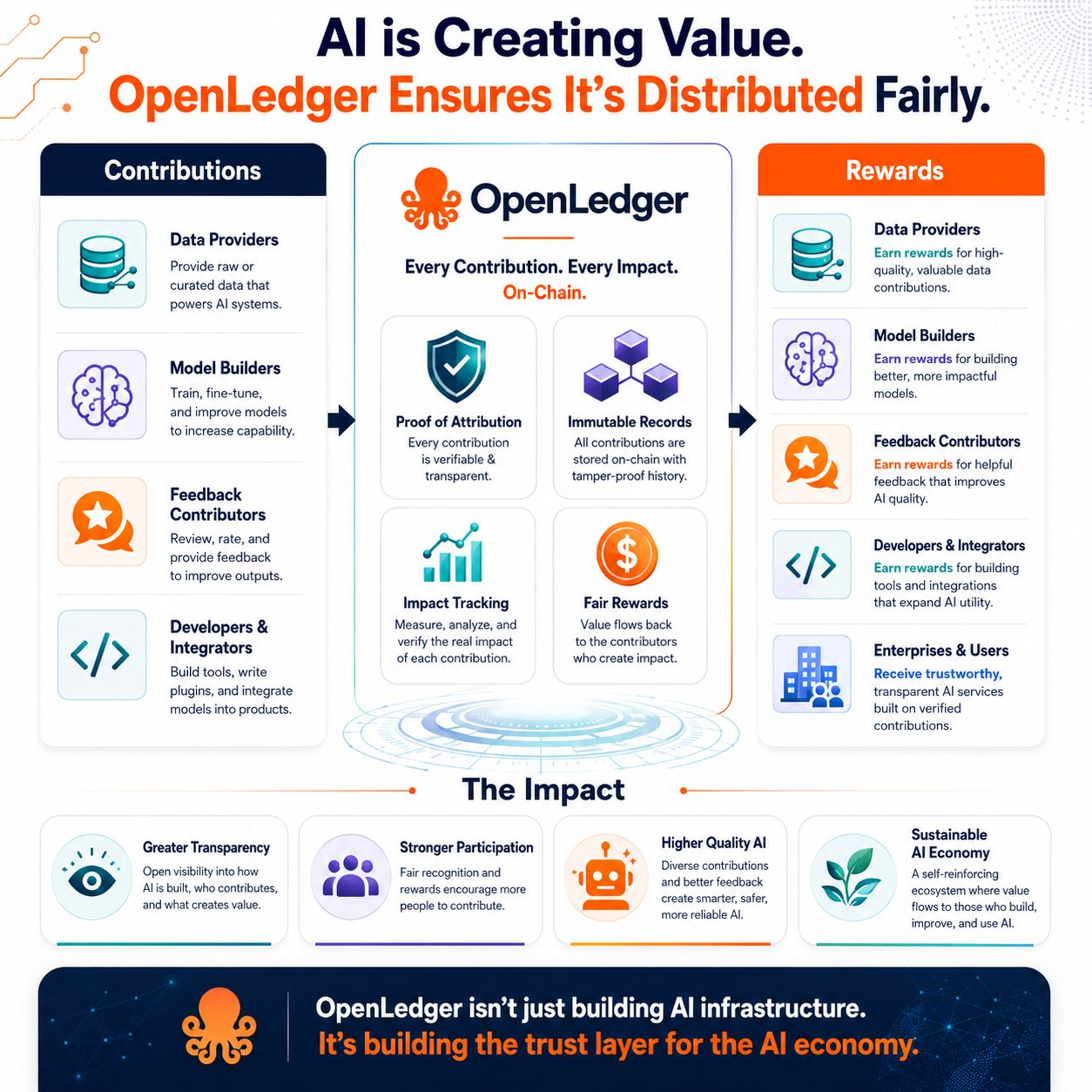
The protocol appears less interested in creating “better AI” in the traditional sense and more interested in building an economic coordination layer around how intelligence itself is produced, validated, and attributed. That distinction is subtle but important. Most AI companies focus on performance. OpenLedger seems focused on traceability.
At first I thought that sounded unnecessarily idealistic. The internet has never been particularly good at fairly distributing value. Why would AI suddenly become different?
But then I started thinking about what happens if the current trajectory continues unchanged.
AI models become more powerful by absorbing increasingly distributed forms of human contribution, while ownership becomes increasingly concentrated around a handful of entities capable of controlling compute, infrastructure, and deployment. Intelligence slowly transforms into a black box economy where the labor underneath the system becomes impossible to identify even though the system depends entirely on that labor existing.
And honestly, that starts looking less like innovation and more like extraction at scale.
I think OpenLedger recognizes this emerging imbalance. The protocol’s architecture seems designed around the idea that datasets, models, agents, and contributors should not disappear into a centralized intelligence system without leaving economic fingerprints behind.
Technically, that involves things like validation systems, decentralized coordination, attribution frameworks, staking mechanisms, and on-chain records. But reducing the protocol to its components misses the more interesting part. The architecture matters because of what it implies socially.
It implies that intelligence may eventually require public infrastructure.
Not public in the governmental sense, but public in the sense that participation, attribution, and value distribution cannot remain entirely opaque if AI systems become foundational to economic life.
That idea changes the emotional texture of the protocol entirely.
Suddenly OpenLedger feels less like a speculative crypto experiment and more like an attempt to redesign institutional trust around machine intelligence.
Of course, this is also where skepticism becomes unavoidable.
Because attribution sounds elegant until you try implementing it inside probabilistic systems.
How exactly do you measure contribution inside a model trained on enormous amounts of blended information? How do you determine whether a dataset genuinely improved intelligence or merely existed somewhere within the training pipeline? How do you stop people from gaming reward systems once contribution itself becomes financially valuable?
These are not minor technical details. They are existential design problems.
And I think many decentralized AI projects underestimate how brutally difficult coordination becomes once incentives enter the system.
Human behavior changes the moment visibility becomes monetized.
The internet already taught us this. Metrics reshape participation. Platforms built to reward contribution eventually produce performative behavior optimized for whatever the system measures. Social cooperation slowly turns into economic signaling.
That risk exists here too.
If attribution becomes financial infrastructure, participants may eventually optimize for measurable contribution rather than meaningful contribution. Systems intended to distribute value fairly can unintentionally create new forms of manipulation around visibility itself.
This is why I still remain cautious about projects like OpenLedger despite finding them intellectually compelling.
There is also the practical tension between decentralization and speed.
Modern AI development moves aggressively fast because centralized organizations can iterate without consensus friction. They retrain models rapidly, alter systems internally, deploy updates immediately, and optimize around singular authority structures.
Decentralized coordination does the opposite. It introduces negotiation into systems that currently reward velocity above all else.
That creates a difficult tradeoff.
Can decentralized AI infrastructure remain competitive while preserving distributed ownership principles? Or does scale inevitably pull intelligence toward centralization because centralized systems simply move faster?
I don’t think anyone truly knows yet.
And maybe that uncertainty is the most honest part of the entire conversation.
Still, even with all those flaws and unanswered questions, I think OpenLedger matters for one reason that has very little to do with token prices or infrastructure narratives.
It forces people to confront the possibility that intelligence itself is becoming an economic coordination problem.
Not merely a technical one.
For decades the internet trained us to believe data was abundant and ownership was secondary. AI changes that equation because the systems now generating enormous economic value are built directly on accumulated human contribution. Once intelligence becomes productive infrastructure, attribution suddenly matters in ways the earlier internet never had to solve.
That realization sits underneath OpenLedger’s entire philosophy.
The protocol seems built around a simple but increasingly difficult question: if intelligence is collectively produced, should ownership remain centralized?
I don’t think the project fully answers that question yet. Honestly, I’m not sure any system can. The coordination complexity alone is staggering. Governance becomes messy. Validation becomes subjective. Incentives distort behavior. Decentralization introduces friction exactly where markets reward efficiency.
And yet I still find myself returning to the idea behind it.
Because even if OpenLedger never fully succeeds, it exposes something unresolved about the future of AI that many people still prefer not to examine too closely.
The industry keeps talking about making intelligence more powerful.
Far fewer people are talking about who disappears inside the process of creating it.