
I've been in this space long enough to be tired of most of it.
Every week there's a new "AI blockchain" that's going to change everything. You read the deck, you nod, you forget about it by Thursday. I stopped getting excited a while ago. Not because the ideas are bad. Because the follow-through usually is.
So when I first saw @OpenLedger I did what I always do. I waited.
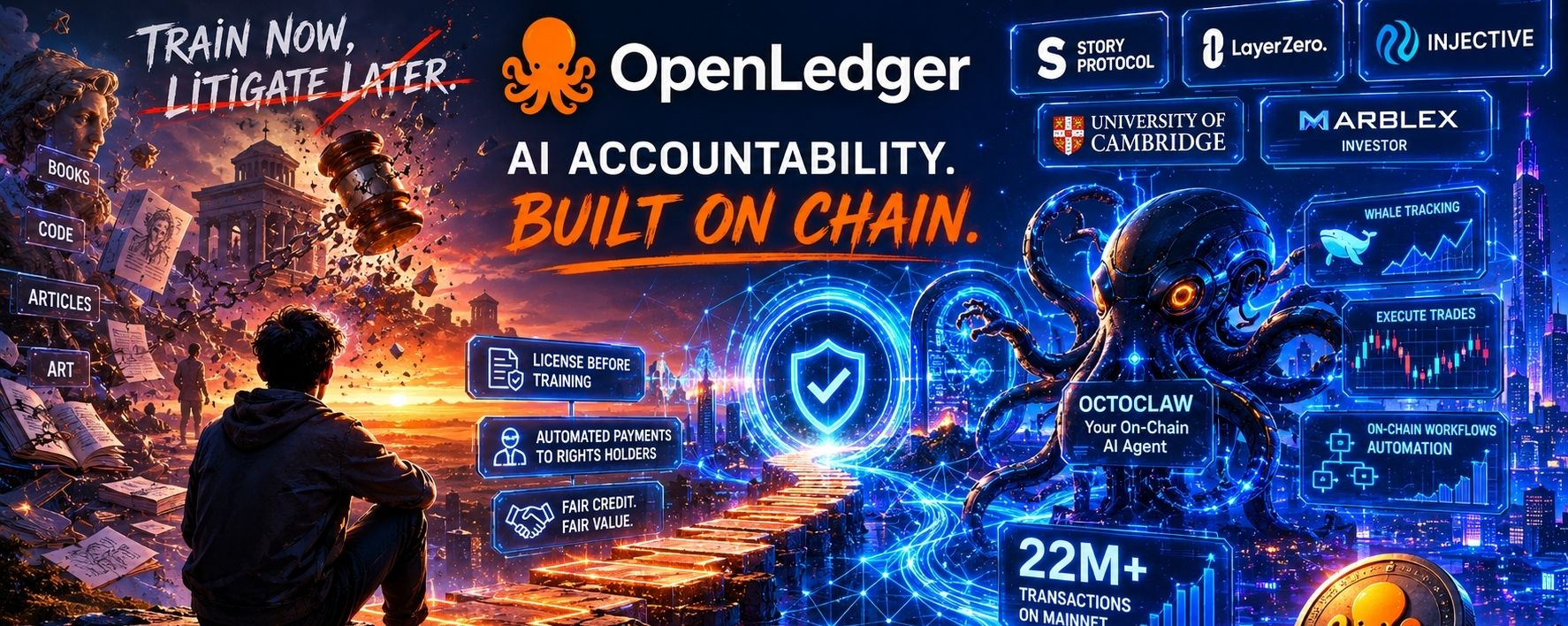
I watched the announcements pile up. Story Protocol, LayerZero, Injective, Cambridge University, some Korean gaming company called MARBLEX putting actual money in. I kept waiting for the part where it falls apart. Where the mainnet is a ghost town. Where the "partnership" is just two logos on a slide.
That part hasn't come yet.
What came instead was OctoClaw. An actual downloadable agent that tracks whale movements, executes trades, automates on-chain workflows. Not a demo. Not a testnet. A thing you put on your computer and use. One platform connecting on-chain execution and data retrieval, replacing the five different tools most people were duct-taping together to do the same job. I don't know why but that detail, the replacing five tools thing, hit different for me. That's a real user problem. Someone actually thought about the friction.
And then there's the data thing.
This is the part I keep coming back to when I'm being honest with myself. Every AI model we use, the impressive ones, the ones people build companies on, almost certainly trained on work that wasn't licensed. Books, code, articles, art. Just... taken. The industry decided that was fine and kept moving. The phrase OpenLedger used was "train now, litigate later." And I sat with that for a minute because it's accurate. That is exactly what happened. That is exactly what is still happening.
There's something a little melancholic about it honestly. The people who created the content that made these models smart didn't get a say. Didn't get paid. Didn't even get credited. And the models got smarter and the companies got valued higher and the creators just kind of... watched.
What OpenLedger and Story Protocol built together is a standard where IP gets licensed before training, not after. Where payments go to rights holders automatically, at the moment their work actually influences a model output. I think most people read that announcement and moved on. I read it three times. Because if that actually works at scale, it changes something fundamental about who benefits from AI. Not just who builds it.
The chain itself has crossed 22 million transactions. That's not a marketing number, that's activity. For a project at this stage that matters more to me than any partnership list.
I'm not saying this is a sure thing. I've been wrong about projects with better fundamentals. Token unlocks, market conditions, execution risk, all of it is real. And $OPEN has had rough days recently, down in the short term while the broader narrative around AI infrastructure is still finding its footing.
But I keep thinking about who wins if AI accountability becomes non-negotiable. The EU AI Act is already asking hard questions. Lawsuits are piling up. Enterprises are starting to care about compliance in ways they didn't two years ago. And if that pressure keeps building, the project that built enforcement into the execution layer from the start isn't a niche play anymore.
It might just be the thing everyone needed and nobody wanted to build first.
I don't know. Maybe I'm reading too much into it. Maybe this is just another cycle of hope before the reality check. But something about OpenLedger feels less like a bet on hype and more like a bet on a problem that isn't going away.
And those are usually the ones worth watching quietly.