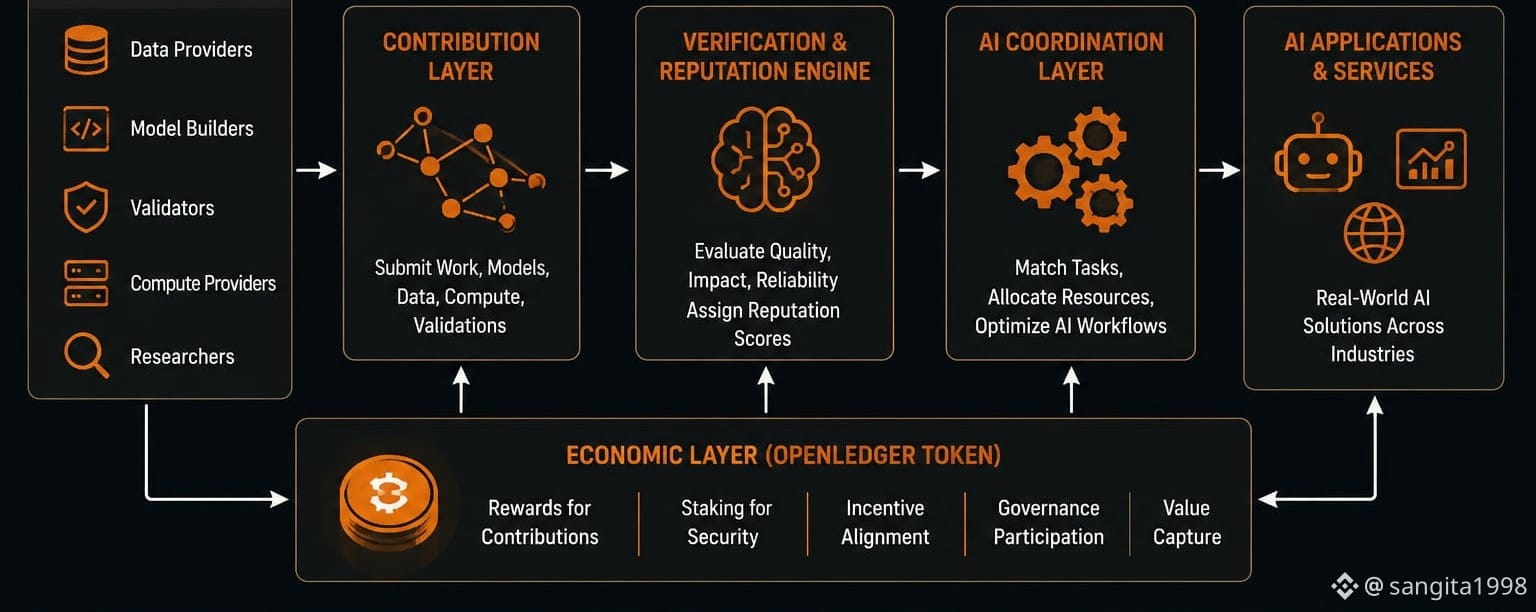
OPENLEDGER SAYS IT BUILT THE FIRST AI NATIVE CONTRIBUTOR ECONOMY. I THINK IT MAY HAVE JUST REPACKAGED AN OLD INTERNET PROBLEM.
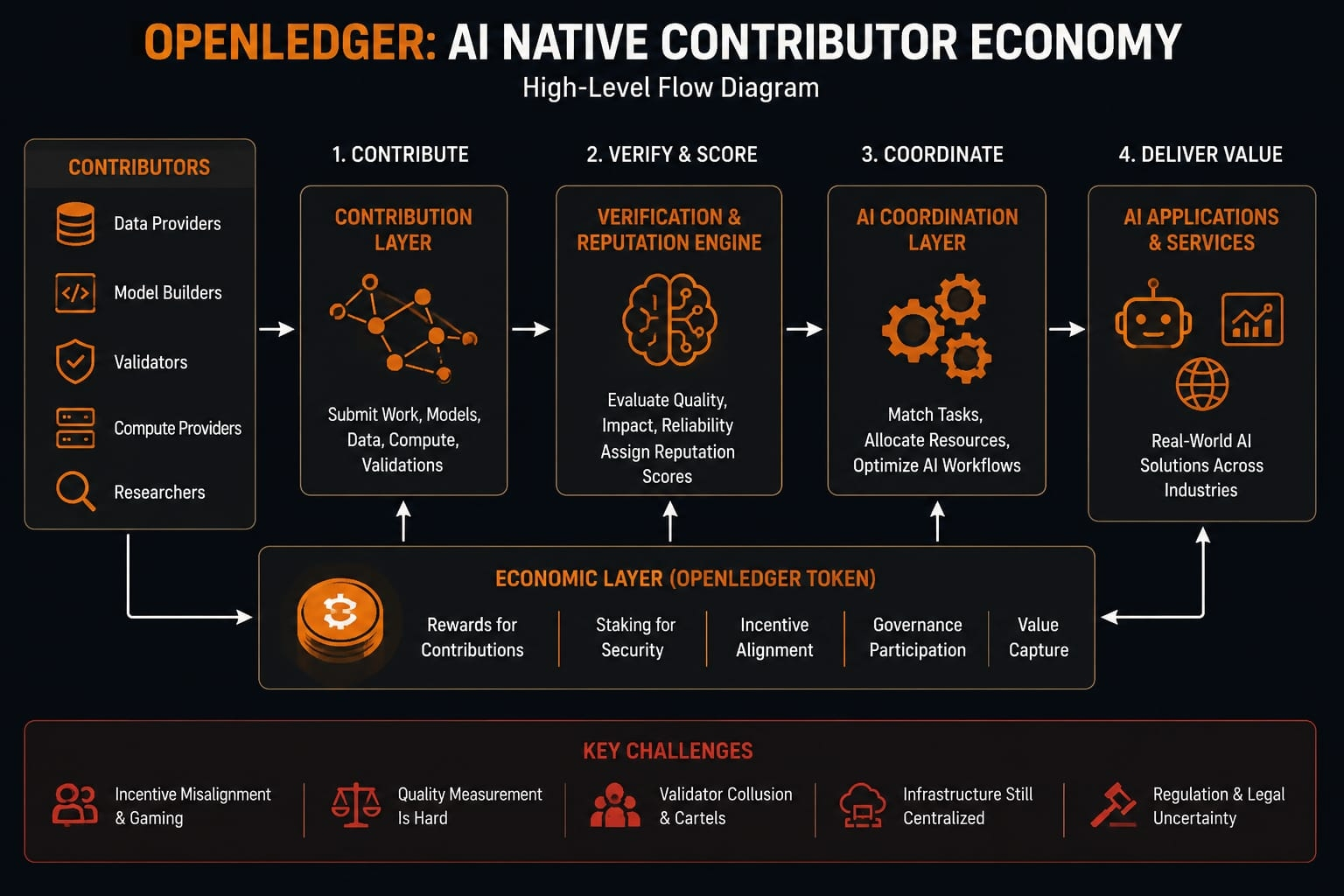
Look, I understand why projects like OpenLedger are getting attention right now. The AI industry is bloated with money, compute is becoming scarce, developers are frustrated with centralized gatekeepers, and crypto is still searching for its “this actually matters” moment after years of speculative theater disguised as innovation.
@OpenLedger So when a company walks in and says, “We’re building a decentralized contributor economy for AI,” people want to believe it. It sounds clean. Elegant, even. A giant open network where developers, data providers, validators, and model builders all get rewarded fairly for their contributions. No monopolies. No Big Tech choke points. Just programmable incentives coordinating machine intelligence across the internet.
That’s the sales pitch.
I’ve seen this movie before.
The names change every cycle, but the structure rarely does. First comes the claim that a massive industry is broken. Usually true. Then comes the token. Then the “ecosystem.” Then the promise that decentralization will magically align incentives better than messy human institutions ever could.
And then reality shows up carrying a baseball bat.
The core problem OpenLedger claims to fix is not imaginary. That part is real. AI is becoming absurdly centralized. A tiny number of companies control the models, the compute infrastructure, the data pipelines, and increasingly the distribution layer itself. If you want access to serious AI infrastructure today, you usually end up renting it from one of a handful of corporations with trillion-dollar balance sheets and enough GPUs to make smaller countries nervous.
That concentration creates obvious problems.
Developers become dependent tenants. Smaller startups struggle to compete. Open-source contributors improve systems they don’t own. Data providers feed giant models without seeing meaningful long-term upside. And meanwhile the economic gravity keeps pulling toward the largest infrastructure players because AI at scale is brutally expensive.
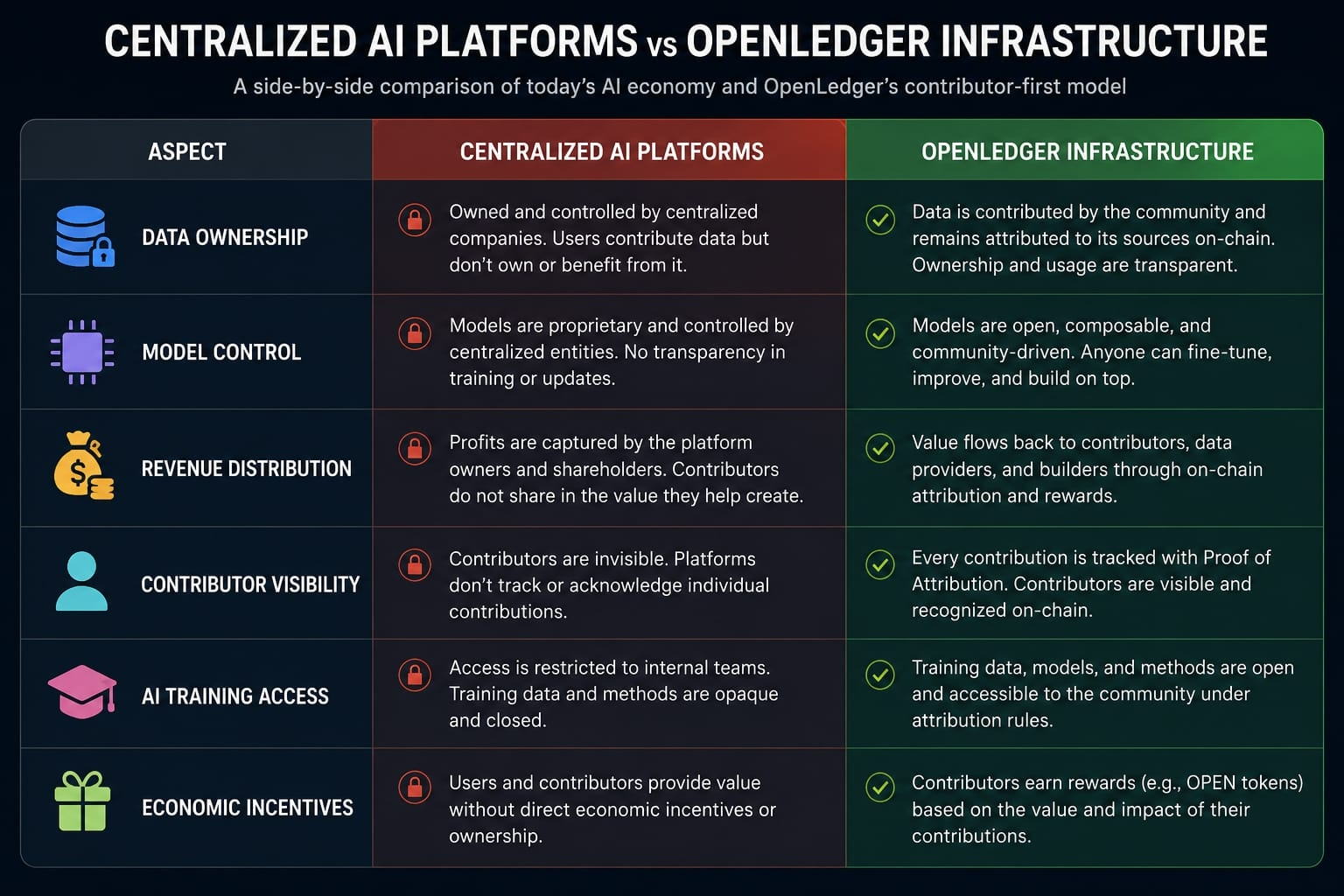
So OpenLedger comes along and says: what if contributors themselves owned part of the system?
Fair question.
But here’s where things start getting slippery.
Because when you strip away the branding, OpenLedger is essentially trying to build a labor marketplace, a verification network, a payment rail, a reputation system, and an AI coordination layer all at the same time. On blockchain infrastructure. With token incentives holding the whole thing together.
That is not simplification. That is complexity stacked on top of complexity.
And complexity has a habit of breaking in ways whitepapers never mention.
Let’s be honest about what these systems are really trying to do. They want strangers across the internet to collaborate on AI infrastructure without trusting each other directly. So the network becomes the trust machine. Reputation scores, token staking, validation layers, contributor rankings, reward mechanisms — all designed to replace traditional institutions with code-driven coordination.
Sounds great in theory.
But the moment you actually operationalize it, ugly questions appear.
Who decides whether a contribution was valuable?
Seriously. That’s the entire system. If someone contributes data, fine-tunes a model, validates outputs, or provides inference capacity, how exactly does the network determine whether that contribution improved the system meaningfully?
This is where the marketing usually gets foggy.
Because AI quality is not objective in the same way blockchain transactions are objective. A payment either happened or it didn’t. But intelligence outputs exist on gradients. One validator might prioritize speed. Another prioritizes accuracy. Another prioritizes engagement. Another prioritizes safety.
So now you need governance systems to decide what “good” intelligence means.
And suddenly your decentralized network starts looking suspiciously centralized again.
Somebody has to define the metrics. Somebody has to tune the incentives. Somebody has to adjust the weighting systems. Somebody decides which contributors get rewarded more heavily than others.
That “somebody” is usually a small group of insiders.
Every time.
Crypto has spent fifteen years promising decentralized governance and somehow keeps arriving at the same destination: concentrated influence hidden behind token language.
And here’s the part the marketing teams never like discussing openly. Early insiders almost always capture disproportionate upside long before the “community” arrives.
That’s the catch.
The contributor economy sounds democratic until you ask who owns the infrastructure, who received early token allocations, who controls validator access, who designed the economic rules, and who benefits most if the network becomes valuable.
Follow the cap table. Not the manifesto.
I’m also skeptical about the human assumptions underneath this whole model.
These systems imagine contributors behaving like rational economic actors inside beautifully balanced incentive structures. But humans don’t work that way. They game systems. They collude. They spam. They optimize for rewards even when it damages long-term quality.
Especially online.
Open participation systems always attract noise. Always.
If OpenLedger becomes successful enough to matter, it won’t just attract brilliant contributors. It will attract low-quality data farms, synthetic AI-generated garbage, validator cartels, incentive manipulators, and people looking to exploit reward structures at industrial scale.
Because wherever tokens flow, extraction follows.
And unlike traditional software systems, AI infrastructure has a particularly nasty problem: bad outputs are often hard to detect immediately.
That’s dangerous.
A flawed validator in a financial blockchain gets noticed quickly because money disappears. But corrupted training data, biased reinforcement signals, or low-quality model evaluations can quietly poison AI systems over time without obvious failure at first.
You don’t always know the intelligence layer is drifting until something important breaks.
And then there’s the decentralization claim itself.
Look carefully at most decentralized AI projects and you’ll notice something uncomfortable. The expensive parts usually remain centralized anyway.
Who owns the GPUs? Large operators.
Who can afford industrial-scale inference infrastructure? Large operators.
Who has access to the best proprietary datasets? Large companies.
Who controls the cloud dependencies underneath supposedly decentralized networks? Usually Amazon, Microsoft, or Google somewhere in the stack.
This is the dirty secret of modern AI infrastructure. Compute concentration is real. Energy concentration is real. Hardware concentration is real.
You can decentralize governance forums all day long. The physical infrastructure still lives in warehouses full of expensive chips owned by people with deep pockets.
That matters because infrastructure eventually determines power.
And then there’s the broader issue nobody in these sectors likes admitting: maybe most users don’t actually care about decentralized contributor economies.
Really.
Developers care about reliability. Enterprises care about uptime, legal liability, and support contracts. Consumers care about convenience. They want the AI system to work. Fast. Cheap. Predictable.
The average business executive is not sitting around dreaming about tokenized validation layers for distributed machine intelligence contributors. They’re trying to automate workflows without getting sued.
That’s the real world these projects eventually collide with.
Now, to be fair, OpenLedger is at least asking more serious questions than many AI-crypto projects floating around right now. Most of the sector still looks like speculative wrappers glued onto generic AI tooling. OpenLedger is trying to address something real: how value gets distributed in increasingly collaborative AI ecosystems.
I’ll give them that.
But solving a real problem does not automatically mean the proposed solution is viable.
That’s another lesson this industry keeps relearning the hard way.
Sometimes the “decentralized solution” simply introduces new coordination problems larger than the original ones. More governance friction. More attack surfaces. More economic complexity. More systems nobody fully understands until failure arrives.
And failure always arrives eventually.
That’s the part younger markets tend to forget during hype cycles. Systems are easy to praise during growth phases. Everything looks intelligent while liquidity is flowing and nobody is stress-testing assumptions seriously.
The real test comes later.
What happens when contributors start fighting over rewards? What happens when validators disagree politically? What happens when low-quality AI content floods the network because the incentive structure accidentally rewards quantity over usefulness? What happens when enterprises demand accountability for harmful outputs and the “decentralized governance community” suddenly becomes legally inconvenient?
That’s where the clean diagrams stop helping.
Look, maybe OpenLedger figures some of this out. Maybe the coordination layer becomes useful enough that developers tolerate the added complexity. Maybe enterprises eventually accept decentralized contribution systems because centralized AI monopolies become too expensive or too politically dangerous.
But I keep coming back to the same uncomfortable thought.
Every generation of technology creates new middlemen while claiming to remove the old ones.
And after twenty years of watching the industry recycle that promise in different forms, I’ve learned to pay less attention to the rhetoric and more attention to who controls the incentives once the system gets large enough to matter.
Because that’s usually where the real architecture reveals itself.
Not during launch announcements.
Not during token rallies.
Not while everyone is still pretending the incentives are perfectly aligned.