
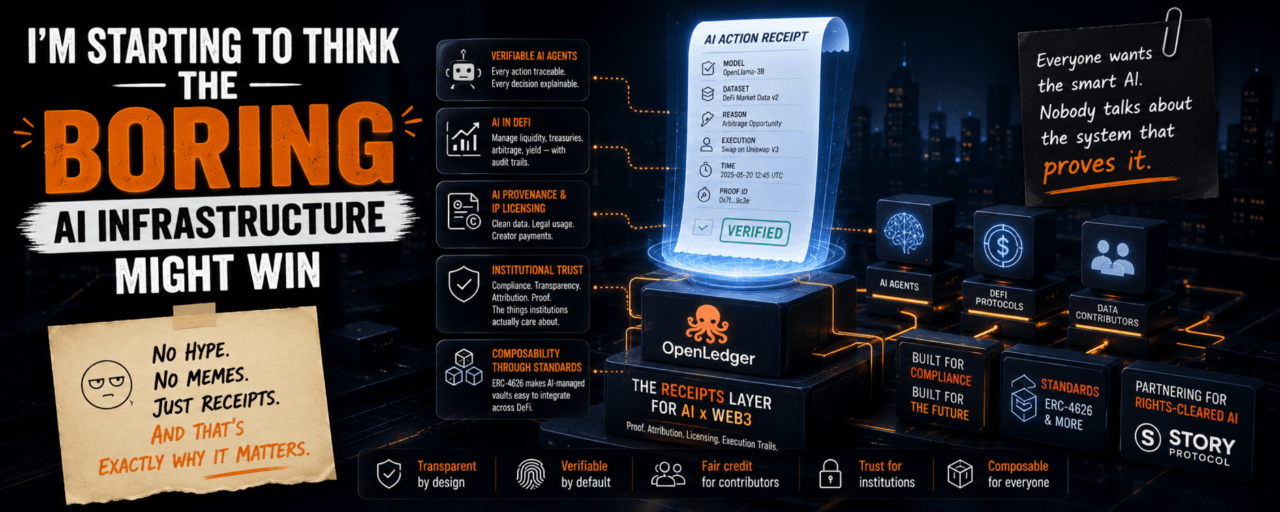

I used to ignore the boring infrastructure stuff. Not because it is useless. Because, let’s be honest, it does not scream “viral post.” No laser eyes. No moon chart. No “this will change everything by next Tuesday” energy.
Just systems. Proof. Audit trails. Attribution. Verification. Very boring. Very important.
And that is exactly why I am paying more attention to OpenLedger.
Because the more I look at AI x Web3, the more I think the loudest part of the market is not always the most useful part.
Everyone wants to talk about AI agents.
Fair.
Agents are exciting. They can research, automate, trade, manage tasks, maybe even touch DeFi strategies.
Sounds amazing.
Also sounds like a complete mess if nobody can verify what the agent actually did.
Imagine giving an AI agent access to liquidity or treasury operations, and when you ask why it made a move, it basically says:
“Trust me, bro. I processed the data.”
Beautiful.
That is exactly the kind of answer institutions love before moving serious money.
Obviously not.
This is where I think OpenLedger’s quieter role becomes interesting.
I do not see it only as another AI token story.
I see it more like a receipts layer for AI.
Which model was used? Which data influenced the result? What triggered the action? Who contributed to the output? Was the data rights-cleared? Can the action be audited later?
These are not sexy questions.
But they are the questions that matter when AI stops being a toy and starts touching money, ownership, IP, and real execution.
That is the part people often skip.
They want the AI agent to trade. They want the AI agent to manage yield. They want the AI agent to automate decisions.
Cool.
But who checks the logic?
Who proves what data shaped the action?
Who confirms the model did not just hallucinate with confidence like it had three coffees and a Twitter account?
This is why verifiable AI matters.
OpenLedger’s core idea around attribution, transparency, and AI execution trails feels important because AI agents will need more than intelligence.
They will need accountability.
Especially in DeFi.
If an agent manages liquidity, executes arbitrage, or interacts with a vault, the action itself is only half the story.
The other half is the trail.
Why did it move funds? Which signal did it follow? Which model made the call? Can users audit the process? Can institutions trust the system?
Without that, we are basically building financial robots and hoping they behave.
Very safe. Very relaxing.
Then there is the IP side.
This one is even more underrated.
AI does not learn from magic. It learns from data, content, creative work, code, communities, and knowledge.
So when AI creates value, the obvious question is:
Who owned the input?
And who gets paid?
I think this is where OpenLedger’s role around provenance and attribution becomes more serious.
If AI models are trained on rights-cleared data, if usage can be proven, if licenses can be enforced, and if creator payments can be distributed, then AI becomes less of a black box and more of an actual economy.
Because right now, AI often feels like a giant machine eating everyone’s work and then acting surprised when creators ask for credit.
Very innocent. Very believable.
OpenLedger’s story becomes stronger when I look at it through this lens.
Not just data monetization.
Not just agents.
But proof.
Proof that data was used. Proof that contributors mattered. Proof that AI actions had a reason. Proof that models and agents did not just appear from the fog.
That is the infrastructure institutions may actually care about.
Retail loves hype.
Institutions love documentation.
Painful but true.
They want compliance. They want auditability. They want clean data. They want licensing clarity. They want risk controls.
They are probably not going to trust an AI agent just because the logo looks futuristic.
Shocking, I know.
This is why I think the “boring infrastructure” angle around OpenLedger is actually one of the better narratives.
Because if AI agents become serious, the market will eventually need systems that can verify what those agents are doing.
And if AI enters DeFi more deeply, standards also matter.
ERC-4626 is a good example. It standardizes tokenized yield-bearing vaults, which makes vault products easier to integrate across DeFi.
Again, not flashy.
But very useful.
If AI-managed vaults or yield strategies become a real thing, composability matters. A standardized vault structure makes it easier for protocols, agents, and users to interact.
So the bigger picture becomes clearer to me.
AI agents need execution. DeFi needs standards. Institutions need compliance. Creators need attribution. Models need provenance. Users need trust.
And OpenLedger is trying to sit somewhere in the middle of all that.
Quietly.
Not as the loudest thing in the room.
More like the thing everyone ignores until they suddenly need proof, receipts, and audit trails.
That is usually how infrastructure works.
Nobody cares about the rails until the train has to move.
Nobody cares about the plumbing until the water stops.
Nobody cares about verification until the AI agent does something expensive and everyone starts asking questions.
So yes, I am starting to think OpenLedger’s boring side might be the most important side.
Because the future of AI x Web3 will not only be about smart agents.
It will be about trusted agents.
Verifiable agents.
Auditable agents.
Agents that can show why they acted, what they used, and who contributed to the value they created.
That is not hype.
That is infrastructure.
And boring infrastructure has a funny habit of becoming very important once the market grows up.