
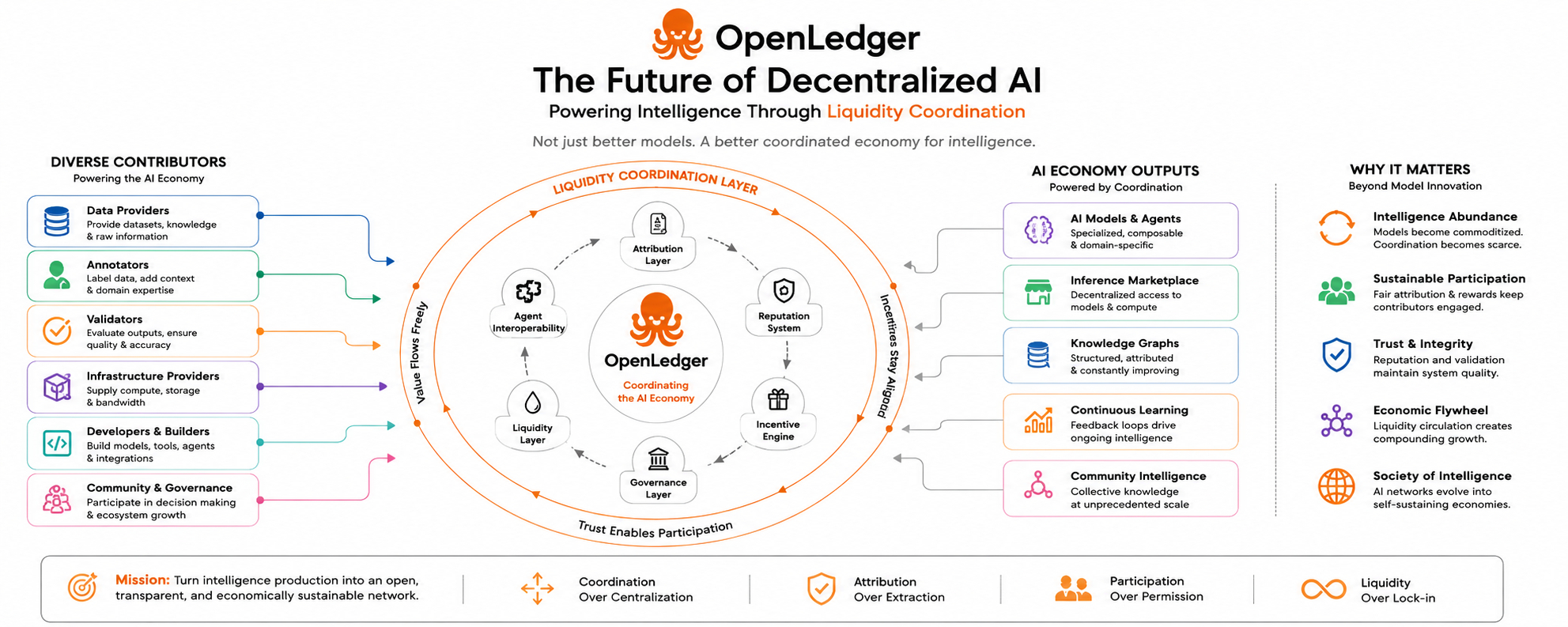
For most of the AI boom, the industry behaved as if intelligence itself was the scarce asset. Every major breakthrough was framed around scale — larger models, larger datasets, larger compute clusters, larger funding rounds. The assumption hiding underneath all of it was simple: whoever builds the smartest model wins.
But the deeper you look at where AI is heading, the less convincing that assumption becomes.
The strange thing about modern AI is that breakthroughs do not stay rare for very long anymore. A capability that looks untouchable today becomes reproducible months later. Open-weight ecosystems move faster than most people expected. Fine-tuning has become dramatically cheaper. Distillation compresses massive systems into smaller ones. Specialized models increasingly outperform giant general-purpose systems in narrow domains. The market still talks about intelligence as if it were permanently scarce, while the actual trend suggests intelligence is slowly becoming abundant.
And abundance changes where value lives.
Once something becomes easier to reproduce, the bottleneck moves somewhere else.
That “somewhere else” may end up being coordination.
This is why projects like OpenLedger are more interesting than they initially appear. Most people reduce decentralized AI to a familiar crypto narrative — tokens, governance, staking, incentives. But that interpretation misses what is structurally changing underneath these systems.
The real experiment is not simply decentralizing models.
It is decentralizing the economy around intelligence itself.
That sounds abstract until you think about what actually powers AI behind the scenes. Models are only the visible layer. Beneath every successful AI system sits an enormous hidden network of contributors: people generating datasets, labeling information, curating domain expertise, evaluating outputs, building infrastructure, routing inference, refining feedback loops, maintaining retrieval systems, and supplying compute. Centralized AI companies solved this problem by owning the entire pipeline internally. Everything flows upward into one company, one balance sheet, one closed ecosystem.
Decentralized AI cannot function that way.
It has to coordinate strangers.
And coordinating strangers is fundamentally an economic problem, not just a technical one.
That changes the entire nature of the challenge.
A decentralized AI network only survives if participation keeps circulating through the system. Contributors need incentives. Data providers need attribution. Validators need rewards. Agents need liquidity. Communities need governance mechanisms that feel economically meaningful rather than symbolic. Without that circulation, even the best model eventually becomes irrelevant because the ecosystem around it stops moving.
That is why liquidity may matter more than model innovation itself.
Not liquidity in the narrow trading sense people associate with crypto markets, but liquidity in the broader economic sense — the ease with which value, information, participation, and incentives move through a system without getting trapped.
Most conversations about AI still underestimate how important this becomes once intelligence stops being scarce.
The first generation of decentralized AI projects often misunderstood this completely. Many assumed that open-sourcing a model and adding token incentives would naturally create a sustainable ecosystem. But open access alone does not create durable coordination. The internet already proved that. Information abundance without structure usually produces fragmentation, noise, and decay.
The same applies to AI.
A decentralized model without strong coordination mechanisms slowly collapses into economic exhaustion. Contributors lose motivation because rewards feel disconnected from impact. Low-quality data floods the system because filtering becomes weak. Governance becomes performative. Speculators overpower builders. Infrastructure deteriorates because maintenance is less glamorous than innovation. Eventually the ecosystem starts looking alive on the surface while hollowing out underneath.
This is why attribution suddenly matters so much.
For years, AI systems absorbed enormous amounts of public information without any serious attempt to track who created value inside the system. The architecture received attention. The company received valuation. The contributors disappeared into the background.
But decentralized AI changes the political economy of intelligence.
Once participation becomes financialized, attribution stops being philosophical and becomes existential. If contributors cannot see how their work connects to outcomes, the system loses legitimacy. And once legitimacy disappears, participation eventually disappears too.
That is where projects like OpenLedger become more interesting than a normal blockchain infrastructure play. Their broader ambition appears to be turning intelligence production into something economically traceable — not just generating outputs, but mapping how value flows backward through datasets, agents, and contributors.
Whether current attribution systems are sophisticated enough to fully solve that problem is another question entirely. The technical difficulty is enormous. Measuring influence inside large models is still messy, imperfect, and computationally expensive. But directionally, the shift matters.
Because the future AI economy may care less about who created the smartest isolated model and more about who built the most economically alive network around intelligence production.
That distinction changes how power accumulates.
Traditional tech companies scale through ownership. They hire more employees, acquire more infrastructure, centralize more operations, and expand internal control. Decentralized intelligence systems scale differently. They scale by increasing participation density. The stronger the coordination layer becomes, the more valuable the network becomes.
That starts looking less like a software platform and more like an economy.
And economies behave differently from companies.
The strongest economies are not necessarily the most technologically advanced ones. Often they are simply the best at keeping capital, labor, information, and incentives circulating efficiently between participants. The same logic may eventually apply to AI networks.
This is part of why the obsession with model superiority feels increasingly incomplete. Model advantages are becoming easier to compress over time. What remains difficult is sustaining healthy participation at scale. Data quality, reputation systems, governance legitimacy, contributor incentives, agent interoperability — these are slower-moving problems that cannot be solved simply by adding more GPUs.
The industry still talks as if the future belongs to whoever builds artificial general intelligence first. But history suggests infrastructure wars are rarely won purely through invention.
Railroads were not won by whoever invented trains.
The internet was not won by whoever invented networking.
Cloud computing was not won by whoever invented servers.
The long-term winners were usually the systems that coordinated activity most efficiently around the innovation.
AI may follow the same pattern.
And there is another uncomfortable possibility hiding inside all this: decentralized AI could eventually become less about intelligence and more about economic organization itself.
That sounds dramatic, but think about what happens if intelligence becomes modular, composable, and financially connected. Specialized agents begin interacting with each other. Data contributors receive continuous rewards. Communities collectively govern niche knowledge systems. Inference marketplaces emerge. Reputation systems determine routing trust. Tokens become coordination primitives for intelligence production.
At that point, the AI network stops behaving like a product.
It starts behaving like a society.
That future carries enormous risks too. Financializing intelligence creates incentives for manipulation. People begin optimizing for rewards rather than truth. Synthetic activity floods systems. Governance gets captured by capital concentration. Speculation overwhelms utility. The same market forces that create efficiency can also corrupt information quality itself.
And unlike social media, broken AI systems shape cognition directly.
That makes decentralized AI both fascinating and dangerous at the same time.
The protocols that survive will probably not be the ones with the flashiest demos or the loudest narratives. They will be the ones capable of maintaining trust while coordinating enormous amounts of decentralized participation without collapsing into extraction, spam, or chaos.
Which brings the conversation back to liquidity.
Not hype liquidity.
Not exchange liquidity.
Coordination liquidity.
The ability to keep intelligence, incentives, reputation, contribution, and value moving fluidly between millions of participants who do not know each other but still choose to cooperate.
That may ultimately become more important than the model itself.
Because intelligence alone does not build civilizations.
Coordination does.
