

I Will Be Honest...
OPEN LEDGER made me think about something I had been ignoring for a long time.
Yeah... We talk endlessly about artificial intelligence getting smarter, faster, and more Powerful, but almost nobody talks enough about where the intelligence actually comes from. Every AI model is trained on human input somewhere. Human conversations. Human writing. Human knowledge. Human behavior. Yet most of the people contributing value to these systems disappear completely once the model becomes successful.
That part never sat right with me.
I keep asking Myself a simple question: if AI is learning from people, then why do the people usually become invisible inside the process?
The deeper I look into the current AI landscape, the more I notice how disconnected everything feels. Data comes from one place, models are trained somewhere else, profits go somewhere else entirely, and users rarely know what is happening underneath. Even developers building useful systems often struggle to prove ownership, attribution, or long-term value creation.
In crypto, we already learned how important transparency is. Blockchains became powerful because they created visible systems where transactions, ownership, and incentives could be verified openly. But AI still feels strangely opaque compared to that. We use models every day without understanding who trained them, what data shaped them, or who should actually benefit when those models generate value.
That gap feels bigger than most people realize.
I think this is why OPEN LEDGER caught my attention in a different way than most AI narratives do. It is not simply trying to build another model or another infrastructure layer for speed. What stood out to me is the attempt to connect AI outputs back to the people and datasets that made those outputs possible in the first place.
And honestly, that changes the conversation.
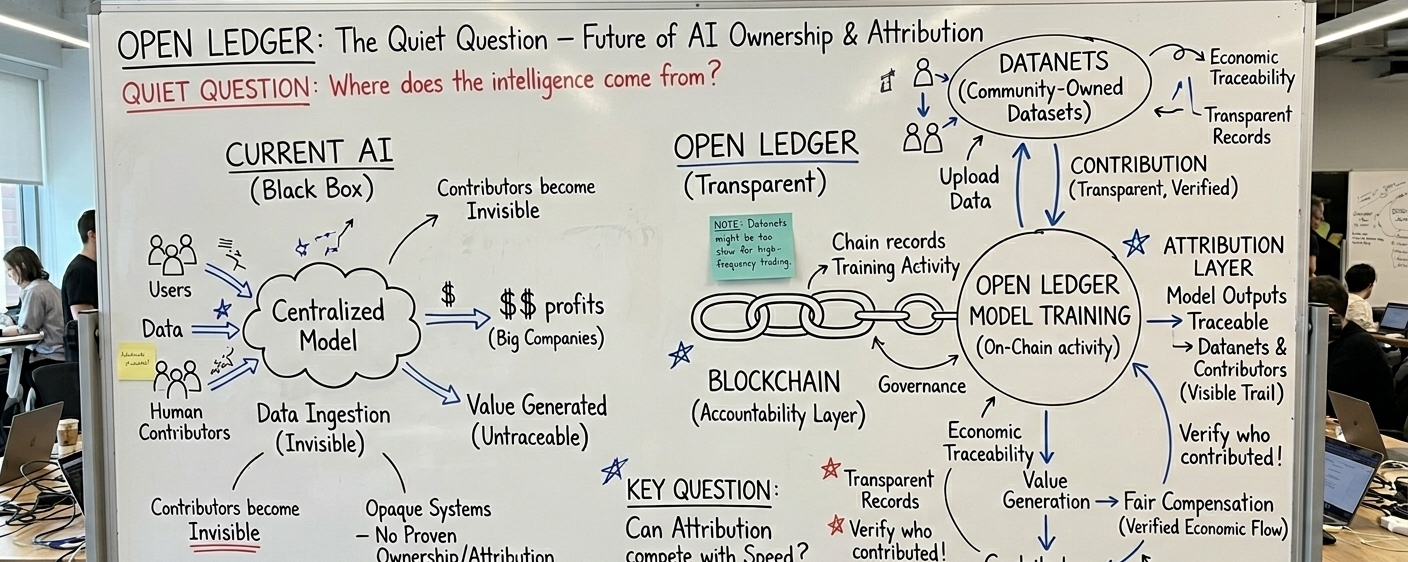
The idea behind OPEN LEDGER is surprisingly simple when you strip away the technical language. Instead of treating AI training like a black box, it creates a system where datasets, model development, contributions, and governance exist transparently on-chain. People can build or contribute to what they call “Datanets,” which are essentially community-owned datasets used for training AI systems.
What interested me most is not just the data contribution itself, but the attribution layer attached to it.
Normally, when an AI model generates value, almost nobody can trace where that intelligence originated from. But OPEN LEDGER is trying to create a structure where model outputs can be linked back to the datasets and contributors involved in training the system. In theory, that means every AI interaction becomes connected to a visible economic trail instead of disappearing into centralized infrastructure.
I think that idea matters more than people currently understand.
Right now, most discussions around AI focus heavily on compute power and scaling. Bigger GPUs. Faster inference. Larger models. But over time, I suspect trust and attribution may become equally important. As AI becomes integrated into finance, research, healthcare, education, and online systems, people will eventually start asking deeper questions.
Where did this model learn from?
Who contributed to its intelligence?
Who deserves compensation when it creates value?
And maybe most importantly, can any of this actually be verified?
This is where the blockchain side of OPEN LEDGER becomes meaningful. The chain is not there just for branding purposes. It acts more like an accountability layer. Contributions, training activity, governance participation, and reward distribution are all recorded transparently instead of being hidden behind private infrastructure.
I also found the governance side interesting because it reflects a broader shift happening in digital systems. Instead of development decisions being fully centralized, OPEN token holders participate in protocol direction through on-chain governance mechanisms. Whether that model works perfectly long term is still an open question, but the attempt itself reflects something important: people increasingly want visibility into how digital systems evolve.
At the same time, I do not think these systems solve everything overnight.
One thing I keep thinking about is whether decentralized AI coordination can realistically compete with the speed and resources of large centralized companies. Open systems are often more transparent, but they can also become slower, fragmented, or difficult to coordinate. Building sustainable incentives around data quality is also extremely hard. Not all data is useful, and measuring contribution fairly across large ecosystems becomes complicated very quickly.
That is why I do not see projects like OPEN LEDGER as instant solutions. I see them more as experiments attempting to solve a problem the industry has not fully confronted yet.
And maybe that is exactly why they matter.
Because the uncomfortable truth is that AI is already reshaping digital economies faster than governance, attribution, and ownership systems can adapt. Most people are still focused on model performance while ignoring the deeper economic structure underneath. But eventually the conversation will move beyond “What can AI do?” toward “Who benefits from what AI does?”
That shift feels inevitable to me.
My view is Simple.
If systems like OPEN LEDGER succeed even partially, we could enter a world where AI development becomes more collaborative and economically traceable. Data contributors may no longer be invisible. Smaller communities could build specialized AI systems around their own knowledge instead of depending entirely on centralized platforms. And users might finally gain visibility into how intelligence itself is produced and monetized.
But if these ideas fail, that also tells us something important. It may reveal that decentralization works better for finance than for AI coordination. Or that attribution at scale is harder than the industry currently assumes.
Either outcome teaches us something valuable about where technology is heading.
And honestly, that is the part I find most interesting.
Not the hype. Not the token charts. Not the short-term narratives.
The real question is whether AI can evolve into a system where trust, contribution, and value distribution remain visible instead of disappearing behind closed infrastructure.
What are we actually building when we combine AI with blockchain?
Do people deserve ongoing ownership when their data helps train intelligent systems?
And if AI becomes part of everyday life, should attribution become as important as computation itself?
I think the industry is Still very early in answering those questions. But projects like OPEN LEDGER are at least forcing the conversation to happen.