

At first I thought the AI race would mostly be about intelligence.
Who has the best model.
Who reaches AGI first.
Who trains faster.
Who raises more capital.
Pretty standard narrative.
But recently I’ve been questioning that entire framing a bit.
Not because intelligence doesn’t matter.
Obviously it does.
But because the deeper AI goes into real-world usage, the more another bottleneck keeps appearing underneath everything:
human contribution.
And honestly… I didn’t expect that realization to hit this hard.
A few weeks ago I was testing several AI products for research workflows and market analysis.
Some felt incredible.
Others felt strangely hollow.
Like they had information…
but no texture.
They could summarize markets but couldn’t really capture behavior.
Could explain sentiment but not timing.
Could imitate expertise without carrying actual lived context.
Hard to explain exactly.
But you feel it after enough usage.
That’s when I started thinking differently about projects like OpenLedger.
Most people still evaluate AI infrastructure through a technical lens.
Model quality.
Inference speed.
Compute access.
Latency.
Architecture.
OpenLedger seems more focused on something less visible:
how intelligence gets sourced in the first place.
That’s a very different layer.
And maybe a harder one.
Because data sounds scalable in theory until you remember humans are involved.
Then suddenly it becomes messy.
People optimize incentives.
Communities form.
Contributors burn out.
Quality fluctuates.
Ownership matters.
Reputation matters.
Well... that's the weird part.
Crypto historically got very good at coordinating capital.
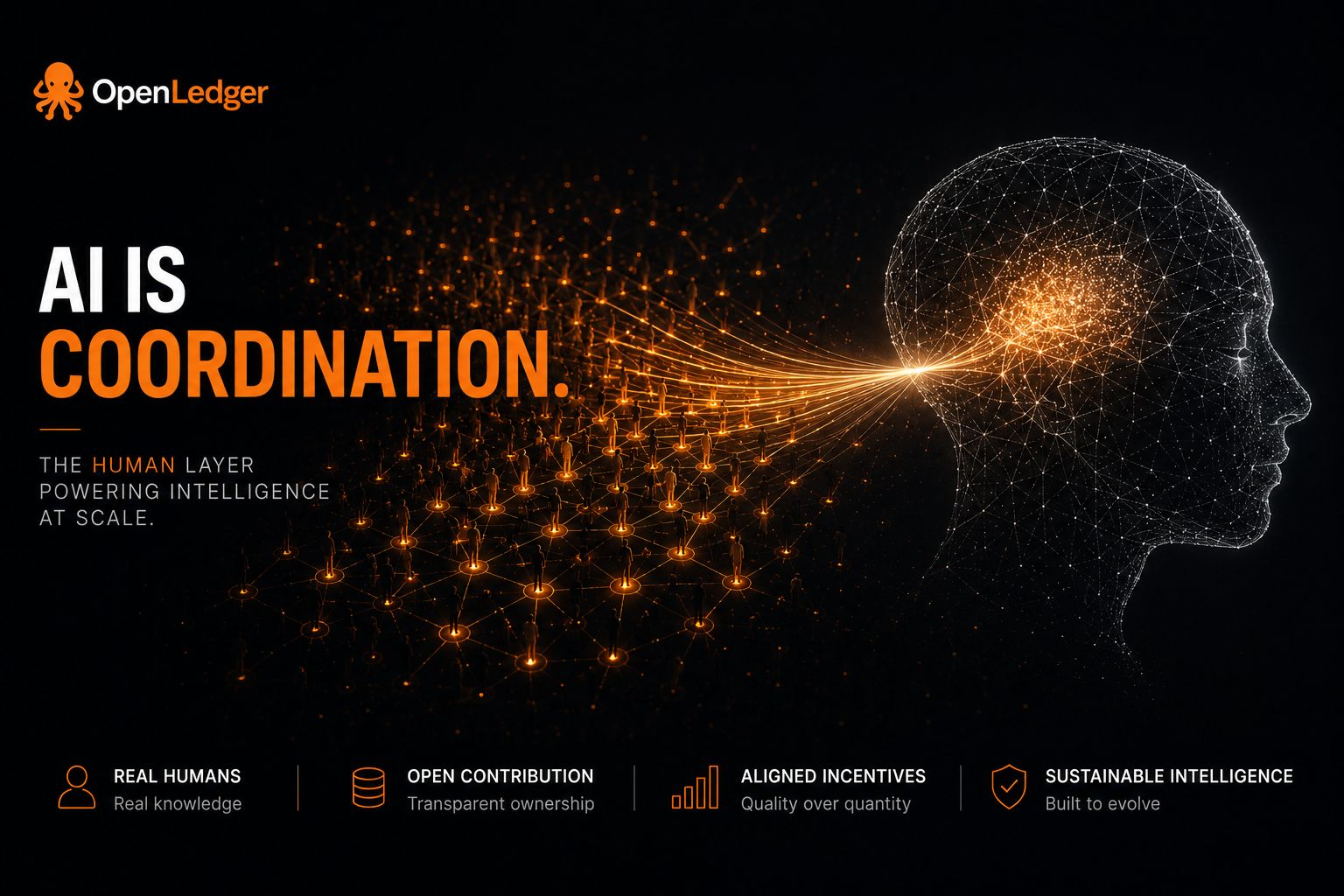
But AI might require coordinating expertise.
Different game entirely.
The more I think about it, the more OpenLedger feels less like a traditional AI protocol and more like an experiment in turning specialized human knowledge into an economic network.
And honestly? I’m not fully sure the market has processed what that means yet.
Because if this direction actually works… it changes the structure of AI competition itself.
Imagine two future AI systems.
One has slightly better models.
The other has access to thousands of continuously updating niche contributors:
traders,
doctors,
lawyers,
engineers,
regional operators,
analysts,
native communities,
supply chain workers.
Who wins long term?
I genuinely don’t know anymore.
A year ago I probably would’ve said the better model wins easily.
Now I’m less certain.
Because models can increasingly be replicated.
Human ecosystems are harder to copy.
Especially when contributors feel economically connected to the system itself.
That emotional layer matters more than people admit.
People contribute differently when they feel ownership.
Wikipedia proved part of this already.
Open source proved part of this.
Crypto communities proved part of this too… sometimes in chaotic ways.
But OpenLedger seems to be exploring whether that coordination can directly feed AI infrastructure itself.
That creates very strange implications.
For example...
what happens when the most valuable AI datasets are no longer static assets owned by corporations, but living networks maintained by incentivized communities?
That feels important.
Also slightly dangerous.
Because incentive systems don’t automatically produce truth.
Sometimes they produce noise optimized for rewards.
I still think that’s one of the biggest unsolved problems here.
Actually maybe the biggest.
The internet already struggles with engagement farming.
Now imagine “knowledge farming.”
Contributors generating optimized outputs just to maximize economic upside.
Synthetic expertise.
Synthetic consensus.
Synthetic intelligence loops.
And honestly... parts of the current internet already feel like that.
That’s why I keep going back and forth mentally on this whole category.
One moment I think decentralized contribution networks could become incredibly valuable.
Next moment I think they could collapse into incentive spam at scale.
Maybe both happen simultaneously.
That possibility keeps bothering me a bit.
Because the future AI stack may not just be a technical competition.
It may become a behavioral competition.
Who designs the healthiest incentive environment?
Who attracts the highest signal contributors?
Who maintains quality without excessive centralization?
Who balances openness with reliability?
Those questions feel bigger now than model benchmarks.
And weirdly… crypto might actually matter more in that world than people expect.
Not because tokens magically fix AI.
They don’t.
But because crypto has spent years experimenting with online coordination systems under economic pressure.
DAOs.
Reputation systems.
Token incentives.
Contribution economies.
Governance structures.
Messy experiments, yes.
But maybe useful preparation.
The more I connect these dots, the more I suspect the future winners in AI may not look like traditional software companies at all.
They may look more like economic ecosystems.
Networks where intelligence emerges from continuous participation instead of centralized accumulation.
And maybe that sounds too abstract right now.
Maybe I’m overthinking it.
But OpenLedger was one of the first projects that made me stop viewing AI purely as a compute race.
Now I keep seeing it as a coordination race instead.
And honestly...
that shift changes a lot @OpenLedger $OPEN #OpenLedger
