
Most AI crypto projects start sounding the same after a while. Every week there’s another protocol talking about autonomous agents, decentralized intelligence, AI economies, or some futuristic system that’s supposedly going to replace everything. But when you look closer, a lot of it feels shallow. Big narratives, vague architecture, and not much underneath besides a token and a roadmap full of promises.
That’s honestly why OpenLedger caught my attention recently.
At first I dismissed it like everyone else probably did. Another AI blockchain project launching into a market already crowded with AI narratives. But the deeper I looked into what they’ve been building over the last few months, the harder it became to write it off as just another trend-driven launch.
What makes OpenLedger interesting isn’t the marketing. It’s the fact that the project seems focused on solving real structural problems that the AI industry is heading straight toward.
The token launch obviously brought attention first. OPEN launched across Binance, Upbit, Bithumb, KuCoin, MEXC, Gate, HTX and several other exchanges almost simultaneously, which almost never happens for a new project unless there’s serious coordination and backing behind it. Binance alone reportedly processed around $182 million in volume during the first day of trading, and the project distributed a 10 million token airdrop at launch. That kind of debut naturally created noise across the market.
But token launches come and go. Crypto has seen hundreds of projects explode for two weeks and disappear six months later. The more important question is whether the actual infrastructure underneath matters once the excitement fades.
That’s where OpenLedger starts separating itself a bit.
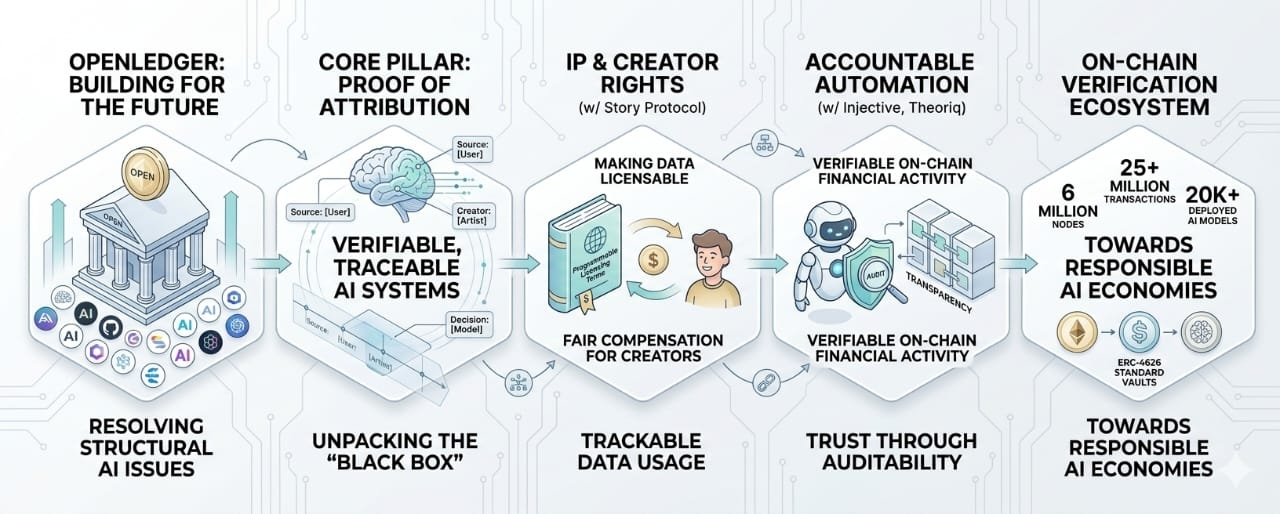
The entire project revolves around something they call Proof of Attribution. It sounds technical at first, but the idea behind it is actually pretty simple. AI systems today operate mostly like black boxes. Models consume massive amounts of data, generate outputs, make decisions, and nobody can fully trace where information came from or why certain outcomes happened. That becomes a massive problem once AI starts handling financial systems, intellectual property, business automation, or anything involving real economic value.
OpenLedger is basically trying to create an attribution layer for AI. A system where datasets, contributors, decisions, and outputs can actually be verified and tracked instead of disappearing inside opaque models.
That might end up becoming way more important than people realize right now.
One of the clearest examples came from their partnership with Injective earlier this year. The goal wasn’t just “AI trading crypto,” because honestly everybody says that now. The interesting part was the attempt to make AI-driven financial activity verifiable on-chain.
That matters because AI agents controlling liquidity or managing trading strategies introduce a trust problem nobody really talks about enough. If an autonomous agent loses money, manipulates liquidity, or makes irrational decisions, how do users actually understand what happened? Traditional AI systems usually can’t provide transparent reasoning trails. OpenLedger’s architecture tries to solve that by recording attribution and decision pathways directly into verifiable systems.
That changes the conversation from blind automation into accountable automation.
And once real capital starts relying on AI systems, accountability becomes everything.
The partnership with Story Protocol might actually be even bigger long term though. Because one of the largest unresolved issues in the entire AI industry right now is intellectual property. Almost every major AI company is facing criticism or lawsuits over training data. Models scrape content from the internet at enormous scale, but creators rarely know whether their work was used, how it was used, or whether they deserve compensation for it.
OpenLedger and Story Protocol built infrastructure designed to solve that problem by making AI training data traceable and licensable. In simple terms, creators can register ownership, licensing conditions become programmable, and AI systems can prove whether they used authorized data sources. If content contributes to model outputs, royalties can theoretically be distributed automatically.
That sounds boring compared to flashy AI demos, but honestly this is the kind of infrastructure that could become foundational later. The entire AI industry is eventually going to collide with copyright law, creator rights, and regulatory pressure. Systems that can provide attribution and transparent licensing may end up becoming necessary rather than optional.
That’s why OpenLedger feels more serious than most projects chasing the AI narrative right now. It’s focused less on spectacle and more on building economic rails around AI systems.
The same pattern shows up again in their partnership with Theoriq. Theoriq develops AI agents capable of participating in DeFi environments, while OpenLedger provides the attribution and audit layer behind those agents. Again, the focus isn’t just automation for the sake of automation. It’s about making autonomous systems accountable when they interact with real financial activity.
That distinction matters a lot more than the market probably realizes today.
Because everybody loves the idea of AI agents running portfolios and optimizing yield until something goes wrong. Once money is involved, transparency suddenly becomes extremely important. Institutions, funds, regulators, and users are not going to trust black-box financial systems forever.
OpenLedger seems to understand that earlier than many other projects.
Even their adoption of ERC-4626 vault standards fits the same broader direction. They’re creating systems where AI can manage yield-bearing strategies inside standardized DeFi vaults while keeping activity auditable. Instead of users blindly trusting automation, the infrastructure is designed so strategy behavior can actually be inspected.
That’s really the recurring theme behind everything they’re building: AI systems that can be verified instead of blindly trusted.
And honestly, that may become one of the defining requirements of the next AI era.
Right now people are still fascinated by the novelty of AI. But over time the conversation is going to shift toward accountability. Governments will demand transparency. Enterprises will require auditability. Creators will demand compensation. Financial systems will require explainability. Nobody is going to comfortably hand over economic infrastructure to systems that operate like mysterious black boxes forever.
OpenLedger seems to be building for that future specifically.
The testnet numbers also suggest the ecosystem activity is at least meaningful enough to pay attention to. Reports mention around 6 million registered nodes, over 25 million processed transactions, and roughly 20,000 AI models deployed on top of the network. Obviously crypto metrics should always be viewed carefully because every project inflates engagement to some extent, but even allowing for exaggeration, the scale still points toward real participation and experimentation happening around the protocol.
And importantly, the activity appears connected to actual infrastructure development instead of pure speculative farming.
That’s probably the biggest reason OpenLedger feels different from many AI crypto projects right now. Most projects are trying to monetize AI hype. OpenLedger looks more like it’s trying to build the accounting, attribution, and verification systems that AI economies might eventually need in order to function responsibly.
Maybe it succeeds. Maybe it doesn’t. Crypto is unpredictable and strong technology alone guarantees nothing.
But if you zoom out and look at where the AI industry is clearly heading, the problems OpenLedger is trying to solve feel very real.
Who owns the data?
Who gets paid?
Can AI decisions be audited?
Can creators verify usage?
Can autonomous systems operate transparently?
Those questions are not going away. If anything, they’re only becoming more important as AI moves deeper into finance, media, business infrastructure, and everyday digital life.
And right now, OpenLedger is one of the few projects in the AI x crypto sector that actually seems focused on building around those questions instead of just using AI as a marketing slogan.
