

Most AI crypto projects are built on a beautiful lie. They promise a decentralized marketplace where you upload a dataset, collect a nice token payout, and watch the ecosystem grow.
Sounds clean. Sounds fair.
But if you are actually deep in the weeds of machine learning architecture, you know it is absolute n0nsense.
Models do not stay static.
They iterate, drift, and morph constantly.
The moment a base model undergoes secondary fine tuning, the whole structure fractures. Let me break down why most tokenized data projects are fundamentally a ticking time bomb and what actually changed onchain recently.
The Data Dilution Trap
The massive exploit nobody in the retail crowd wants to discuss
traditional tokenized marketplaces only reward the ingestion phase.
The Input: You deposit a clean, high-signal data corpus.
The Token Drops: The system mints you a one-off reward coupon.
The Training: The model trains on your knowledge base.
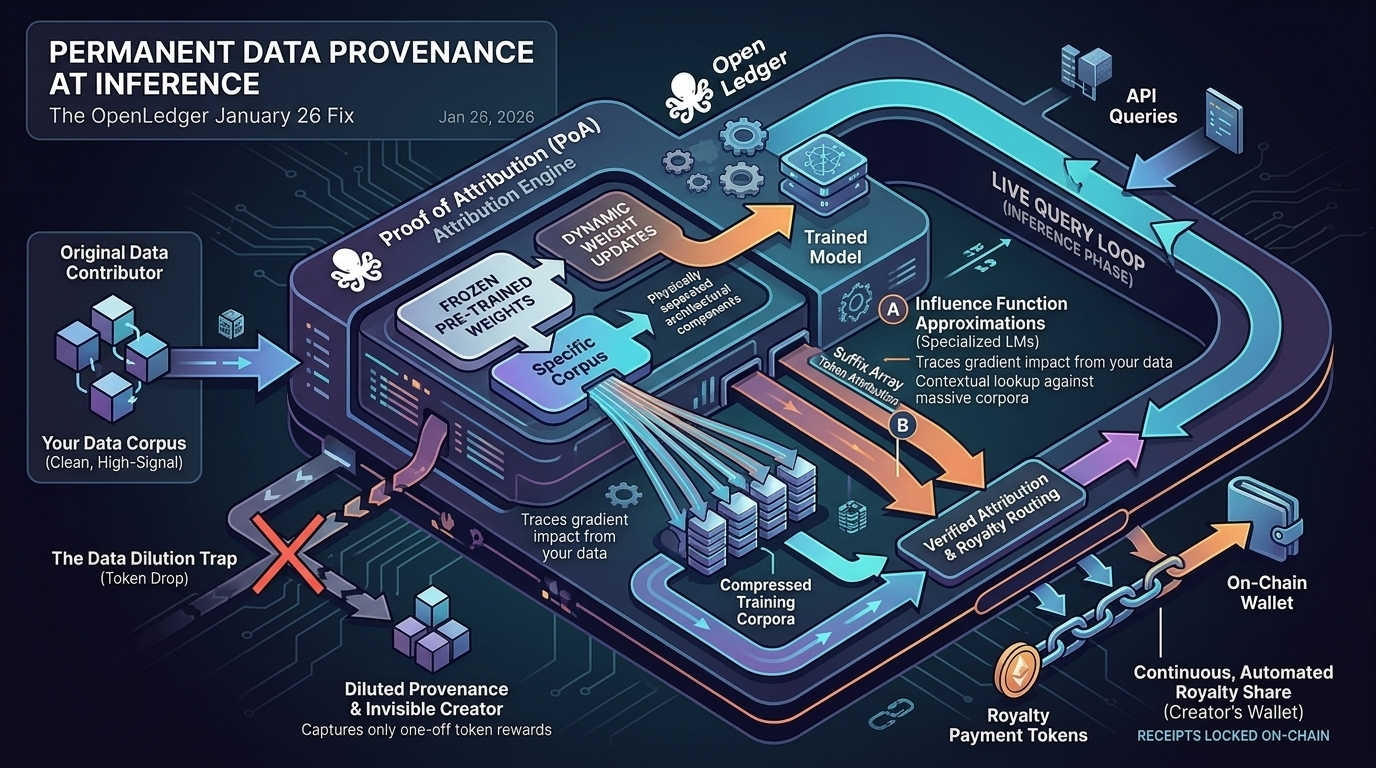
Then a downstream developer comes along.
They take that trained model, apply custom low-rank adaptations, and fine-tune it for a specific corporate niche.
The second that update clears, the original data lineage gets mathematically diluted.
The tracking breaks. The provenance trace disappears.
The downstream platform captures 100% of the recurring inference value, while the original creator is left completely invisible, handed crumbs while the machine digests their digital identity.
If a data network cannot protect ownership across model variations, it is not a sustainable infrastructure layer. It is just a subsidized data extraction trap.
The January 26 Fix: Permanent Provenance Rails
The quiet projects are usually the ones you have to look at closest. On January 26, 2026, OpenLedger quietly deployed an update to its core attribution engine with no loud marketing spaces or hype screenshots.
Just raw engineering targeting the model modification seam.
The update hardcodes Proof of Attribution (PoA) directly into the execution runtimes instead of the static upload layer.
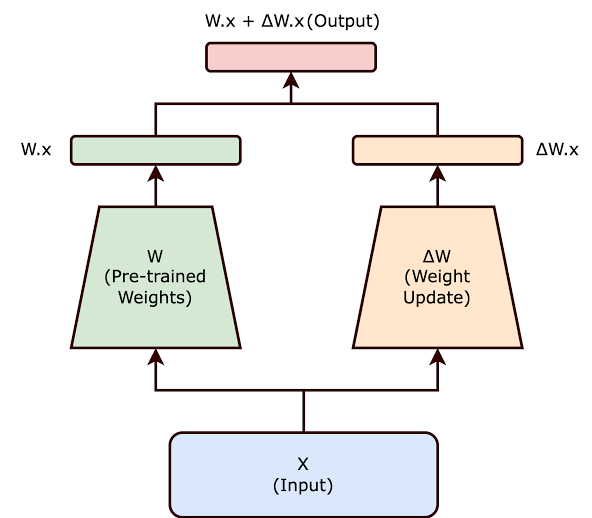
Instead of flattening new behavioral inputs into an untraceable black box, the architecture physically separates the frozen pre-trained weights from the dynamic weight updates.
As seen in the graphic above, the input paths stay distinct.
This allows the system to implement a two-pronged tracking pipeline during live query loops:
Influence Function Approximations: For targeted, specialized language models (SLMs), it traces the exact gradient impact your data pool had on the output.
Suffix Array Token Attribution: For multi-billion parameter architectures, it runs real-time context lookups against compressed training corpora.
The result is that provenance does not fracture when the model drifts.
You are not paid once at training. Instead, you get a continuous, automated royalty share routed to your wallet every single time an API query relies on your contribution footprint.
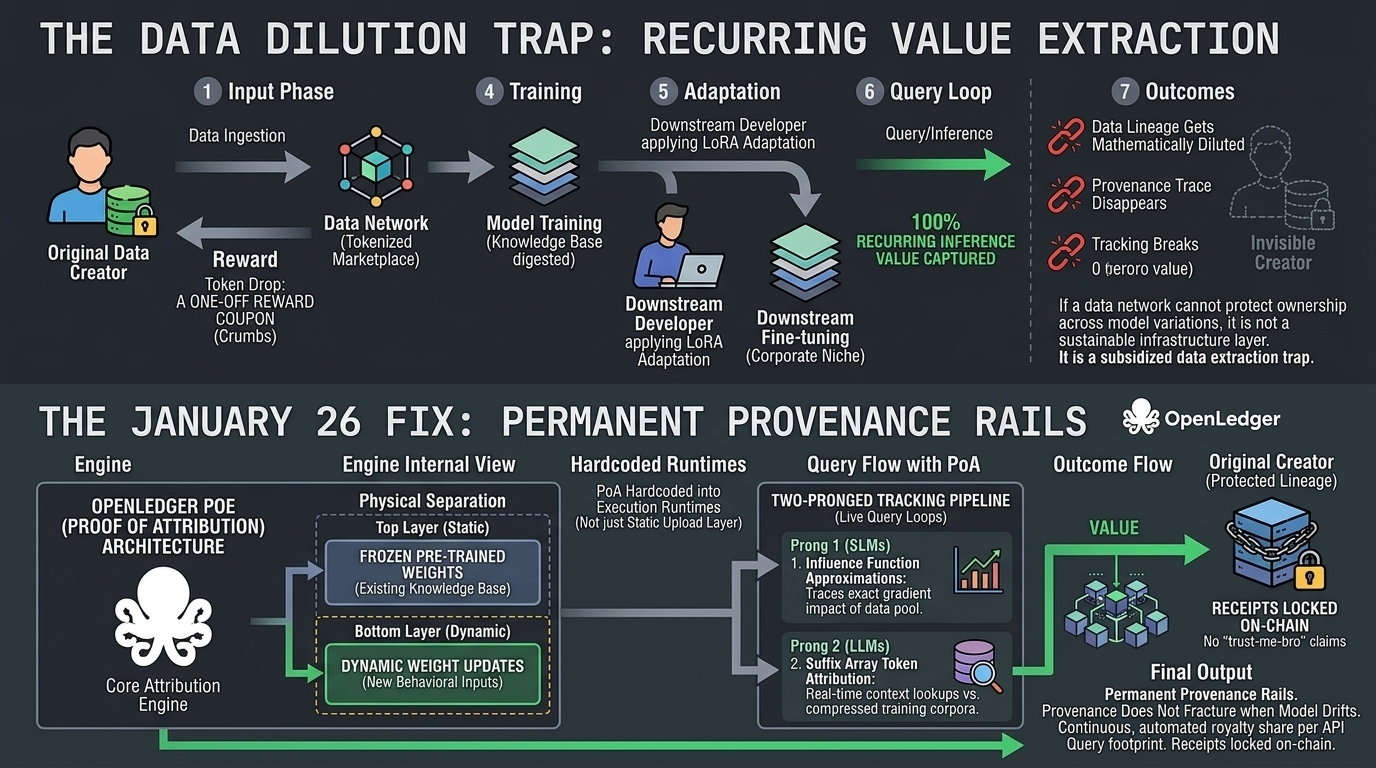
No trust-me-bro claims from a centralized wrapper. The receipts are locked on-chain.
Cold Trader Realism
Look, I am completely indifferent to nice whitepapers. I care about structural numbers.
Right now, $OPEN is hovering around $0.20 with a highly restricted 21.55% circulating launch float out of its 1 billion max supply.
The 24-hour volume sitting near $24M looks decent on a chart, but do not let that fool you.
That is speculative retail activity and node operators carrying over testnet habits.
Most active DataNets are still stuck in Phase 1, circularly seeding datasets and chasing leaderboard rankings.
The economic loop only closes when external developers physically route massive, live production traffic through the Model Factory.
If that organic demand side does not materialize, this is just beautiful engineering sitting alone in an empty room.
But if they successfully onboard real-world builder traffic, the structural tokenomics switch from an inflationary emissions game into a mechanical supply squeeze.
I am not chasing the short-term pump.
PS : I am watching the unglamorous developer adoption logs over the next two quarters, because in the long run, the uncompromised infrastructure layer always wins.
#OpenLedger $OPEN #openledger @OpenLedger
