
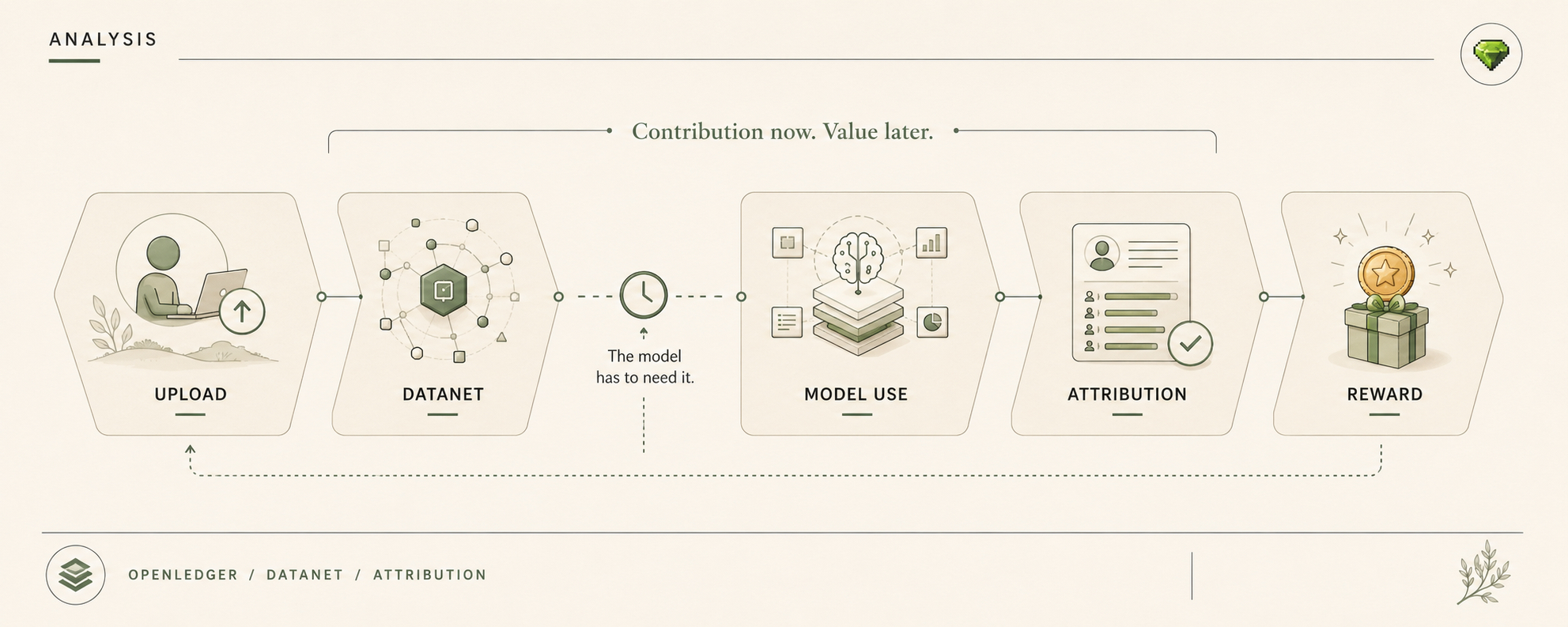


Alright... the longer I sit with @OpenLedger , the more I keep coming back to the same uncomfortable version of it.
Actually...
Not the nice one where AI provenance means people stop pretending model outputs fell out of the sky. Good. That version is real. Centralized AI still makes too many workflows feel like somebody cooked the entire decision in a locked room and then handed everyone else a confident answer with no receipt. OpenLedger is right to push against that.
It gets worse when provenance stops acting neutral and starts deciding who knows what.
Because tracing an output is one thing.
Letting one side keep the richer model context while the other side only gets an attribution path is something else.
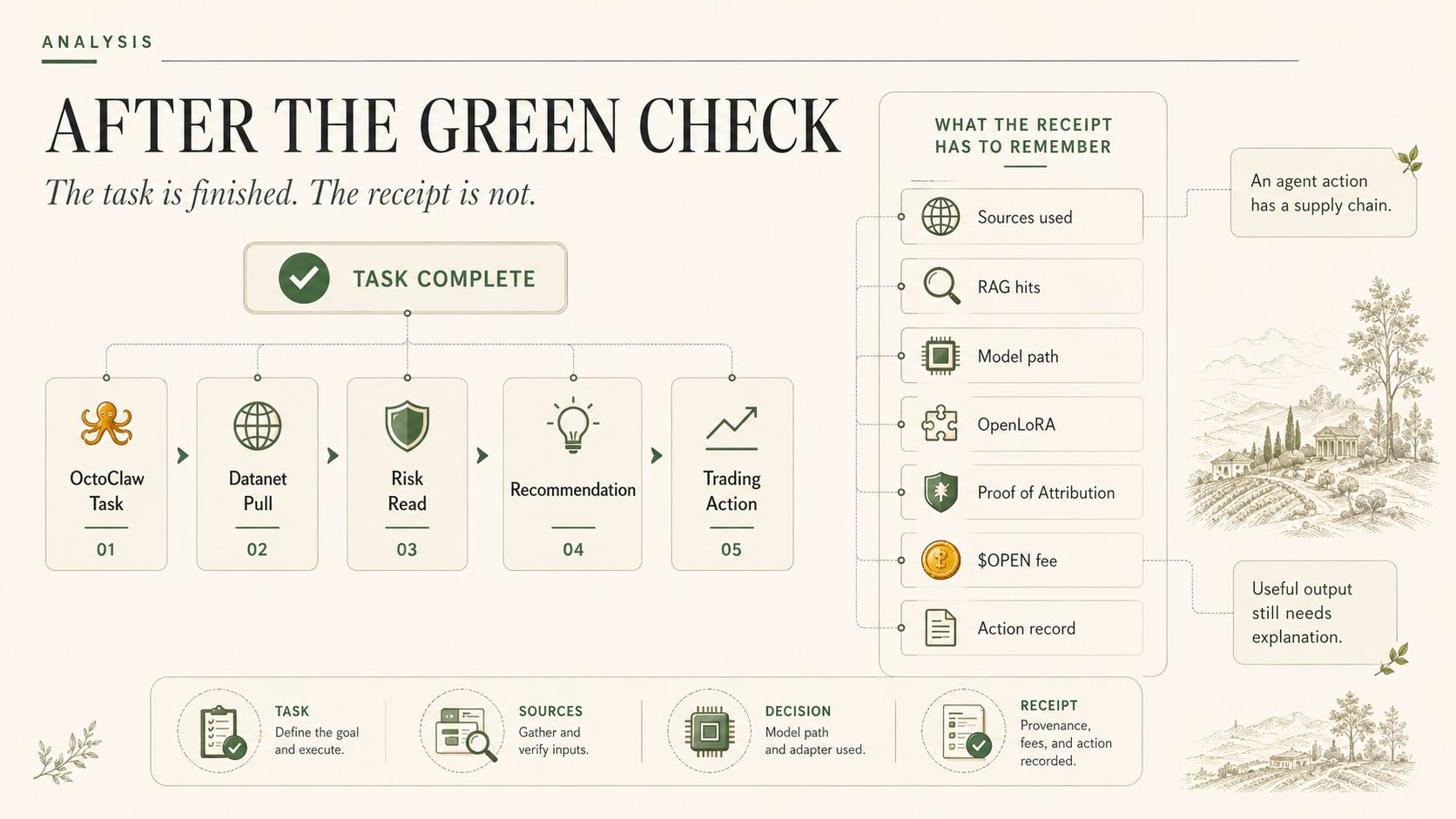
Thats not always abuse. Not even close. Sometimes it is exactly the right design. Datanet sources stay organized. Model lineage gets tracked. PoA shows which contribution shaped the output. $OPEN rewards can move toward the people who actually added value. Fine.
Still leaves a very old market problem sitting there in better clothes.
Who actually knows more here?
Who saw the thin part of the Datanet?
Who knows the OpenLedger's OpenLoRA adapter was tuned around a narrow slice?
Who is being asked to trust the trace without enough context to know what the output is really leaning on?
That is where, I think, OpenLedger stops being just an AI provenance story and starts feeling like bargaining power.
Apart from everything, if we talk about OpenLedger's octoclaw...
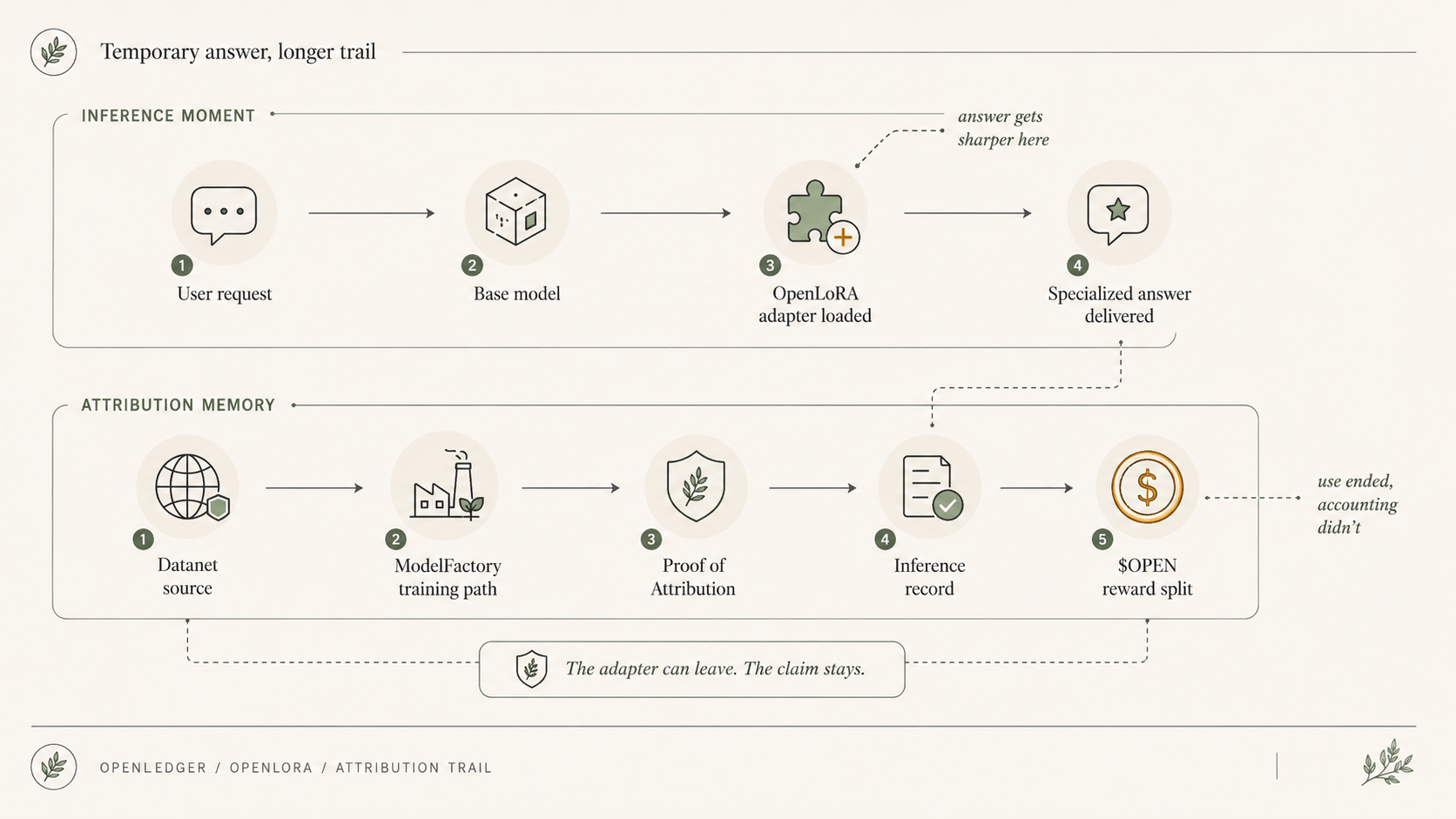
Take a trading agent or treasury workflow. One side can show that the output came through a traceable path. Datanet source, ModelFactory deployment, OpenLoRA adapter, PoA trail, whatever version of yes, this output has lineage the system needs. OpenLedger can make that possible without forcing everyone to guess where the answer came from. Good use case. Good reason for the infrastructure to exist.
But now one side still lives with the fuller internal picture. The composition of the dataset. The weak region of the source pool. The adapter that almost failed evaluation but still shipped. The market signal that barely cleared the action threshold. The context around why the output looked acceptable.
The other side gets the trace and a smaller story.
Maybe that’s enough.
Maybe.
Markets are not usually that charitable.
Because one party having materially richer context than the other is not some theoretical discomfort. It changes how people size, hedge, delay, trust, discount, route, or walk away. You do not need a black box for that to matter. You just need one side knowing where the model got fragile and the other side getting told the output technically has provenance.
Great.
I have seen enough systems do this in less elegant ways already. OpenLedger just makes it cleaner. That’s the part people skip.
Provenance can absolutely reduce AI opacity. It can also harden asymmetry into the product design itself. Not by accident either. By design. One side keeps the operational context because it has to, supposedly. The other side gets a PoA path, maybe a contribution trail, maybe a confidence sentence if they complain enough.
And the whole thing still gets sold as trust-minimized because the lineage was verifiable.
That’s a little too neat for me.
Say a counterparty is looking at some OpenLedger-backed agent output and gets told: the Datanet was valid, the model path was traceable, the contribution was attributed, the system verified the route. Fine. But the builder still knows whether the source pool was deep or thin. They know whether the OpenLoRA adapter was strong or just barely acceptable. They know whether the agent output came from a robust signal or a technically usable one.
That difference matters.
A lot, actually.
I have watched the other side hear “traceable” and still price like “uncertain.”
Because if one side keeps the richer context, then provenance is no longer just protecting users from black-box AI. It is also deciding who gets informational depth and who gets procedural reassurance instead.
And yes, those are different things.
One side gets to think in gradients.
The other side gets a lineage path.
One side sees the near-miss.
The other sees attributed.
One side knows what uncertainty got compressed to produce the clean output.
The other gets told the clean trace is the trust answer.
That's not fraud.
Doesnt have to be.
Still not symmetrical.
And the market will feel that even when it cannot articulate it cleanly. A user will ask for more cushion. A desk will quote wider. A partner will move slower. A builder will decide the PoA trail is technically fine and still not enough to treat the output like they would if the context were distributed more evenly.
Thats where OpenLedger gets more interesting to me than the usual AI transparency cheerleading.
Not whether the output can be traced.
Whether the trace quietly gives one side enough context to negotiate, price, or time the interaction better while the other side is left with enough information to proceed and not enough to feel fully comfortable about why.
And once that becomes normal, provenance starts shading into information asymmetry with better branding.
That’s the ugly version.
Not because OpenLedger failed. Because it worked. The Datanet stayed legible. The model path stayed traceable. PoA did what it was supposed to do. The attribution trail stayed clean. The public story got less stupid than centralized AI's usual black-box nonsense.
And one side still walked away knowing a lot more than the other.
Enough more that it changes the relationship, even if everyone keeps pretending the trace made things clean.