Most people still talk about AI like it’s only a model race.
Bigger models. Faster inference. More agents. Better automation.
But after watching the AI sector evolve over the last year, I think the more important battle is starting somewhere else entirely.
Ownership.
Not ownership in the usual crypto sense where every project suddenly turns something into a tokenized narrative. I mean actual ownership of contribution inside AI systems.
Because right now the entire AI economy runs on invisible labor.
Millions of people create the data. Conversations. Research. Code. Feedback loops. Niche expertise. Human correction. Domain-specific knowledge. Cultural context.
Then centralized systems absorb all of it into training pipelines where attribution basically disappears forever.
The value compounds upward.
The contributors disappear downward.
That imbalance is starting to matter more as AI becomes infrastructure instead of novelty.
And honestly, that’s the reason @OpenLedger caught my attention recently.
Not because it’s another “AI x blockchain” headline.
Mostly because it seems focused on something deeper than hype cycles: making intelligence economically traceable.
$OPEN #OpenLedger
AI Is Entering Its “Data Legibility” Era
One thing that feels increasingly obvious now is that the AI industry cannot scale forever on black-box economics.
We already see pressure building from multiple directions:
copyright disputes
regulatory scrutiny
enterprise audit requirements
model provenance concerns
synthetic data contamination
distrust around AI-generated outputs
The industry spent years optimizing capability.
Now it may need to optimize accountability too.
That changes the conversation completely.
The question stops being:
“How smart is the model?”
And slowly becomes:
“Can we verify where intelligence came from?”
That distinction matters more than most people realize.
OpenLedger seems built around this exact transition.
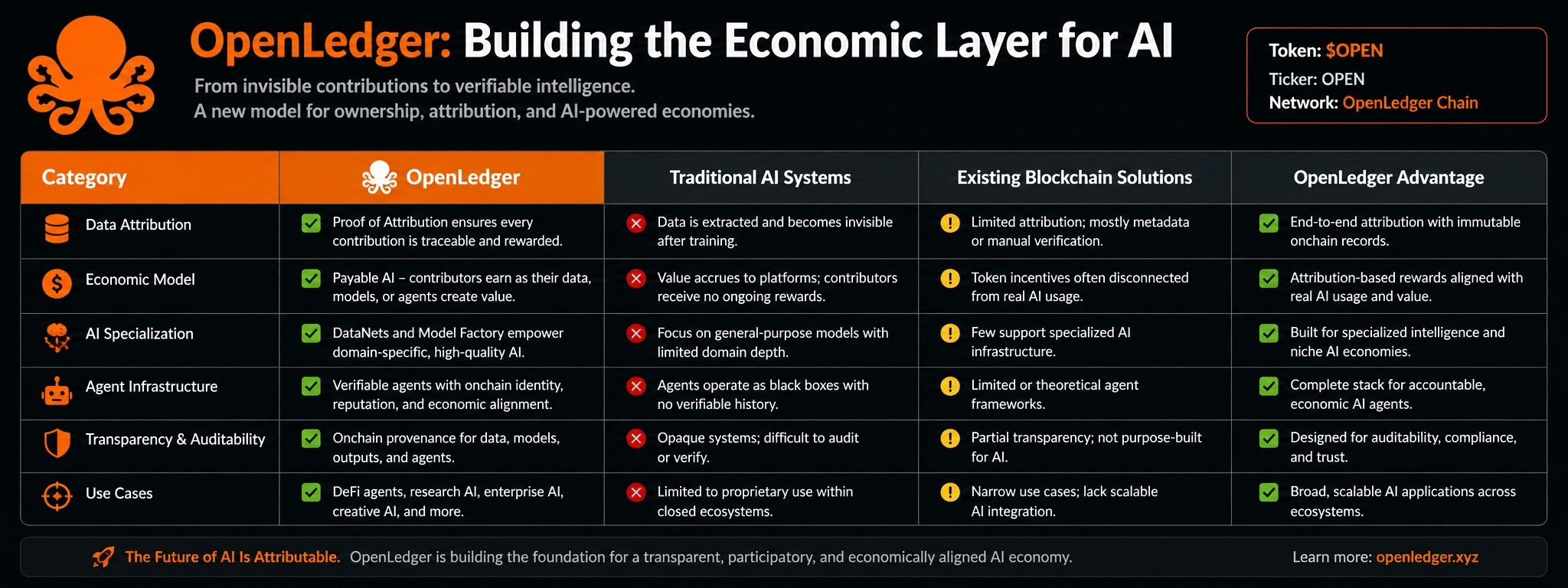
The project describes itself as an AI-native blockchain focused on making data, models, and autonomous agents verifiable, attributable, and economically connected onchain. (Openledger)
At first glance that sounds abstract.
But the implications become interesting once you think about where AI markets are actually heading.
The Hidden Problem Inside AI Today
Most AI systems work like extraction engines.
Data goes in.
Models generate value.
Platforms monetize outputs.
But contributors rarely remain connected to downstream economics.
This creates a strange contradiction:
AI depends entirely on collective intelligence while rewarding only infrastructure owners at scale.
That may work early in a technological cycle.
It becomes harder once specialized intelligence becomes the real bottleneck.
And that is where OpenLedger’s architecture feels different.
The core idea behind its “Proof of Attribution” system is that contributions to AI systems should remain measurable and traceable over time. (Binance)
Instead of data becoming invisible after ingestion, attribution layers attempt to track which datasets influence outputs and route rewards accordingly.
Not theoretically. Economically.
That changes AI from a static ownership model into a continuously attributable system.
Honestly, this feels closer to how future AI economies may need to operate.
Because the next generation of AI probably won’t be dominated only by giant generalized models.
It will likely depend heavily on domain-specific intelligence.
Medical data. Legal reasoning. Financial workflows. Scientific datasets. Regional language systems. Specialized research layers.
And specialized intelligence only works if contributors remain incentivized to keep participating.
Without attribution, that loop eventually breaks.
Specialized AI May Become More Valuable Than General AI
This is another part of the OpenLedger thesis I think people are underestimating.
The market spent years assuming larger general-purpose models automatically win.
But increasingly, specialized models seem economically stronger in many real-world environments.
A medical AI does not need infinite internet knowledge.
It needs highly accurate domain expertise.
A trading agent does not need philosophical reasoning.
It needs structured financial context and execution precision.
A legal AI does not need to generate poetry.
It needs verified legal datasets and traceable reasoning paths.
OpenLedger leans heavily into this “specialized intelligence” direction through what it calls DataNets and model infrastructure for domain-specific AI systems. (Binance)
That feels important because specialized AI introduces a very different economic structure than generalized AI.
The scarce asset stops being raw compute alone.
The scarce asset becomes trusted domain data.
And trusted domain data is difficult to source without incentive alignment.
This is where blockchain infrastructure suddenly starts making more sense for AI.
Not because “everything should be onchain.”
But because attribution, ownership history, auditability, and programmable incentives are native strengths of blockchain systems.
The Agent Economy Needs Trust Infrastructure
A lot of people are now talking about AI agents becoming autonomous economic actors.
Trading agents. Research agents. Workflow agents. Coordination agents.
But there’s a hidden issue inside that future.
How do you verify whether an agent is reliable?
How do you know where its reasoning came from?
How do you audit what datasets shaped its behavior?
How do you compensate the contributors whose information made the agent useful?
Most current AI systems still operate like sealed black boxes.
That becomes dangerous once agents start managing capital, coordinating markets, or interacting with financial systems.
OpenLedger appears increasingly focused on this exact infrastructure layer.
The project’s roadmap references verifiable agents, attribution systems, programmable AI economics, and onchain identity layers for models and autonomous systems. (Chainwire)
That is interesting because the future AI stack may not only need intelligence.
It may need auditability.
Especially once autonomous systems start interacting with money.
And honestly, crypto markets are probably one of the first places where this transition becomes obvious.
Because DeFi moves too quickly for purely manual execution already.
Why This Matters for DeFi Specifically
DeFi has quietly become an ideal environment for AI agents.
Markets run 24/7.
Liquidity constantly rotates.
Yield opportunities decay quickly.
Risk conditions change in real time.
Manual users increasingly struggle to maintain edge.
That naturally creates demand for intelligent execution systems.
But once agents begin handling capital allocation, leverage management, liquidity routing, and strategy automation, trust becomes extremely important.
Not just performance.
Trust.
Because nobody wants opaque autonomous systems making financial decisions without accountability layers.
This is where OpenLedger’s broader “Payable AI” framework becomes interesting.
The idea is not simply automating intelligence.
It is creating economic systems where intelligence itself remains attributable, measurable, and reward-aligned. (Openledger)
That may sound subtle.
I don’t think it is.
It could become foundational.
OpenLedger Feels More Focused on Infrastructure Than Narrative
A lot of AI crypto projects still market abstraction.
Infinite AI economies. Autonomous everything. Fully agentic futures.
OpenLedger feels more grounded in infrastructure design.
The ecosystem includes components like:
Proof of Attribution
DataNets
Model Factory
OpenLoRA
attribution-based rewards
verifiable model provenance
agent infrastructure
onchain contribution tracking
(Binance)
The interesting thing is that none of this optimizes particularly well for short-term hype.
Infrastructure rarely does.
But infrastructure tends to matter later when industries scale.
And AI feels like it is entering that phase now.
The industry is moving from experimentation toward coordination problems.
Who owns the data?
Who gets compensated?
Which models are trustworthy?
How do contributors remain economically aligned?
How do autonomous systems remain auditable?
These are not side questions anymore.
They increasingly look like core market structure questions.
The Bigger Shift May Be Economic, Not Technical
One thing I keep coming back to:
AI’s biggest transformation may not actually be intelligence itself.
It may be the restructuring of economic relationships around intelligence.
Today, AI is largely extractive.
Tomorrow, AI may become participatory.
Meaning contributors remain attached to value creation instead of disappearing behind centralized systems.
That shift changes incentives completely.
If contributors can continuously monetize useful data, models, workflows, or domain expertise, AI ecosystems start behaving less like closed corporations and more like open economies.
OpenLedger’s architecture appears designed around that possibility. (Openledger)
Not just “AI on blockchain.”
But AI as an attributable economic network.
That distinction matters.
Why Attribution May Become More Important Than Scale
The AI industry still acts like scale solves everything.
More compute. More parameters. More data.
But over time I suspect attribution becomes equally important.
Because intelligence without traceability creates friction.
Especially in:
finance
healthcare
law
enterprise systems
governance
autonomous execution
institutional adoption
Institutions do not only care whether AI works.
They care whether it can be audited.
That is a completely different requirement.
And honestly, most current AI systems are not built for that world.
OpenLedger seems to be positioning itself directly into this gap.
A blockchain optimized for transparent AI economics instead of only speculative narratives.
Whether the market fully understands that yet is another question.
Final Thoughts
I don’t think OpenLedger is interesting because it promises “AI magic.”
The more interesting part is that it recognizes something the market is slowly waking up to:
The future AI economy probably cannot remain opaque forever.
As AI systems become more financially integrated, autonomous, and economically powerful, attribution stops being optional.
It becomes infrastructure.
And the projects building attribution layers early may end up controlling extremely important parts of the AI stack later.
That does not guarantee success for OpenLedger.
But it does place the project inside a very relevant long-term lane.
The transition from:
closed intelligence → accountable intelligence
extractive AI → participatory AI
black-box models → attributable systems
passive infrastructure → economic coordination layers
feels increasingly inevitable.
And honestly, that is why I think @OpenLedger is becoming one of the more intellectually interesting AI infrastructure projects to watch right now.
Not because it is loud.
Because it is focused on a problem the industry probably cannot ignore forever.