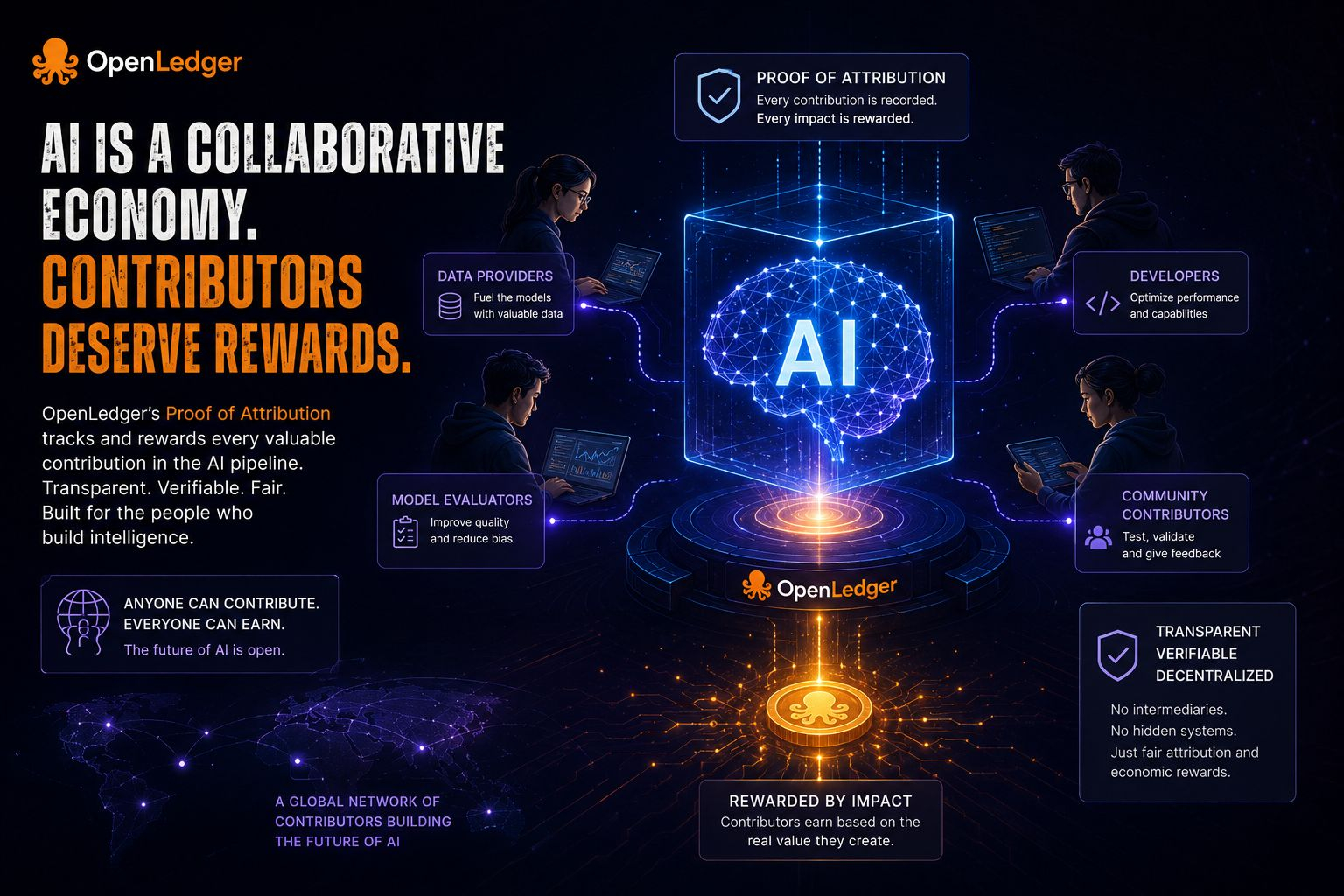
The AI industry runs on contributions from millions of people, but most of them never get recognized.
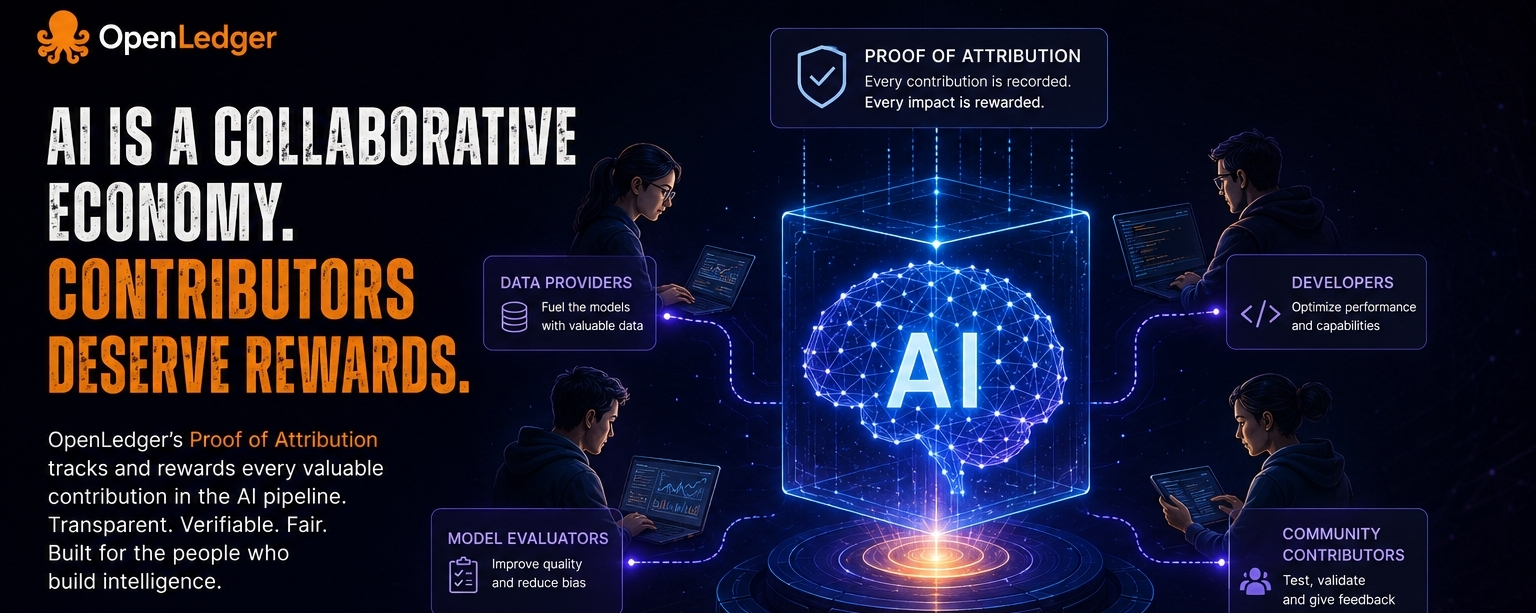
Data providers train the models. Evaluators improve outputs. Developers optimize performance. Communities test products before launch. Yet the value created by these contributors is usually absorbed by centralized platforms that control the infrastructure, the monetization, and the attribution.
That’s one of the biggest flaws in today’s AI ecosystem.
OpenLedger approaches this differently through Proof of Attribution, a system designed to track and reward contributions across the AI lifecycle. Instead of treating data and model improvement as invisible labor, it turns them into measurable on-chain contributions tied to economic value.
This changes the relationship between people and AI.
Contributors are no longer just users feeding systems for free. They become participants in the network itself. If someone provides valuable data, improves model quality, or helps optimize performance, their impact can be recorded and rewarded transparently.
The interesting part is that this creates an open participation layer for AI development.
You don’t need to own massive infrastructure or work inside a closed corporation to contribute. Independent researchers, niche communities, domain experts, and smaller builders can all take part and earn based on the value they add. That creates a much more scalable and collaborative ecosystem compared to the current model where a few centralized entities capture most of the upside.
Proof of Attribution also introduces accountability.
In traditional AI systems, tracing where intelligence comes from is almost impossible. Data sources are vague, ownership is blurred, and contributors disappear behind the platform. With attribution recorded on-chain, the creation process becomes transparent. Contributions can be verified, tracked, and connected directly to outcomes.
That matters because AI is becoming infrastructure.
The systems being built today will shape search, finance, healthcare, entertainment, and digital interaction itself. If the foundation of AI remains closed and extractive, the imbalance between contributors and platforms only grows larger over time.
OpenLedger’s model pushes toward a different future — one where AI becomes a collaborative economy instead of a centralized black box.
The next phase of AI may not belong to the companies with the biggest servers.
It may belong to the networks that reward the people making intelligence possible in the first place. @OpenLedger #OpenLedger $OPEN