
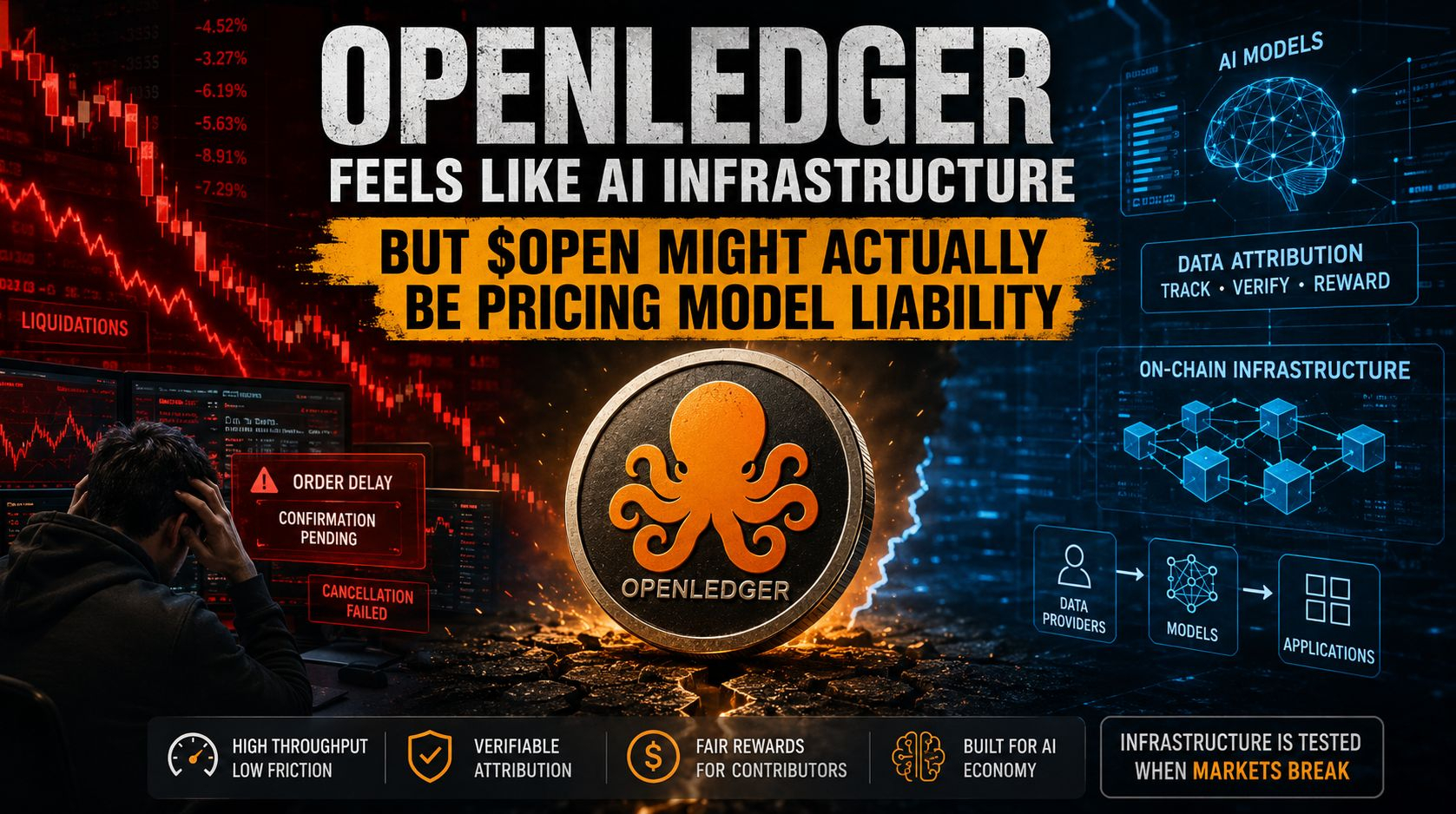
I’ve traded through enough liquidation cascades to stop caring about narratives before I care about execution
The part most people remember is the candle. I remember the delay
I remember canceling a perp position during a volatility spike and watching the order sit there for another two seconds while the market moved against me anyway. I remember signing transactions during gas spikes only to realize the cheap hedge became expensive after latency and slippage stacked together. I remember fills disappearing because the chain itself could not keep up with trader behavior once panic entered the order flow
That’s usually where I start paying attention to infrastructure projects
Not because I think infrastructure coins automatically become good investments. Most do not. But when you spend enough time inside fast markets you start noticing how much trader psychology is shaped by invisible system friction
That’s why OpenLedger caught my attention
Not because of the AI narrative The market already has enough AI narratives. What interested me was the idea that OpenLedger is trying to treat data attribution and AI execution like infrastructure instead of branding
Honestly I think the market is still trying to decide whether OPEN should be priced like a utility layer or like a liability attached to model economics
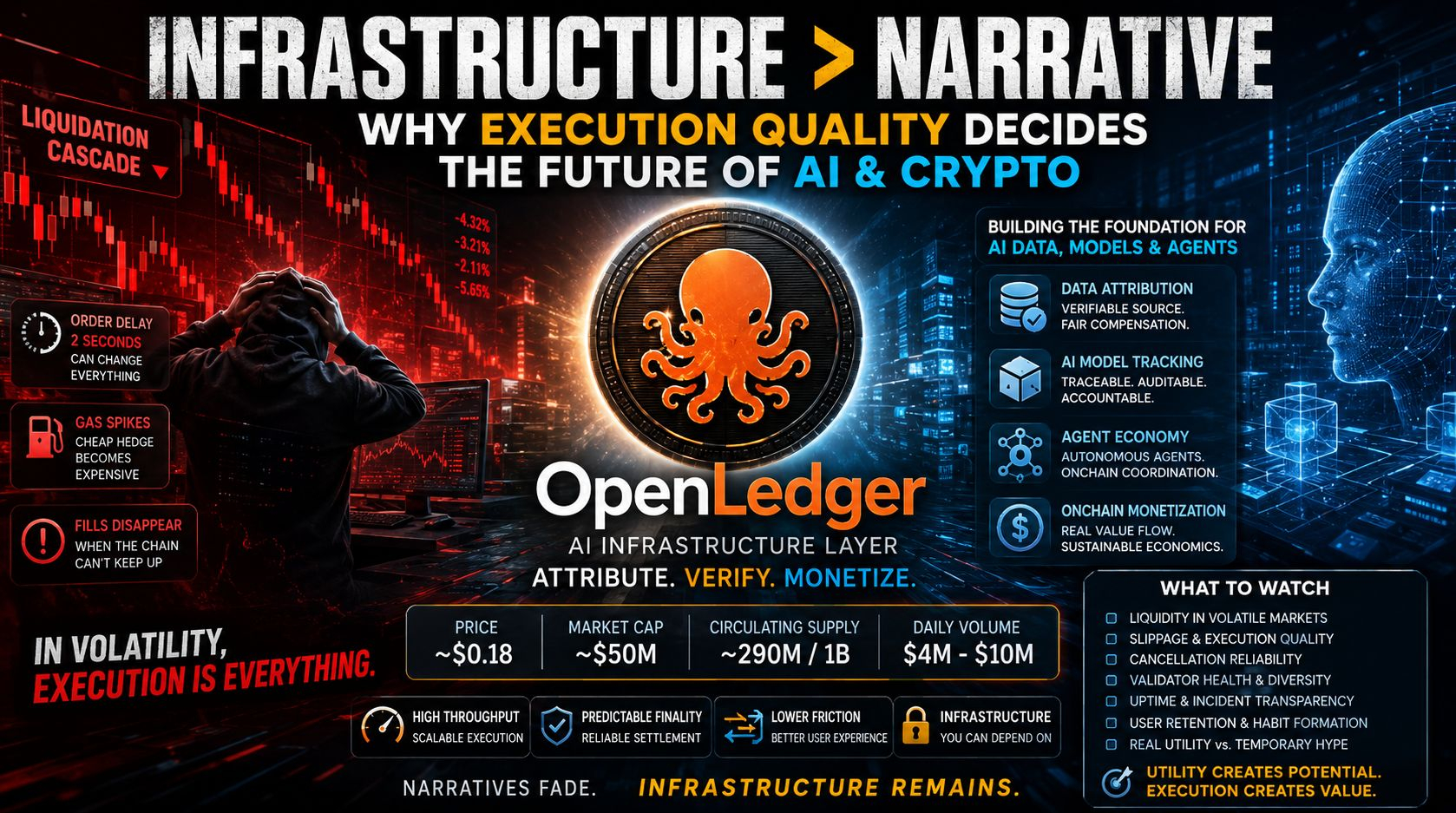
Right now OPEN is trading around the low 0.18 dollar area with daily volume fluctuating between roughly 4 million and 10 million dollars depending on market conditions. Circulating supply sits around 290 million tokens out of a 1 billion max supply with market capitalization hovering near the 50 million dollar range according to major tracking platforms like CoinMarketCap and CoinCodex
None of that is inherently bullish or bearish to me.
What matters more is whether liquidity remains stable when conditions get ugly
Because projects always feel smooth when volatility is low
The real test happens during stress
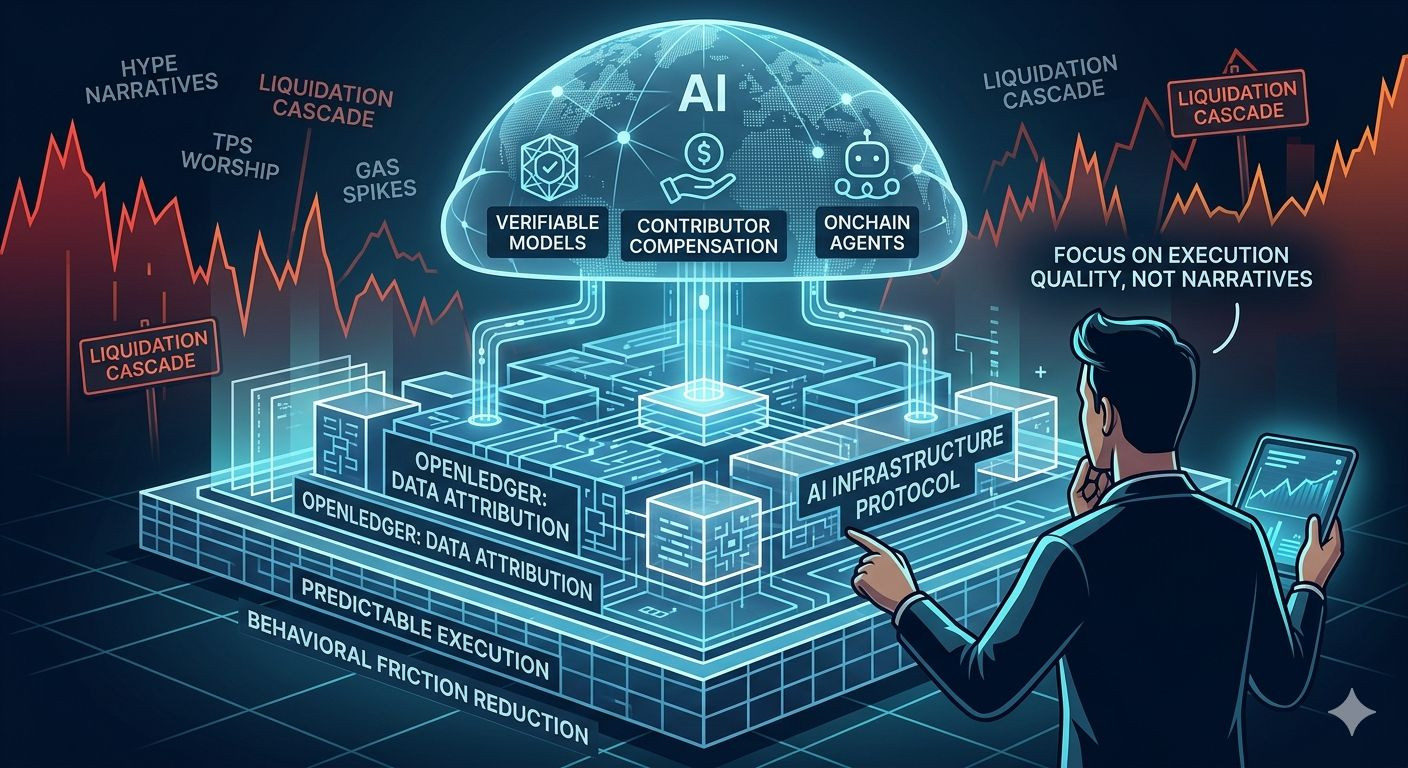
From what I’ve seen OpenLedger is basically trying to build an AI focused blockchain where datasets models and agents can be tracked attributed and monetized directly onchain. In practical terms they are trying to solve a problem that keeps growing inside AI systems. Nobody really knows where the underlying data came from who contributed value or how compensation should flow once models become commercially useful
That sounds abstract until you think about it like a trader
Markets price certainty
If AI models are built on unverifiable or unattributed data pipelines then eventually somebody absorbs legal operational or economic risk. The interesting thing about OpenLedger is not the AI branding itself. It is the attempt to turn attribution into infrastructure instead of policy
That matters because infrastructure changes behavior more effectively than promises do
The chain architecture itself is designed around high throughput coordination between data providers models and applications. Like most modern chains the pitch includes faster execution scalable validation and lower friction between interactions. But I’ve learned not to worship TPS numbers anymore
A chain claiming massive throughput means nothing if execution quality breaks under emotional conditions
I care more about whether cancellation requests remain reliable during volatility I care whether finality stays predictable when users rush exits simultaneously I care whether the validator structure introduces hidden fragility
That’s where the conversation becomes more interesting
Because every fast chain makes tradeoffs somewhere
Usually it is decentralization
Sometimes it is validator concentration Sometimes it is geographic clustering. Sometimes it is reliance on a smaller set of infrastructure operators than the marketing suggests. The uncomfortable reality is that performance optimization almost always introduces dependency somewhere inside the stack
And traders eventually discover those dependencies the hard way
If validator participation becomes too concentrated then uptime risk stops being theoretical. If network coordination depends heavily on a small infrastructure subset stress events become harder to model. Most traders do not think about this during green candles. They think about it when withdrawals slow down or confirmations lag during liquidation events
That’s why I do not evaluate infrastructure chains based on peak performance metrics
I evaluate them based on behavior degradation
How ugly does the experience become once fear enters the market
Because fear is the real stress test
The broader DeFi ecosystem still has a retention problem nobody likes admitting. Most users do not leave because they suddenly stop believing in decentralization. They leave because friction compounds.
Repeated signing requests
Gas unpredictability
Execution hesitation
Bridging confusion
Lag during volatility
Tiny delays that slowly retrain users into avoiding interaction altogether
People underestimate how much behavioral damage bad UX creates inside financial systems
A trader who misses two exits because confirmations lag starts reducing size Then they stop using the protocol entirely Eventually liquidity migrates somewhere emotionally safer
That’s where OpenLedger’s design philosophy actually becomes relevant to me
If attribution AI execution and application interaction can happen with less operational friction then the protocol has a chance to create habitual usage instead of speculative attention. Habit matters more than hype
Because narratives rotate every quarter
Behavior sticks longer
A realistic scenario looks something like this
Bitcoin drops 4 percent in twenty minutes after macro headlines hit. Perp funding flips negative almost instantly. Altcoins begin unwinding harder than expected. Open interest starts collapsing across exchanges Liquidations cascade through overleveraged longs. Spreads widen.
This is the environment where infrastructure stops being invisible
You are trying to reduce exposure quickly while also rotating into a hedge position Your cancellation request matters Confirmation speed matters. Slippage matters. Even interface responsiveness matters because hesitation compounds emotionally once volatility accelerates
If the system introduces uncertainty traders freeze
And freezing gets expensive fast
Projects like OpenLedger seem to understand that infrastructure quality is psychological as much as technical Lower friction changes decision making behavior Predictable execution changes sizing confidence. Reliable settlement changes participation frequency
But there is still an open question the market has not fully answered
Does AI infrastructure create durable token demand or does value eventually leak toward the application layer instead
That’s the part I still watch carefully
Because building useful infrastructure and capturing sustainable token value are not the same thing
Going forward these are the things I would actually monitor instead of getting distracted by headlines
Liquidity quality during volatile sessions
Slippage behavior when volume spikes suddenly
Order cancellation reliability during stress
Validator churn and concentration trends
Uptime consistency
Incident history transparency
Whether users repeatedly come back because interaction genuinely feels smoother
And most importantly whether the protocol creates behavior change instead of temporary attention
That’s the difference between infrastructure people speculate on and infrastructure people quietly depend on
My approach with projects like this stays simple
I verify metrics independently I read validator documentation I test transactions personally I paper trade interactions before committing size. I watch how systems behave during emotionally unstable market conditions because that’s where truth usually leaks through
Narratives can attract liquidity for a while
Execution quality decides whether it stays
My current view on OpenLedger is pretty balanced. I think the project is targeting a real problem around AI attribution and infrastructure coordination. I also think the token market still has not fully figured out how to price that kind of utility rationally There is potential there but there is also meaningful execution risk both technically and economically
And honestly that uncertainty is probably more realistic than pretending the market already knows exactly what this becomes