
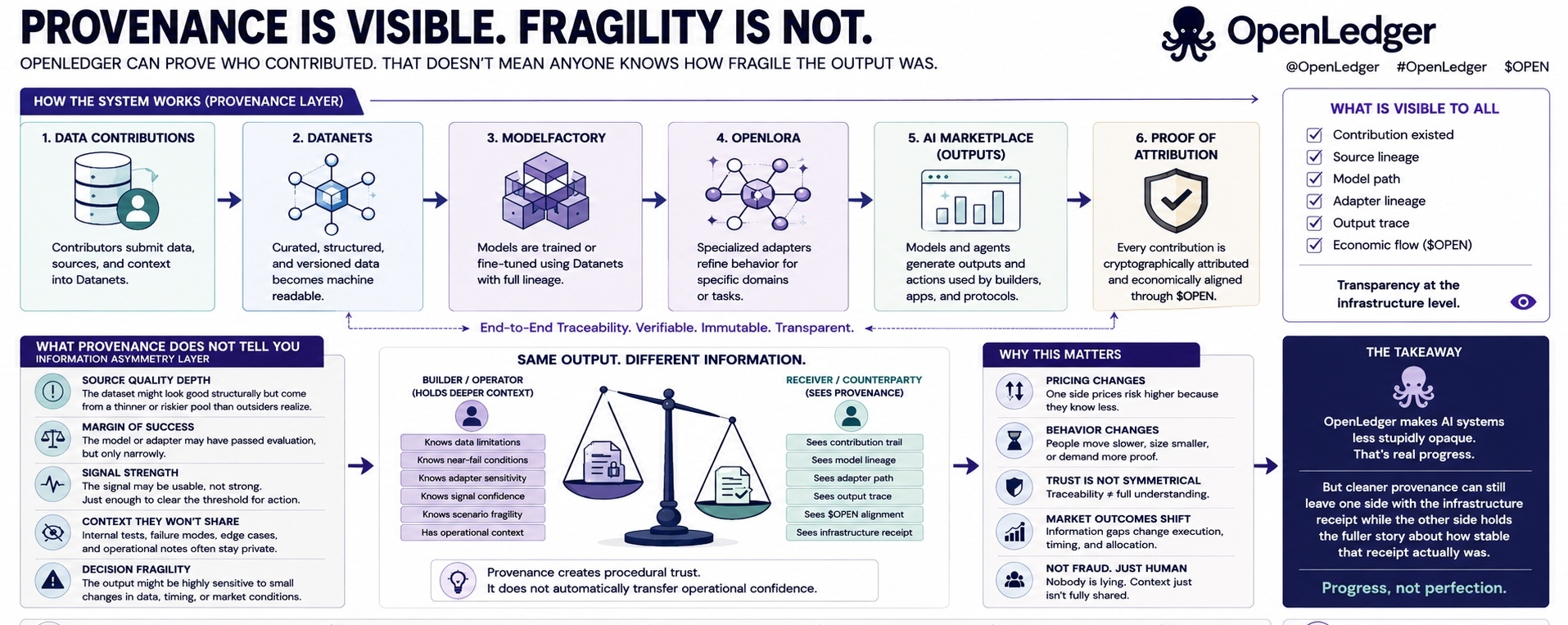
Proof of Attribution solves a problem crypto AI desperately needed solved.
That part is obvious.
For too long, model outputs have behaved like magic tricks. Useful answer appears. Action gets triggered. Decision gets priced. Revenue gets generated. Nobody really knows what contributed to the result, who shaped the model behavior, or whether the system quietly leaned on infrastructure nobody is acknowledging.
OpenLedger is right to attack that.
Traceability matters.
Still, the more interesting tension starts after provenance becomes visible.
Because proving lineage is not the same thing as distributing understanding.
That distinction keeps bothering me.
Imagine an OpenLedger-powered workflow where some autonomous system produces an output that actually matters. Maybe a treasury action. Maybe an agent decision. Maybe some execution path shaped through Datanet context, ModelFactory logic, and a narrow OpenLoRA specialization.
Now the output is not a black box anymore.
Good.
There is lineage.
Contribution can be traced.
Proof of Attribution can show what shaped the result.
The architecture did its job.
But now ask the uncomfortable question.
How much does the party showing the trace still know that the receiving party does not?
Because provenance tells you where something came from.
That does not automatically tell you how fragile the path was.
Maybe the Datanet looked structurally fine but came from a thinner source pool than outsiders realize.
Maybe the OpenLoRA adapter technically passed evaluation but only narrowly.
Maybe the model route was acceptable, not strong.
Maybe the signal barely cleared whatever threshold made autonomous action feel justified.
That is not fraud.
Not even close.
That is just informational asymmetry wearing cleaner infrastructure.
And markets care about that difference a lot.
A provenance trail might reassure one side.
The other side might still be sitting on richer operational context.
That changes behavior.
Position sizing changes.
Trust changes.
Counterparty confidence changes.
Execution timing changes.
A desk hearing “traceable” does not necessarily hear “robust.”
That is where OpenLedger becomes much more interesting than the lazy transparency narrative.
Because this is not just about proving contribution happened.
It is about how much informational depth provenance actually transfers.
And those are not the same thing.
One side may know the adapter almost failed.
One side may know the signal was technically usable but strategically weak.
One side may know the source pool looked shallower than the clean attribution story suggests.
The other side gets lineage.
That is better than black-box AI.
Absolutely.
Still not symmetrical.
That asymmetry matters because provenance can create procedural trust without necessarily transferring operational confidence.
Those are completely different things.
I keep thinking about how markets behave when one side has materially richer context.
Nobody needs deception for pricing behavior to change.
Nobody needs malicious intent.
A user simply asks for more margin.
A partner moves slower.
A counterparty widens assumptions.
A treasury discounts the output harder.
Because traceability is useful.
But useful is not the same thing as complete.
That is the uncomfortable category.
OpenLedger can absolutely make AI systems less stupidly opaque.
That is real progress.
But cleaner provenance can also create a new version of informational imbalance where one side gets the infrastructure receipt and the other side still holds the fuller story about how stable that receipt actually was.
That is a much harder problem.
Because the system worked.
The Datanet remained legible.
Model lineage existed.
OpenLoRA behavior stayed attributable.
Proof of Attribution did what it promised.
$OPEN aligned value routing.
Everything behaved correctly.
And one party still walked away understanding the fragility of the output far better than the other.
That is why I do not think provenance automatically equals trust.
Sometimes it just replaces black-box opacity with a cleaner version of uneven context.
That is still progress.
Just not the simple kind people want it to be.