
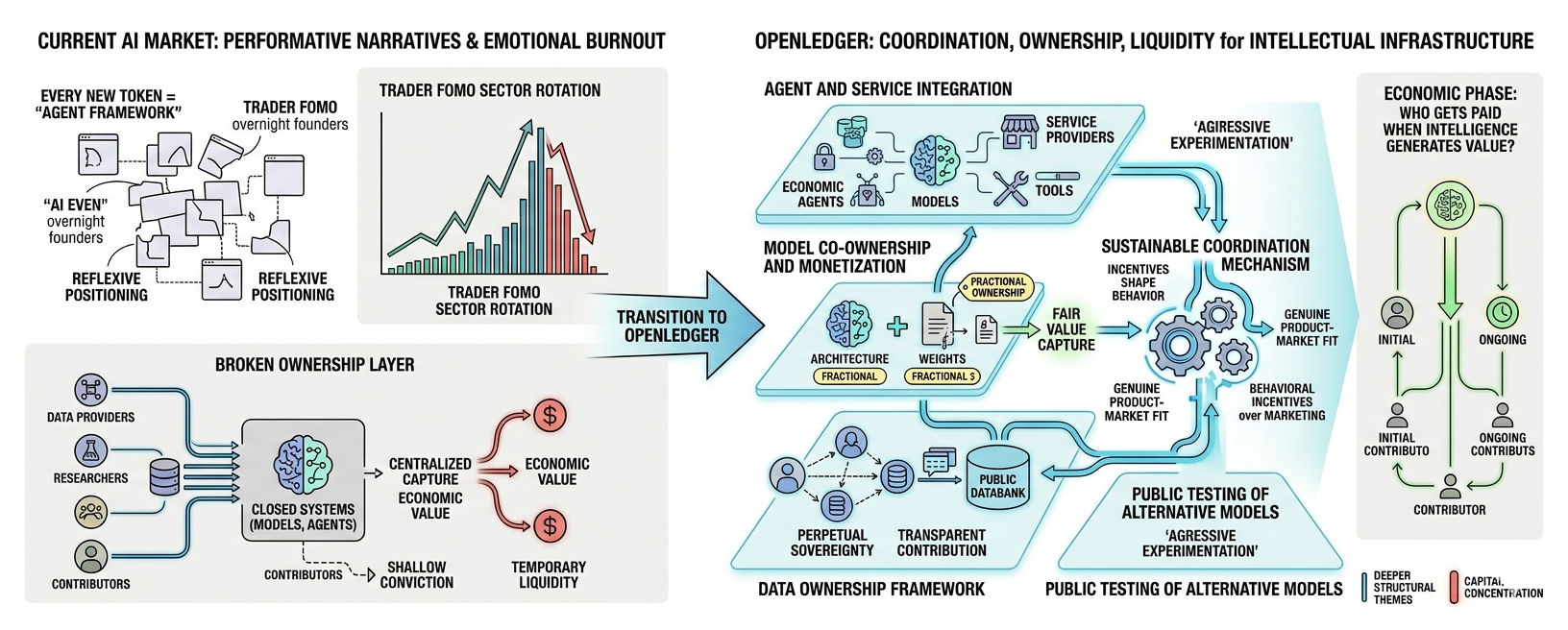

I don’t think most people fully understand how exhausted the market became from performative AI narratives.
At one point every new token suddenly had an “agent framework,” every founder became an AI visionary overnight, and every chart pumped purely because traders were terrified of missing another sector rotation. It stopped feeling like conviction and started feeling like reflexive positioning.
You could almost sense the emotional burnout building underneath the excitement.
That’s usually the stage where I become more interested, not less.
Because once the noise dies down a little, you finally get to see which projects were built for speculation and which ones were actually trying to solve something structurally difficult.
OpenLedger sits in that second category for me.
Not because I think it’s perfect. Honestly, I’m naturally skeptical of almost every AI-related crypto project now. Too many ecosystems confuse attention with utility. Too many communities mistake temporary liquidity for genuine product-market fit.

But OpenLedger touches a problem I think becomes impossible to ignore over the next few years.
AI is becoming economically valuable at an insane pace, yet the ownership layer around that value still feels deeply broken.
Most people contributing data today don’t own anything meaningful.
Most models operate inside closed systems.
Most incentives remain heavily centralized even while projects market themselves as “community-driven.”
Crypto has always had flaws, but one thing it understands better than traditional tech is how financial incentives shape participation behavior. That matters more in AI than people realize.
Because intelligence itself is becoming productive infrastructure.
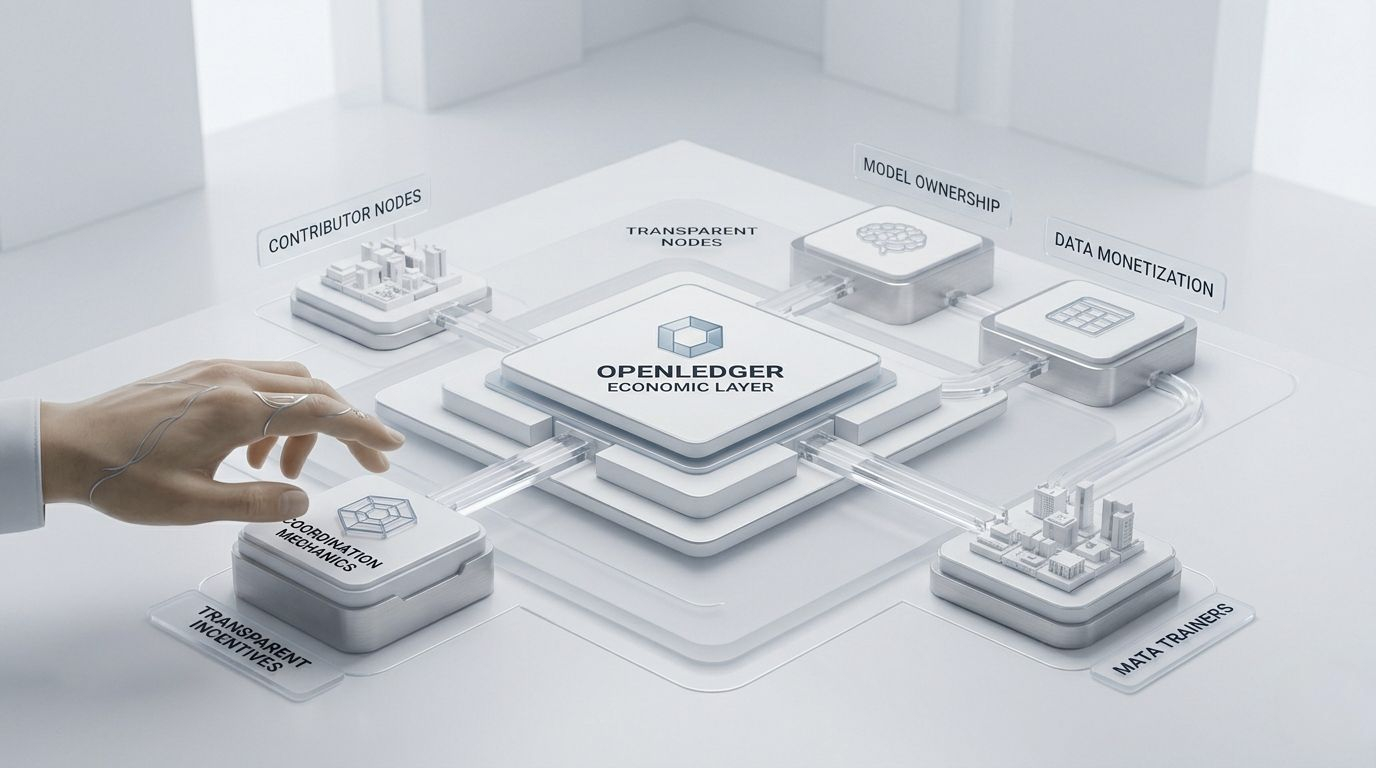
And once something becomes infrastructure, the real battle shifts toward coordination, ownership, and liquidity.
That’s where OpenLedger starts becoming interesting beyond surface-level branding.

I’ve spent enough time trading different narratives to notice when liquidity starts behaving differently around a sector. AI speculation initially moved with pure momentum psychology. Fast rotations. Shallow conviction. People didn’t care what projects actually did as long as volume kept expanding.
Now the market feels more selective.
Capital isn’t disappearing from AI entirely. It’s concentrating.
That distinction matters.
When liquidity contracts after an overheated phase, weaker ecosystems usually reveal themselves quickly because activity collapses once incentives slow down. But projects connected to deeper structural themes often survive longer than expected even during quieter periods.
That survival itself becomes information.
OpenLedger’s approach toward monetizing data, models, and agents feels aligned with where the AI conversation eventually has to go. Not the flashy demo phase. Not the “look what my chatbot can do” phase.
The economic phase.
Who gets paid when intelligence generates value?
Who owns the underlying contribution layer?
Who captures upside from data creation instead of merely feeding centralized systems for free?
These questions sound philosophical until billions of dollars start depending on the answers.
And honestly, I think crypto is one of the few environments willing to experiment aggressively enough to test alternative models in public.
There’s another psychological layer here too.
Retail attention still mostly flows toward visible excitement. Fast candles. Viral clips. Big personalities. But under the surface, I’ve noticed more experienced capital gradually leaning toward ecosystems with sustainable coordination mechanics rather than pure emotional momentum.
You can feel the difference in the conversations.
Less blind optimism.
More focus on whether activity inside a network would continue even if token prices stopped moving for a while.
That’s a much harder standard.
I learned that lesson painfully during previous cycles when I confused narrative strength with ecosystem durability. Some projects looked unstoppable until incentives weakened for even a few weeks. Then entire communities vanished almost instantly because there was never any real economic gravity holding participants together.
That kind of collapse changes how you evaluate new sectors.
Now I pay closer attention to behavioral incentives than marketing quality.
OpenLedger still has a lot to prove obviously. Every early infrastructure narrative does. But I think the market is underestimating how important ownership frameworks become once AI integrates deeper into everyday digital activity.
People eventually want transparency around contribution.
They want participation to feel economically fair.
And they definitely don’t want another future where value extraction becomes even more centralized under the disguise of innovation.
Maybe that’s why OpenLedger keeps staying in my mind longer than most AI projects lately.
Not because it feels loud.
Because it feels directionally aligned with a problem the industry still hasn’t fully processed yet.
