


I notice most blockchains share a common pattern. Validators exist, but nobody talks about them until something goes wrong. A missed block. A double sign. A slashing event. Suddenly everyone cares. OpenLedger deserves a different treatment. Validators are not just emergency responders. They are the foundation of everything.
Every transaction on @OpenLedger depends on validators. Data purchases. Model licenses. Agent payments. Burns. Governance votes. All of it relies on validators doing their job correctly, honestly, and consistently. Understanding validators means understanding OpenLedger itself.
Validators perform three essential functions on OpenLedger.
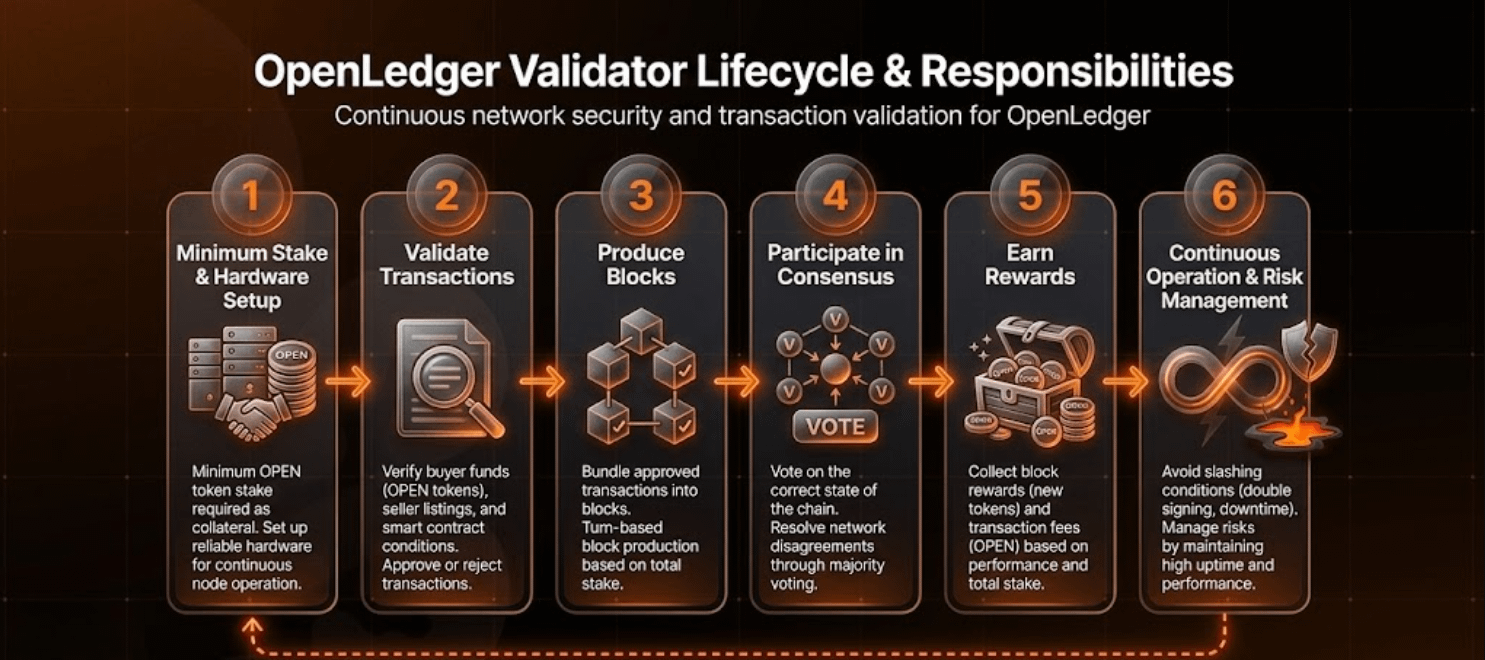
First, they validate transactions. When someone buys a dataset, the transaction enters a pool of pending actions. Validators check that the buyer has enough OPEN tokens. They verify the seller actually listed that dataset. They confirm the smart contract conditions are met. Valid transactions get approved. Invalid ones get rejected.
Second, they produce blocks. Approved transactions get bundled into blocks. Each block gets added to the chain. Validators take turns producing blocks based on their stake. More stake means more turns. More turns means more rewards.
Third, they participate in consensus. Not all validators agree on every block. When disagreements happen, the network needs a way to resolve them. OpenLedger uses a consensus mechanism where validators vote on the correct state of the chain.. The majority wins. The chain continues.
This setup is similar to other proof-of-stake networks but with OpenLedger-specific parameters. The difference lies in what gets validated. Not just token transfers. Data purchases. Model licenses. Agent transactions. Each type has unique verification requirements.
Becoming a validator on OpenLedger requires meeting certain conditions. The network demands a minimum stake of OPEN tokens. This stake serves as collateral. Good behavior earns rewards. Bad behavior loses stake. The minimum stake amount gets set by network governance. Too low, and attackers could spin up many validators cheaply. Too high, and only wealthy participants can join. OpenLedger balances these concerns through community voting.
Validators also need reliable hardware. This requirement often gets overlooked. Validators must run nodes continuously. Downtime causes missed blocks. Missed blocks reduce rewards. Repeated downtime can lead to removal from the active validator set. This filters out casual participants. Validating is not a hobby. It is a responsibility.
Rewards for validators come from two sources. Block rewards come from network inflation. Each block produced creates new OPEN tokens. The validator who produced the block gets most of these rewards. Other validators receive smaller shares for attesting to the block's correctness. Fee rewards come from transaction activity. Every data purchase, model license, and agent payment includes a network fee. These fees accumulate in blocks. Validators collect them when producing blocks.
Total validator rewards depend on two factors. How many blocks the validator produces. How much transaction activity happens on the network. More activity means higher fees. Higher fees mean better validator earnings. This aligns validator incentives with network growth.
Risks exist in validating. OpenLedger includes slashing conditions. A validator who signs two different blocks at the same height gets slashed. A validator who signs a block outside the current consensus window gets slashed. A validator who remains offline for extended periods gets slashed. A portion of their staked OPEN gets destroyed. The rest gets redistributed to other validators. These conditions create strong disincentives for lazy or malicious behavior.
Delegation plays an important role on OpenLedger. Not every OPEN holder wants to run validator hardware. Delegation solves this problem. Token holders can delegate their OPEN to existing validators. The validator keeps a commission. The delegator receives the remaining rewards. Delegation lowers the barrier to participation. Anyone with OPEN tokens can earn validator rewards without running a node. This is inclusive design.
Delegators must choose validators carefully. A validator who gets slashed also slashes the delegated tokens. Delegators lose money when their chosen validator misbehaves. Research matters before delegating. Reputation matters. Track record matters.
The validator set size on OpenLedger has limits. Not all validators are active at once. The network limits active validators to a specific number. Candidates with the highest stake get selected. Others wait in standby mode. Active validators rotate periodically based on performance and stake. This keeps the set fresh and competitive.
Decentralization remains an ongoing goal. Too few validators concentrate power. Too many validators slow down consensus. OpenLedger balances these through adjustable parameters. Governance votes determine the optimal number as the network grows.
Hardware requirements deserve attention. Validators need stable internet connections. They need sufficient storage for blockchain history. They need processing power to verify transactions quickly. Cloud hosting works. Dedicated servers work better. Home connections risk downtime. Serious validators invest in proper infrastructure.
The time commitment for validating is significant. Validating is not set-and-forget. Software updates need installation. Network upgrades need coordination. Performance needs monitoring. Successful validators treat this as a part-time job at minimum.
Validators secure OpenLedger. They process every transaction. They earn rewards proportional to their contribution. They face real penalties for misbehavior.. This creates a self-regulating system. Honest validators prosper. Dishonest ones lose money and disappear.
That is the role of validators on OpenLedger. Not hidden infrastructure. The active foundation of everything the network does.
What do you think makes a good validator on OpenLedger?