
Most people still look at AI through the wrong lens.
They focus on speed. Bigger models. Viral tools. Funding rounds.
But the real question isn’t how powerful AI becomes.
It’s who actually owns the value once intelligence starts scaling everywhere.
That’s the part OpenLedger keeps pulling me toward.
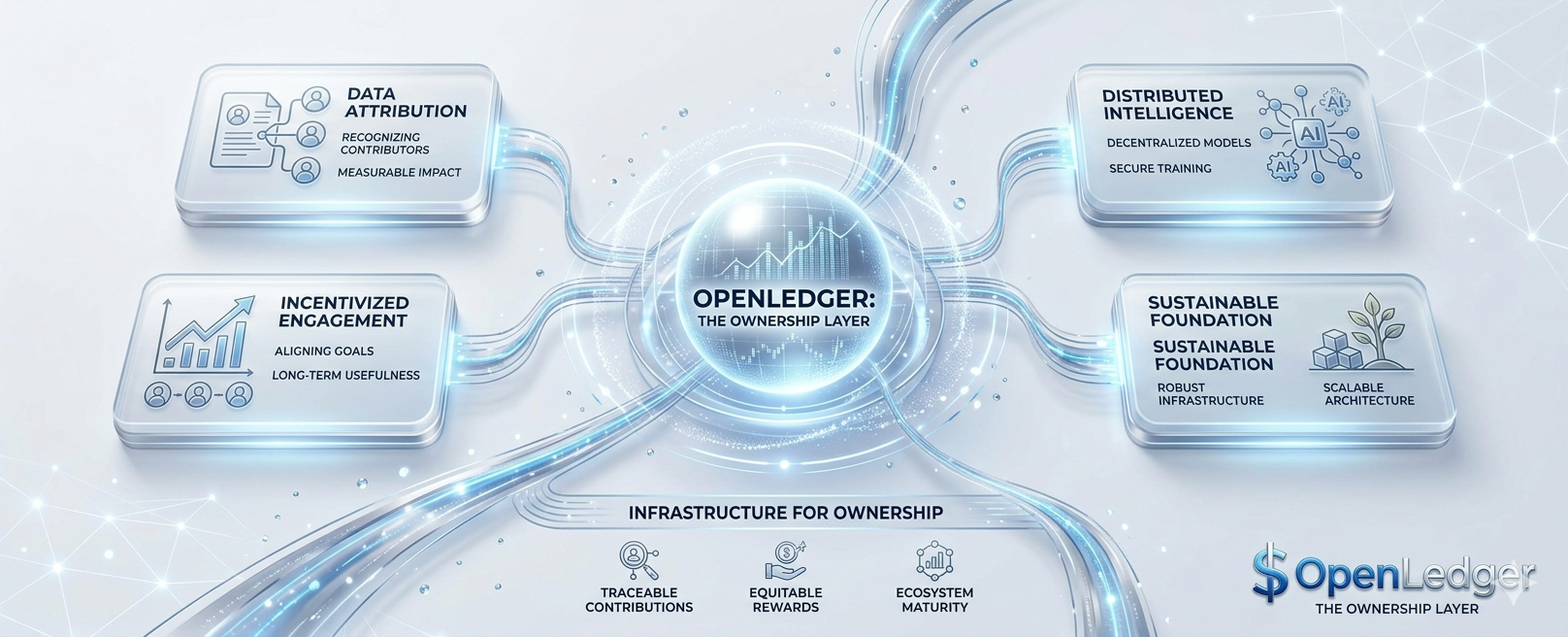
The deeper I explored the ecosystem, the clearer it became that this project isn’t trying to compete in the usual AI race. It’s building something underneath the race itself — an infrastructure layer designed around attribution, contribution, and ownership.
And honestly, that shift feels bigger than most people realize.
Right now, the internet feeds AI constantly. Researchers contribute knowledge. Communities generate context. Users create endless streams of behavioral data. Yet once value is produced, the connection between contributor and reward usually disappears into centralized systems.
OpenLedger approaches that differently.
Instead of treating contributors like invisible fuel, it creates a framework where data, models, and inference activity can actually be traced back to the people helping the network evolve. That changes the psychology of participation completely.
Because when contributors know their work is measurable and recognized, quality improves naturally.
People become more intentional.
Specialized datasets become more valuable.
Builders focus on long-term usefulness instead of short-term noise.
That’s what makes the ecosystem feel surprisingly mature.
The project doesn’t rely on exaggerated promises or loud narratives to appear important. In fact, the strongest thing about OpenLedger may be how quietly it positions itself. While many AI platforms compete for attention, OpenLedger seems focused on solving coordination and ownership at the infrastructure level.
And historically, infrastructure is what survives.
Most hype cycles fade because attention moves faster than utility. But systems that align incentives correctly tend to grow stronger over time, especially when they become foundational to how value flows across an ecosystem.
That’s why OpenLedger feels less like a temporary AI story and more like an early blueprint for how decentralized intelligence could eventually operate at scale.
Not flashy.
Not performative.
Just structurally important.
And in a market full of noise, that kind of quiet clarity stands out more than ever.
