
The longer I spend around AI infrastructure, the more I realize the industry has normalized something deeply strange.
Modern AI systems are built from human intelligence at unimaginable scale, yet the humans behind that intelligence rarely remain connected to the value being created. Knowledge is collected, behavior is analyzed, datasets are refined, models improve, companies grow stronger, and somewhere in that process the original contributors disappear into the background.
The machine remembers the data.
The economy forgets the people.
That imbalance has quietly become one of the defining characteristics of the entire AI era, and honestly, most conversations around AI still avoid confronting it directly. Discussions usually revolve around model capability, speed, scaling, valuations, or competition between companies. Very few people spend time thinking about ownership itself — who contributes to these systems, who benefits from them, and whether the relationship between contribution and value has become fundamentally broken.
That was the first reason OpenLedger stayed in my mind after researching it more carefully.
Not because it felt louder than other projects.
Actually, the opposite.
The project felt unusually focused on infrastructure at a time when most of the market seems obsessed with visibility.
The deeper I explored OpenLedger, the less it resembled a typical crypto narrative and the more it started feeling like an attempt to solve a structural problem inside AI: the absence of transparent attribution and fair economic coordination.
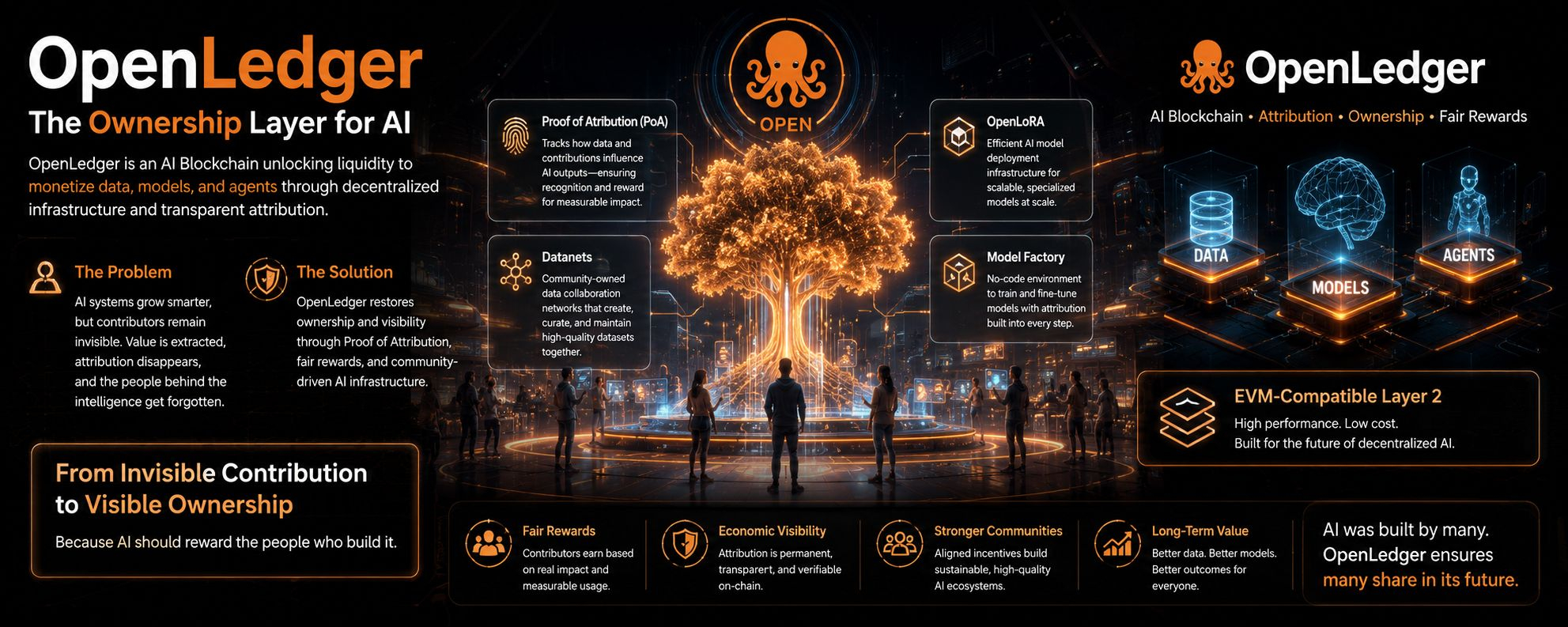
OpenLedger describes itself as an AI blockchain built to monetize data, models, and agents through decentralized infrastructure. But underneath the technical language is a much more human idea. The system appears designed around the belief that the people helping AI evolve should not become economically invisible once the models become useful.
That sounds obvious when written plainly, but the current AI economy operates very differently.
Most systems today absorb contribution silently. Data enters massive training pipelines, intelligence compounds, outputs become monetizable, and attribution slowly dissolves inside the scale of computation. Contributors lose visibility almost immediately after participating. The relationship between creator and outcome becomes impossible to trace.
OpenLedger’s Proof of Attribution framework feels like an attempt to push against that entire structure.
And what makes it interesting to me is that the implications are not only technical — they are behavioral.
Once contribution becomes measurable, people interact with systems differently. Data quality starts mattering more. Expertise becomes economically meaningful instead of disposable. Long-term participation becomes rational because contributors remain connected to the value they help create rather than being removed from it entirely.
That subtle shift in incentives may end up mattering more than people realize.
The project’s Datanets reinforce that idea in a way I found particularly thoughtful. Instead of treating datasets as invisible corporate assets hidden behind centralized infrastructure, OpenLedger approaches them more like collaborative economic networks where communities contribute, curate, and maintain specialized intelligence together.
And honestly, that changes the emotional relationship between people and AI infrastructure itself.
There is a difference between contributing to a system that extracts from you and contributing to a system where participation remains visible. People behave differently when ownership exists. Communities organize differently when incentives feel fair. The quality of contribution changes when contributors know their role does not disappear the moment value starts accumulating elsewhere.
In many ways, OpenLedger reminds me less of speculative crypto architecture and more of how mature creative economies eventually evolved.
Writers receive royalties because authorship matters. Musicians receive licensing revenue because attribution matters. Developers earn through usage because contribution matters.
Yet the people helping shape AI systems — arguably one of the most transformative technologies of this generation — still operate inside ecosystems where contribution is often absorbed without durable economic recognition.
That disconnect feels increasingly unsustainable.
The more AI expands, the more important incentive alignment becomes. Not just for fairness, but for quality itself. Truly valuable AI systems will likely require specialized knowledge, domain expertise, and long-term contributor ecosystems. Those ecosystems become much harder to sustain when participants feel permanently disconnected from the upside they help generate.
That is part of why OpenLedger’s broader infrastructure feels strategically important.
OpenLoRA, the Model Factory, and the surrounding AI Studio ecosystem all point toward a future centered around contributor-based AI economies rather than isolated centralized dominance. The architecture does not seem obsessed with building one monolithic intelligence system. Instead, it feels optimized for enabling many specialized models, datasets, and contributors to coexist inside transparent economic coordination.
And historically, infrastructure built around coordination tends to survive longer than infrastructure built around attention.
Narratives move quickly. Speculation moves even faster.
But systems that solve alignment problems often become more valuable over time because they address friction at the foundation rather than excitement at the surface.
That is also why OpenLedger’s EVM-compatible Layer 2 foundation matters conceptually. Attribution is not being added afterward as a cosmetic feature. It is being embedded directly into how value moves through the ecosystem itself — into datasets, models, contributors, and usage from the beginning.
The more I thought about the project, the more I felt that its strongest quality is not hype, speed, or even technology alone.
It is coherence.
The architecture, incentives, and philosophy all seem connected to the same underlying idea: AI systems become healthier when the people contributing to them remain economically visible.
And as artificial intelligence continues embedding itself deeper into everyday digital life, that question may eventually become unavoidable.
Who contributed to the intelligence? Who influenced the outputs? Who receives the value? Who gets forgotten once the systems scale?
Most AI ecosystems still treat those questions as secondary details.
OpenLedger feels like one of the few projects attempting to build around them from the start.
That is ultimately why the project feels important to me after spending time studying it. Not because it promises instant disruption or because it tries to dominate attention cycles, but because it quietly recognizes something the industry is only beginning to understand:
The future of AI may depend not only on how intelligent these systems become, but on whether the economic structures behind them can finally become transparent, attributable, and fair to the people who helped build them.