Artificial intelligence is changing the world faster than most people can emotionally process.
Every day, AI writes articles, creates art, answers questions, builds software, analyzes markets, and automates tasks that once required years of human skill. It feels magical. Almost unreal. And for many people, it feels like we are standing at the beginning of an entirely new civilization.
But behind all the excitement, there is a quiet truth that rarely gets the attention it deserves:
AI did not create itself.
Every intelligent response, every generated image, every prediction, every model — all of it was shaped by human knowledge somewhere along the way. Writers, artists, researchers, developers, teachers, communities, and ordinary internet users unknowingly helped build the foundation of today’s AI systems.
Yet most of those people were never credited.
Most were never rewarded.
And many never even knew their work was being used.
That disconnect is becoming one of the biggest emotional and economic questions of the AI era.
And this is exactly where OpenLedger enters the story.
OpenLedger is trying to build something bigger than just another blockchain project. Its vision is centered around a simple but powerful idea:
If human knowledge powers AI, then humans should share in the value AI creates.
---
A Different Kind of AI Future
Most conversations around AI focus on power.
Bigger models.
Faster systems.
More automation.
More dominance.
But OpenLedger looks at the problem from a different angle. Instead of asking, “How do we make AI more powerful?” it also asks, “How do we make AI more fair?”
That question changes everything.
Because right now, much of the AI industry feels extremely centralized. Massive companies collect enormous amounts of data, train powerful models behind closed doors, and generate billions in value while the original contributors remain invisible.
For many people, that feels uncomfortable.
Artists worry their work is being copied.
Writers fear losing ownership.
Communities wonder if their collective knowledge is simply becoming free fuel for machines.
There is growing anxiety that AI could become an economy where value flows upward while ordinary contributors disappear from the picture entirely.
OpenLedger is trying to push back against that future.
---
Giving Data a Memory
One of the core ideas behind OpenLedger is attribution.
In simple words, attribution means recognizing where intelligence came from.
Today, when AI generates an answer, most people have no idea what data influenced that response. The process feels like a black box. Information goes in, intelligence comes out, and the original contributors are lost somewhere in the middle.
OpenLedger wants to change that.
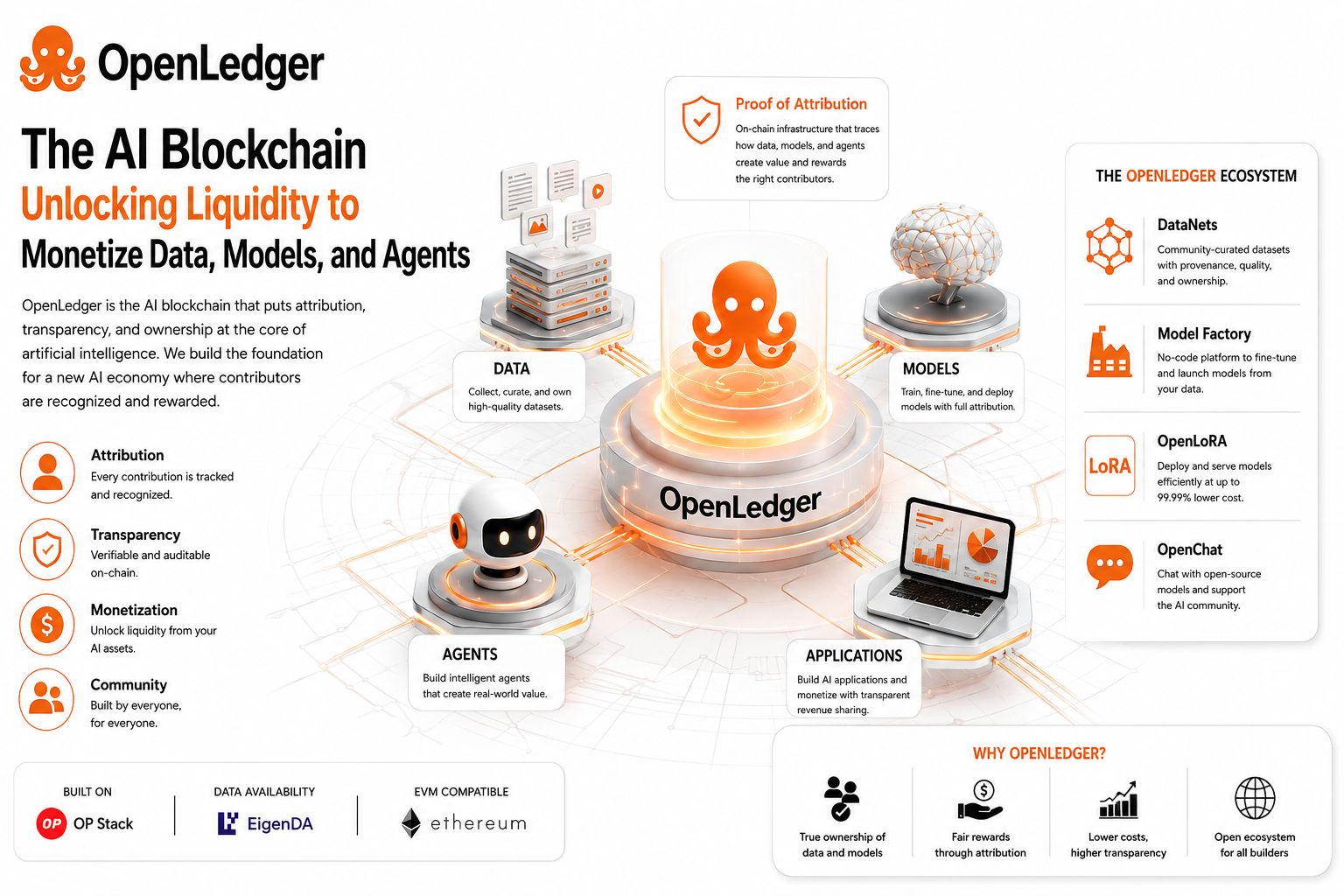
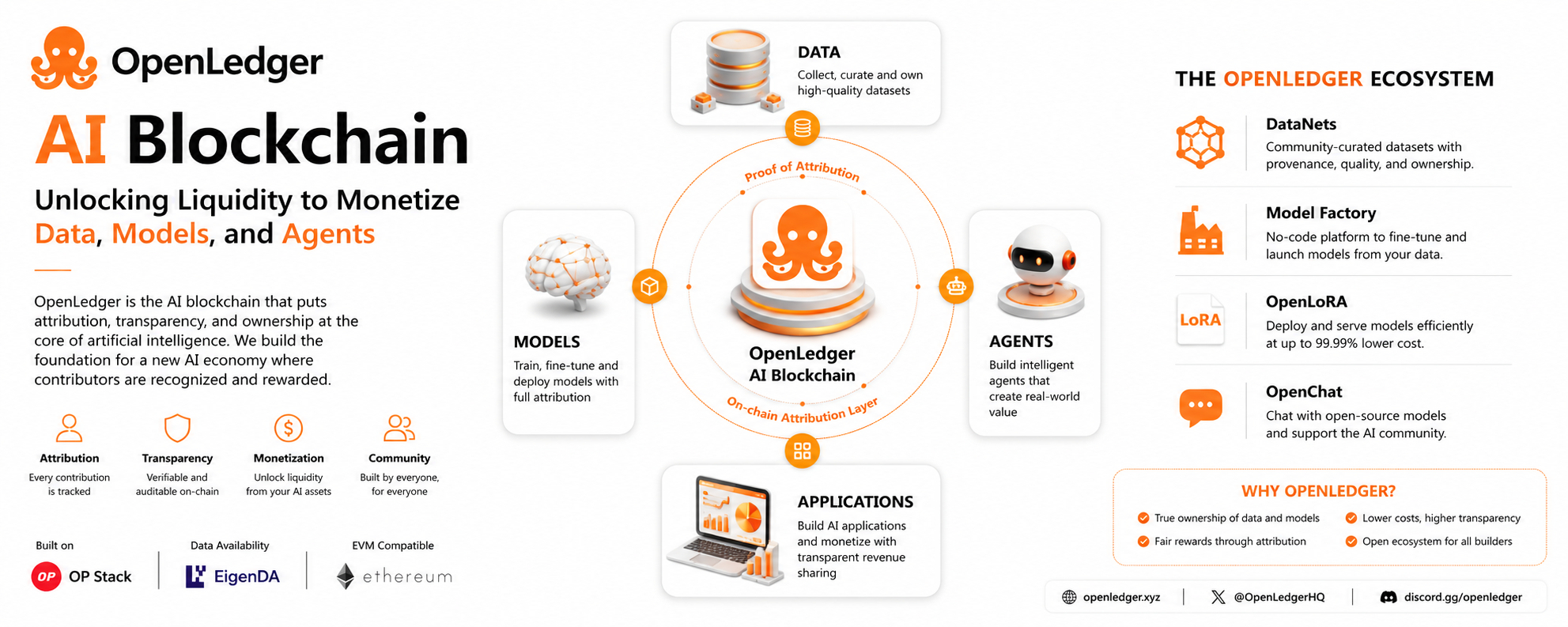
The project introduces a system called Proof of Attribution, designed to help track how datasets contribute to AI outputs. Instead of treating data like disposable fuel, the system aims to connect value back to the people and communities who helped create it.
That idea may sound technical on the surface, but emotionally it is deeply human.
Because everyone wants to feel that their contribution matters.
Everyone wants to know they are not invisible.
And in many ways, OpenLedger is trying to build an AI economy where human effort can finally be acknowledged instead of erased.
---
Why This Matters More Than People Realize
The future of AI is not only about technology.
It is about ownership.
Who owns intelligence?
Who controls the data?
Who profits when AI becomes more powerful?
And who gets left behind?
These questions are becoming more serious every year.
Right now, data is one of the most valuable resources in the world. But unlike traditional resources, most people give away their data constantly without realizing how much economic value it creates.
OpenLedger’s vision is built around changing that relationship.
The project introduces the idea of DataNets — collaborative environments where people can contribute, organize, and monetize specialized datasets for AI models.
Imagine doctors helping build medical datasets.
Teachers helping create educational AI.
Local communities preserving language and culture through specialized models.
Researchers contributing scientific knowledge.
Instead of knowledge disappearing into giant closed systems, contributors could potentially become part of transparent AI economies.
That possibility feels important because it makes the future of AI feel less cold.
Less extractive.
More human.
---
AI Should Not Forget the People Behind It
There is something emotionally strange about modern AI.
The systems sound human.
They communicate naturally.
They create things that feel emotional.
But the people behind the intelligence often become invisible.
OpenLedger seems to recognize that problem at a deeper level.
Its broader vision is not simply about monetizing data. It is about creating a structure where contribution, ownership, and recognition can exist together.
In a world where AI is becoming increasingly automated, that idea carries emotional weight.
Because people do not only want technology that works.
They want technology that feels fair.
---
The Rise of AI Economies
Another fascinating part of OpenLedger’s vision is its focus on AI agents, models, and decentralized intelligence economies.
The internet is changing rapidly.
In the future, AI systems may interact with each other constantly — researching, negotiating, automating businesses, managing workflows, and even making economic decisions independently.
That future sounds exciting, but it also raises serious concerns about transparency and accountability.
OpenLedger positions itself as infrastructure for this next phase of AI evolution.
A system where datasets, models, and AI agents can operate with traceability and economic coordination on-chain.
In simpler terms, it wants AI systems to function in environments where actions, contributions, and value flows are visible instead of hidden.
That transparency could become extremely important as AI grows more powerful.
Because trust may become one of the most valuable currencies in the digital world.
---
More Than Hype
The blockchain and AI industries are both filled with hype.
Every week, new projects promise to revolutionize the future.
Most disappear quietly.
What makes OpenLedger interesting is not just its technology, but the emotional direction of its philosophy.
The project understands that AI is not purely a technical revolution.
It is a human revolution too.
And if humans disappear from the economics of intelligence, society may eventually begin to resist the very systems it once celebrated.
People want progress.
But they also want dignity.
Recognition.
Ownership.
Fairness.
OpenLedger is attempting to build infrastructure around those values before the AI economy becomes too centralized to change.
---
The Bigger Picture
Nobody knows exactly what the future of AI will look like.
The industry is evolving at incredible speed. Competition is intense. Technology changes almost every month. Some projects will fail. Others will reshape entire industries.
But one thing is becoming increasingly clear:
The next era of AI will not only be about intelligence.
It will also be about trust.
And trust cannot survive forever in systems where people feel invisible.
That is why projects like OpenLedger matter.
Not because they have all the answers.
But because they are asking the right questions early.
Questions about contribution.
Questions about ownership.
Questions about who deserves value in an AI-driven world.
And perhaps most importantly, questions about how humanity can remain visible inside the machines it helped create.
Because in the end, artificial intelligence may become incredibly powerful.
But it should never forget the humans behind it.