
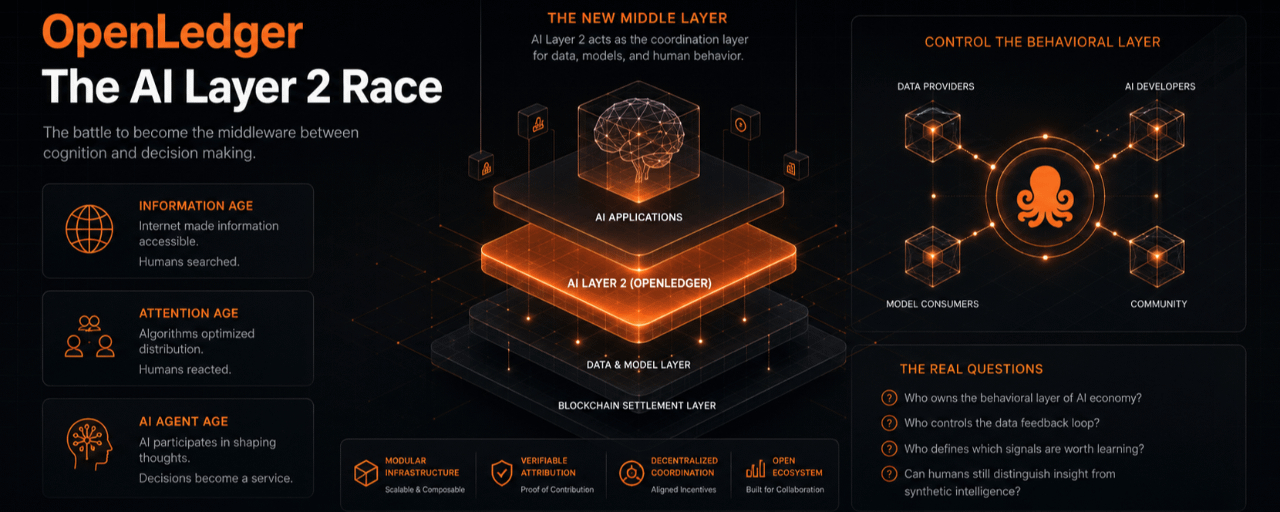
The longer I observe the AI market, the more I notice that most discussions are still focused on surface-level metrics: which model is more powerful, which blockchain is faster, or which infrastructure scales more efficiently. But beneath all of that, the real transformation seems to be happening somewhere else entirely: in the gradual outsourcing of human thinking itself.
That’s why the “AI Layer 2” narrative around projects like OpenLedger feels far more important than many realize.
At this stage, it no longer looks like a simple competition between AI systems or blockchain networks. It increasingly resembles a race to become the intermediary layer between human cognition and decision-making.
It sounds philosophical, but the shift is already visible.
The internet once accelerated access to information. Social media optimized the distribution of attention. Recommendation algorithms then began shaping what people consume. AI appears to be taking this process one step further, not merely distributing information, but actively participating in the formation of thought itself.
That’s the part that stands out.
When many people hear “AI Layer 2,” they think about cheaper computation, scalable inference, or decentralized infrastructure. But the deeper issue seems to revolve around abstraction.
As AI systems become more capable, humans naturally create more layers that reduce cognitive friction. People increasingly stop caring how systems work internally and focus only on outputs.
This creates an interesting paradox.
The smarter the tools become, the less users may feel the need to think independently. Not because humans are becoming less intelligent, but because the brain naturally optimizes for efficiency. If systems can consistently “think on behalf” of users, many people may slowly transition from active reasoning into passive reaction.
That shift already feels quietly embedded within the current AI wave.
Projects building AI infrastructure appear to understand this dynamic very well. They are not merely competing to build the “best AI.” They are competing to become an invisible dependency layer users rely on without fully realizing it.
That distinction matters.
The early internet encouraged people to search for information. Feed algorithms turned users into reactive participants. AI agents may eventually transform decision-making itself into a service layer.
Viewed from that angle, OpenLedger becomes interesting not because of token throughput or tokenomics, but because of the broader philosophical implications behind the model.
Who owns the behavioral layer of the AI economy?
Who controls the feedback loop of data and incentives?
Who decides which signals are valuable enough to model and optimize?
And perhaps most importantly, when systems become highly optimized for automation, will humans still be able to distinguish genuine insight from convincingly synthesized intelligence?
I think much of the market still evaluates AI using traditional SaaS or cloud infrastructure logic. But AI doesn’t seem to operate on the same level.
Cloud computing accelerated data processing.
AI is beginning to intervene directly in perception itself.
That represents an entirely different layer of influence, which may explain why the “AI Layer 2” narrative feels less like a technical trend and more like the emergence of a new coordination layer for digital human behavior.
The most interesting part is that everything is still early.
We still describe these systems using words like infrastructure, efficiency, and decentralization. Yet underneath those narratives, the real competition increasingly appears to revolve around attention, trust, and delegated cognition.
Whether this ultimately reduces information overload or simply deepens dependence on abstraction remains unanswered.
The market still hasn’t decided.