
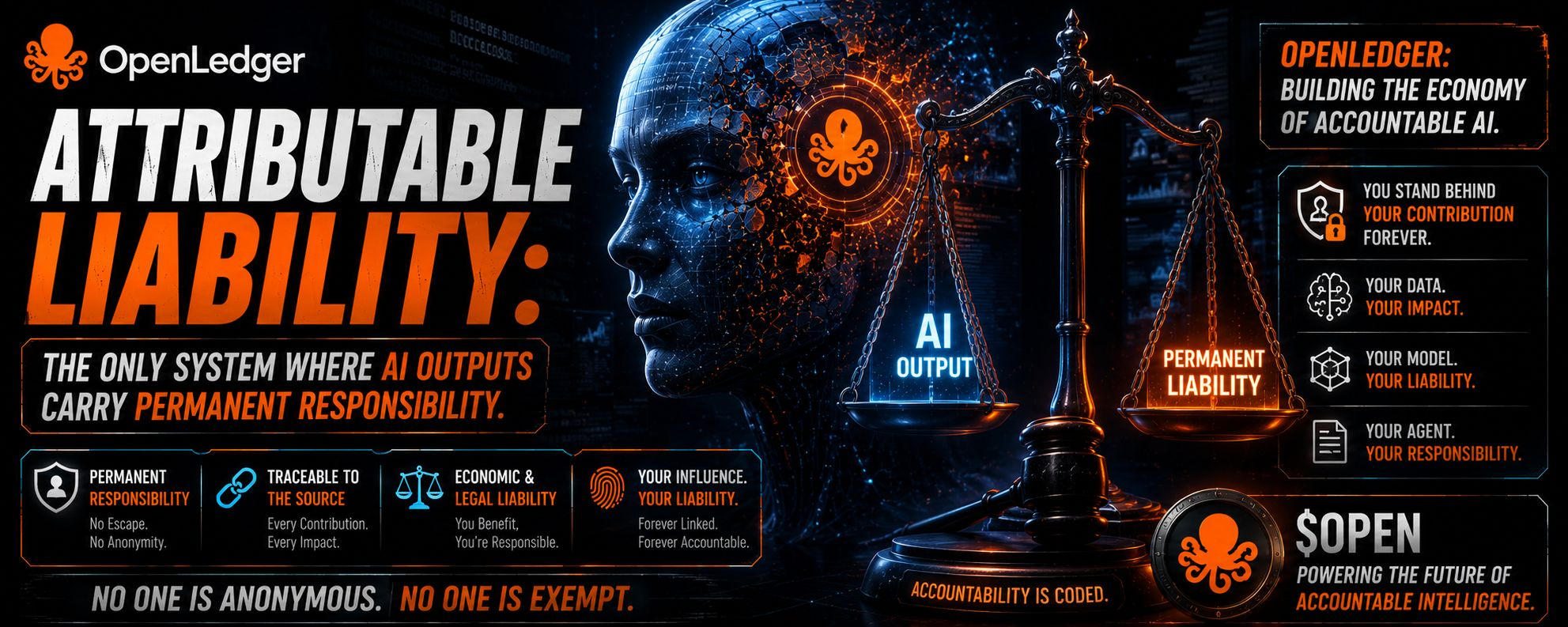
Who contributed? Who gets paid? How do you split incentives fairly across builders, validators, model creators, data providers, and users? Most infrastructure conversations around AI blockchains still orbit those questions because they are easy for markets to understand. Contributors enter the system, value gets tracked, rewards flow outward, token demand forms around participation. Simple enough.
But the longer I look at OpenLedger, the less I think attribution is really the center of the design.
What keeps pulling my attention back is something heavier underneath it.
Liability.
Not social responsibility in the vague corporate sense. Actual attributable responsibility attached permanently to AI outputs, where creators do not simply benefit economically from influence, but remain tied to the consequences of that influence long after deployment.
That changes the emotional structure of the system completely.
And honestly, I think most of crypto is psychologically unprepared for what that means.
I remember watching earlier infrastructure cycles where permanence itself was marketed as inherently valuable. Immutable ledgers. Permanent storage. Permanent provenance. Permanent transparency. At the time it sounded revolutionary because the industry was reacting against opaque systems where accountability disappeared behind institutions.
But permanence creates obligations just as much as it creates trust.
That distinction matters more once AI enters the equation.
Because AI systems do not just store transactions. They absorb influence. They inherit training biases, data contamination, behavioral assumptions, embedded incentives, and sometimes legal exposure. Every dataset, model adjustment, fine-tuning contribution, or agent interaction potentially leaves fingerprints behind.
Most current AI infrastructure still behaves as though influence can be economically rewarded without permanently attaching responsibility to whoever shaped the output.
OpenLedger appears to be moving toward the opposite direction.
Attributable liability.
A system where contributors may remain economically and potentially legally connected to the downstream consequences of what they helped create.
Conceptually, it sounds rational. Almost inevitable, honestly. If AI systems are going to participate in real economies, then someone eventually becomes responsible when those systems fail, manipulate, hallucinate, violate permissions, misuse data, or generate harmful outcomes. Markets eventually demand accountability once enough money starts moving through the system.
But there is a difference between acknowledging accountability philosophically and embedding it structurally into network design.
That is where OpenLedger starts becoming more interesting to me than most AI-related crypto projects floating around right now.
And also more dangerous.
Because crypto traders tend to think in terms of upside participation while ignoring long-tail obligation structures until they suddenly matter all at once.
Most blockchain systems historically leaned on radical transparency as their answer to trust. Every wallet visible. Every transaction traceable. Every interaction permanently archived. Early crypto culture treated exposure almost like moral purity.
The problem is that transparency without attributable responsibility eventually becomes performative.
You can see everything while nobody is truly accountable for anything.
OpenLedger’s framing appears to shift that dynamic. Instead of treating attribution as optional metadata attached to contribution rewards, the architecture seems to imply something more persistent: if your influence shapes outputs, then your relationship to those outputs does not disappear simply because the transaction settled.
That creates an entirely different economic environment.
Imagine a medical AI model trained partly on proprietary healthcare datasets contributed through a datanet. Attribution gets tracked correctly. Contributors receive compensation. Fine.
But years later, regulators challenge the validity of certain outputs. A harmful recommendation emerges. Bias accusations surface. Suddenly attribution is no longer just about rewards. It becomes evidence.
Who remains attached to liability?
Who absorbs reputational risk?
Who faces economic penalties if harmful influence can be traced backward through the contribution graph?
That is where the conversation stops sounding like ordinary crypto infrastructure and starts resembling a persistent accountability economy.
And honestly, I’m not sure markets fully understand the behavioral consequences of that transition yet.
Because permanence changes participation incentives dramatically.
A lot of contributors enjoy the idea of permanent upside attribution. Fewer people enjoy permanent downside exposure.
Crypto has historically thrived partly because responsibility remains fragmented, fluid, and socially escapable. Wallets disappear. Teams dissolve. Governance votes diffuse blame across communities. Most systems optimize heavily for upside asymmetry while externalizing long-term accountability.
OpenLedger’s model potentially compresses that distance between contribution and consequence.
The philosophical argument for this is strong.
If AI creators benefit continuously from downstream usage, perhaps they should also remain connected to downstream failures. Otherwise attribution becomes economically convenient only when rewards flow positively.
But structurally, this creates a difficult tension.
The more permanent liability becomes, the more cautious contributors may become about participation itself.
That matters because AI systems thrive on contribution density. Data providers, fine-tuners, model builders, and agent creators need incentives to enter the network continuously. If long-tail accountability starts feeling legally ambiguous or economically dangerous, participation quality could narrow very quickly toward institutional actors with legal protection and compliance infrastructure.
Ironically, systems designed for accountable decentralization may drift back toward centralized participation simply because risk tolerance becomes uneven.
That possibility feels under-discussed right now.
And crypto has a habit of underestimating how quickly incentive structures alter user behavior once financial consequences become real.
I’ve seen similar patterns before in other infrastructure narratives. Markets initially price growth potential, accessibility, and participation incentives. Then eventually the harder layer appears underneath: maintenance obligations, operational burden, legal exposure, governance fatigue, security assumptions.
That second layer is usually where infrastructure tokens either stabilize into genuine utility or slowly collapse under complexity.
Which brings me back to OpenLedger and the OPEN token itself.
At first glance, the token looks easy to frame. Coordination layer. Incentive routing. Access economy around attributable AI systems. Standard infrastructure logic.
But if attributable liability becomes central to the ecosystem, then the token may evolve into something less speculative and more operationally defensive.
That changes the demand model significantly.
Because recurring token demand rarely survives through excitement alone. It survives when systems create unavoidable economic obligations. Gas fees persist because transactions continue. Security staking persists because networks require protection. Infrastructure survives when users cannot avoid interacting with the economic layer underneath.
Now imagine a future OpenLedger environment where maintaining attribution validity, preserving legal auditability, updating liability states, resolving provenance disputes, or renegotiating retained contribution exposure all require ongoing interaction with the OPEN ecosystem.
Suddenly the token stops looking like simple participation fuel.
It starts resembling arbitration infrastructure around persistent AI responsibility.
That is structurally more interesting than most attribution narratives currently circulating in crypto.
Still, I remain cautious.
Not because the ideas feel weak. Honestly, the opposite. The ideas may be too intellectually heavy for the current market cycle.
Crypto users historically optimize for convenience long before they optimize for accountability. Developers tolerate philosophical complexity only when tooling remains frictionless. Traders reward narratives faster than systems. And mainstream users often prefer plausible deniability over permanent attributable responsibility.
There is also the uncomfortable reality that elegant infrastructure frequently collapses once ordinary human behavior enters the system.
People exploit loopholes. Governance becomes political. Attribution disputes turn emotional. Regulatory interpretations shift unpredictably. Liability itself becomes contested territory.
And AI systems magnify those tensions because outputs rarely emerge from single contributors anymore. Influence becomes layered, probabilistic, and collaborative. One harmful result may involve dozens of invisible dependencies spread across datasets, fine-tuning processes, agents, retrieval systems, and model updates.
Can attributable liability remain computationally manageable in that environment?
More importantly, can it remain socially legitimate?
Those are harder questions than most market participants seem willing to confront right now.
But maybe that is exactly why OpenLedger continues holding my attention despite my skepticism.
The project does not merely seem interested in monetizing AI participation. It appears to be experimenting with whether accountability itself can become programmable economic infrastructure.
That is a much riskier direction than simple attribution rewards.
And maybe much more important long term.
Still, crypto history has taught me to distrust systems that appear intellectually inevitable during their early narrative phase. Markets admire philosophical coherence right up until usability friction, legal ambiguity, and operational burden begin slowing adoption.
That transition quietly kills most ambitious infrastructure projects.
So when I look at OpenLedger today, I do not really wonder whether attributable liability makes conceptual sense. In many ways, it probably does. The harder question is whether developers, contributors, enterprises, and ordinary users will willingly participate inside a system where influence never fully detaches from responsibility — especially once the emotional excitement around AI narratives fades and the real economic weight of permanent accountability finally arrives.@OpenLedger $OPEN
