

I have been started.......................................... seeing a major shift in the crypto industry. The conversation is slowly moving away from pure speculation and toward infrastructure that can support entirely new digital economies..... Artificial intelligence sits at the center of that transition, and OpenLedger ($OPEN ) is one of the projects trying to build the rails. Rather than treating AI as another application layer on blockchain, OpenLedger is positioning itself as an AI-native network where data, machine learning models, and autonomous agents can become economic assets with real ownership and monetization mechanisms.
That idea sounds simple. The implications are anything but.
For years, AI and blockchain evolved in parallel worlds. AI focused on automation, prediction, and content generation. Blockchain focused on decentralization, transparency, and digital ownership. As both technologies mature, the overlap between them is becoming increasingly difficult to ignore. Questions about who owns data, who profits from AI models, and how contributors should be compensated are becoming more important with every new breakthrough.
OpenLedger is built around those questions.
The project's central thesis is that valuable AI resources should not remain trapped inside closed corporate systems. Data, models, and intelligent agents all generate value, yet the economic benefits often flow to the organizations controlling the infrastructure. OpenLedger aims to create a framework where those assets can participate directly in decentralized markets and where contributors have a clearer path to capturing value from what they create.
To understand why that matters, it helps to look at how blockchain itself has evolved.
Bitcoin introduced decentralized money. Ethereum expanded ownership into programmable assets. DeFi demonstrated that lending, borrowing, and trading could operate without traditional financial intermediaries. NFTs brought verifiable ownership to digital content. Each phase expanded the range of assets people could own and monetize online.
AI may represent the next chapter.
Modern artificial intelligence depends on three ingredients: data, computing power, and machine learning models. The problem is that these resources remain heavily concentrated among a relatively small number of technology companies. The organizations with the largest datasets and infrastructure advantages typically maintain significant control over AI development and commercialization.
That concentration has sparked a growing push toward decentralized AI systems.
Across crypto, developers are exploring ways to create more open AI ecosystems where ownership and rewards are distributed across networks rather than centralized platforms. OpenLedger fits directly into that movement, but with a particular focus on liquidity. In traditional markets, liquidity refers to how easily an asset can be utilized or exchanged. OpenLedger applies the same concept to AI resources, treating datasets, models, and autonomous agents as productive assets capable of generating economic activity inside decentralized environments.
It is a bold attempt to financialize AI infrastructure.
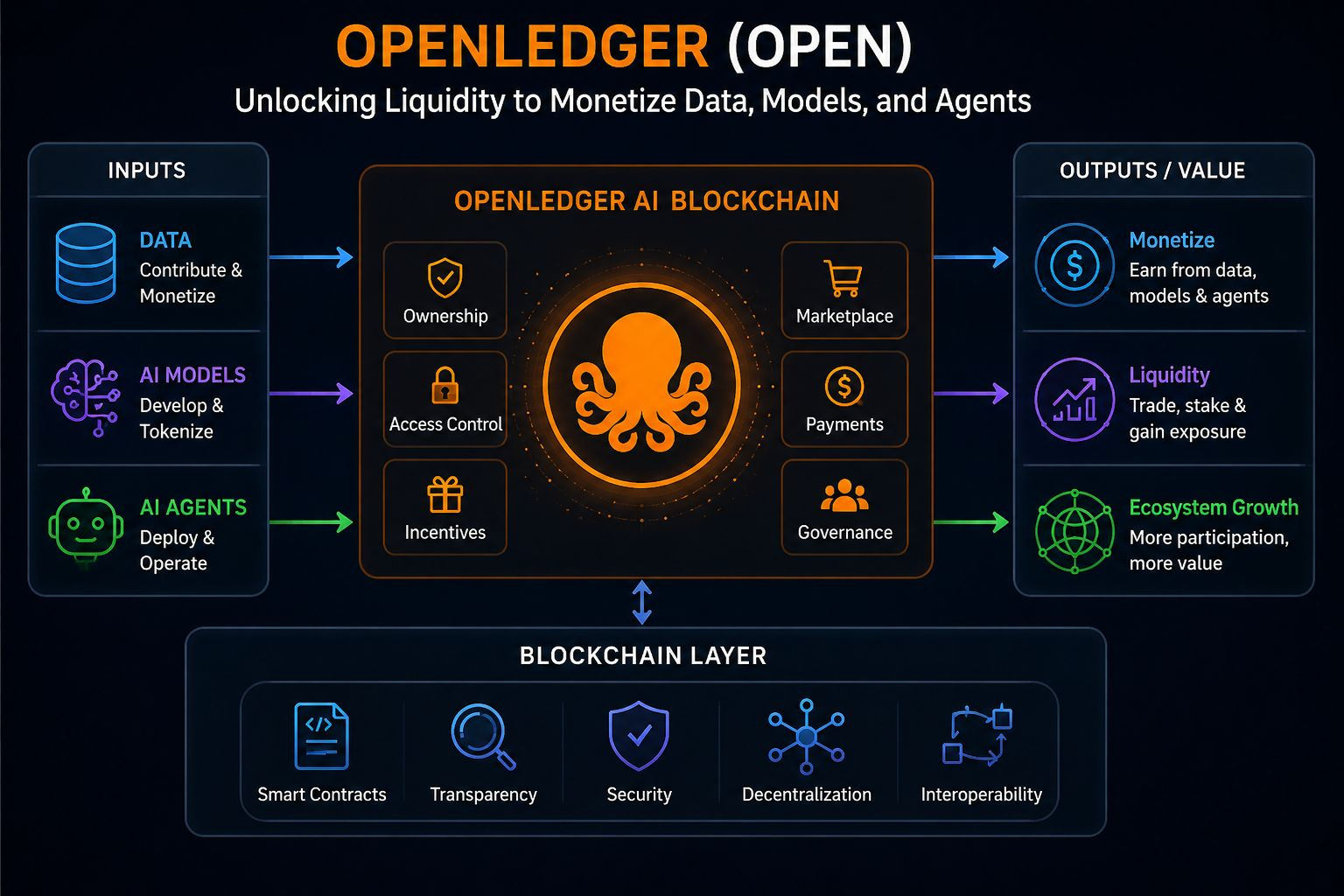
At the foundation of the network sits a data monetization layer. Data remains the fuel powering every machine learning system, yet the people and organizations contributing valuable information often receive little ongoing compensation. OpenLedger seeks to create a marketplace where datasets can be registered, verified, and monetized while contributors maintain a clearer connection to the value their information generates.
Think about a healthcare institution contributing anonymized medical data.
Instead of surrendering that information into a closed ecosystem, the dataset could function as an economic asset whose usage creates recurring rewards. The same principle could apply to financial market data, supply chain records, geospatial information, consumer analytics, or data generated by connected devices. Ownership becomes more transparent, and participation becomes more economically meaningful.
The model layer follows a similar philosophy.
Building advanced AI systems requires expertise, significant computational resources, and substantial investment. Yet many developers depend on centralized distribution channels to commercialize their work. OpenLedger introduces a framework where machine learning models themselves can be economically represented on-chain and deployed into decentralized marketplaces where users pay for access, services, or specialized functionality.
That creates a more direct relationship between builders and users.
Perhaps the most intriguing aspect of the project involves autonomous AI agents. These systems are designed to perform tasks, make decisions, and interact with digital environments with varying levels of independence. Trading assistants, research agents, portfolio managers, customer service systems, and workflow automation tools all fall into this category.
OpenLedger envisions a future where these agents are not simply pieces of software but active economic participants.
Within the network, agents can potentially consume data, purchase services, access applications, pay fees, and generate revenue. In practical terms, that means software could begin participating directly in digital markets rather than operating solely under human supervision. While the concept remains early, it points toward a future where autonomous systems play a much larger role in online economies.
The blockchain acts as the coordination layer that ties everything together.
Smart contracts manage ownership rights, revenue distribution, access controls, marketplace interactions, incentives, and governance. Because these activities occur on transparent infrastructure, participants gain visibility into how value moves through the ecosystem. For an industry often criticized for opaque AI training processes and unclear economic relationships, that transparency could become a meaningful advantage.
The broader significance extends far beyond a single project.
At its core, OpenLedger is attempting to answer whether AI can evolve into a more open economic system rather than remaining concentrated within a handful of dominant organizations. Today, valuable datasets often generate profits for platforms rather than contributors. Independent developers frequently struggle to monetize innovation without relying on centralized marketplaces. Users rarely understand how AI systems are trained or how economic rewards are distributed.
OpenLedger wants to realign those incentives.
If the model succeeds, contributors could share in the value generated by their data, developers could monetize models more directly, and AI services could operate through transparent marketplaces governed by programmable rules. The comparison to DeFi is hard to ignore. Just as decentralized finance challenged traditional financial intermediaries, decentralized AI infrastructure aims to challenge centralized control over artificial intelligence resources.
The opportunity is substantial.
One of the clearest advantages lies in transforming previously illiquid resources into tradable digital assets. Historically, datasets and AI models functioned as internal corporate assets. Blockchain infrastructure opens the possibility of making those resources transferable, monetizable, and economically productive within open networks. That alone expands the universe of assets available to decentralized ecosystems.
Better incentives could also lead to better data.
When contributors have a financial reason to provide useful information, decentralized networks may attract more diverse and specialized datasets. Developers benefit as well. Reduced reliance on centralized platforms creates new pathways for monetization and lowers barriers for smaller teams trying to build commercially viable AI products.
Then there is the agent economy.
As AI systems become more sophisticated, the ability for software agents to hold assets, purchase services, interact with applications, and generate revenue could unlock entirely new categories of digital business models. Whether that vision arrives quickly or gradually, it represents one of the more fascinating possibilities emerging from the convergence of AI and blockchain.
Still, the road ahead is far from simple.
Scalability remains a major challenge. AI systems generate enormous amounts of data and computational demand, while blockchain networks have historically struggled to match the efficiency of centralized infrastructure. Supporting AI-intensive workloads without sacrificing decentralization or security remains one of the industry's toughest technical balancing acts.
Data quality presents another obstacle.
Creating incentives for participation is relatively straightforward. Ensuring the reliability, accuracy, and usefulness of contributed information is much harder. Poor-quality datasets or manipulated inputs could weaken the value of the entire ecosystem if robust validation mechanisms are not in place.
Long-term economics matter too.
Many blockchain projects initially attract participation through token incentives, but lasting success depends on genuine utility and sustainable demand. OpenLedger will ultimately need to prove that developers, contributors, and users derive enough value from the network to support long-term activity independent of rewards programs.
Regulation adds another layer of uncertainty.
The project sits at the intersection of two rapidly evolving industries. Questions surrounding privacy, intellectual property, consumer protection, AI accountability, and cross-border transactions could all influence adoption. Navigating those frameworks successfully may become just as important as solving technical challenges.
Competition is equally intense.
A growing number of projects are pursuing decentralized computing, AI marketplaces, data monetization systems, agent frameworks, and machine learning coordination networks. Competition often accelerates innovation, but it can also fragment users, liquidity, and developer attention across multiple ecosystems.
Even so, OpenLedger reflects a larger trend reshaping crypto.
The industry's next phase may be defined less by speculative narratives and more by infrastructure capable of supporting real economic activity. For retail investors, that means evaluating adoption, utility, and ecosystem growth rather than focusing exclusively on price movements. For institutions, transparent ownership frameworks and programmable economic relationships could create entirely new opportunities around AI deployment. For developers, decentralized monetization models may reduce dependence on traditional gatekeepers.
And for the blockchain sector as a whole, the implications are significant.
The role of blockchain is gradually expanding beyond financial settlement into a coordination layer for increasingly sophisticated digital economies. AI appears poised to become one of the most important forces driving that evolution, and OpenLedger is positioning itself directly within that transformation.
Whether the project ultimately becomes a dominant platform or simply contributes ideas that influence future networks remains uncertain. What is clear is that the underlying thesis touches on one of the most important debates in technology today: who owns AI, who benefits from it, and how value should be distributed as intelligent systems become woven into the fabric of the digital economy.
The answers will not be determined by short-term market cycles. They will emerge from infrastructure, incentives, and execution. OpenLedger is betting that decentralized ownership, transparent coordination, and programmable economics can play a meaningful role in shaping that future. Whether that bet pays off remains to be seen, but the conversation it represents is likely to remain at the center of both AI and blockchain for years to come.....@OpenLedger ......... #OpenLedger $OPEN ...