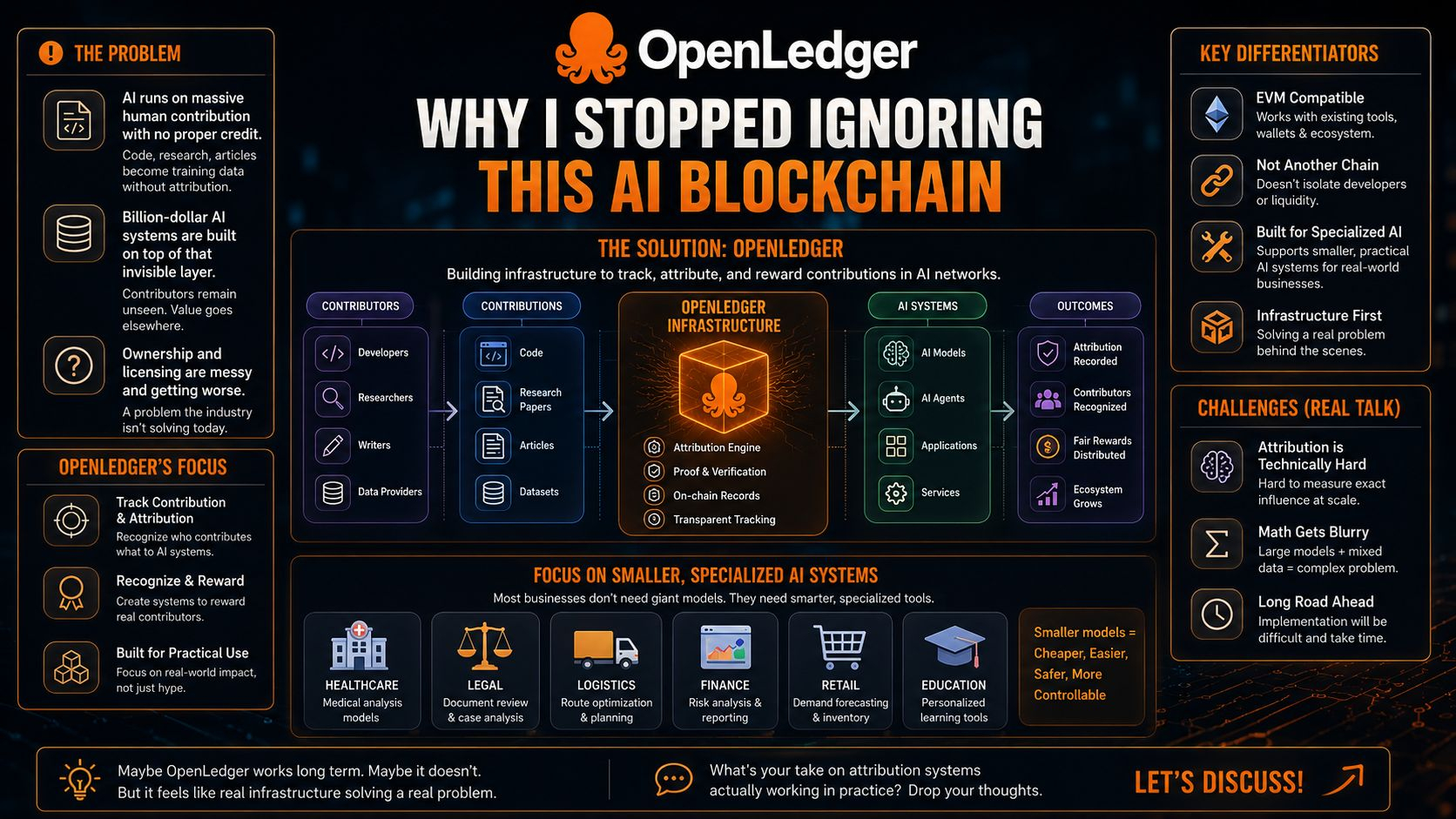

I’ll be honest — when I first saw OpenLedger, I thought it was just another AI crypto project trying to follow the trend.
Right now every second project talks about AI agents, decentralization, and the future of intelligence. Most of them sound exciting at first, but once you read the documents, everything starts feeling the same.
So at first I ignored OpenLedger too.
A few nights later I saw someone discussing their attribution system in a research thread, and that made me curious enough to look deeper.
What actually caught my attention was not some huge promise or crazy roadmap. It was something very simple. They decided to stay EVM compatible instead of building a completely separate ecosystem.
Most projects chasing hype usually try to build their own isolated world because it sounds bigger and more revolutionary. OpenLedger didn’t do that. They focused on compatibility with existing systems and developer tools, and honestly that detail felt important to me because it made the project look more practical and less focused on marketing.
Their OPEN token launched in late 2025 — but honestly that's not what made me pay attention.
After that, I started reading everything more carefully.
And honestly, I think the problem they are trying to solve is bigger than crypto itself.
Today’s AI industry runs on massive amounts of human contribution that almost nobody gets credit for properly.
A developer’s open-source code, a researcher’s published work, a writer’s public articles — all of it quietly becomes training data without any real attribution attached to it.
Then billion-dollar AI systems are built on top of that layer.
That’s the part people still avoid talking about properly.
That’s the gap OpenLedger is trying to fill.
The project is trying to build systems that can track contribution and attribution inside AI networks. Their idea is simple: if someone’s data or work helps improve an AI model, there should eventually be a way to recognize and reward that contribution.
At least in theory.
And this conversation isn't going away anytime soon.
The technology is moving fast, but ownership and licensing questions are still messy. Companies are building increasingly powerful systems using public information, while the people behind that information usually remain invisible.
OpenLedger seems to understand that this may become a serious problem later.
Still, I do have doubts.
A big one, actually.
The attribution problem is technically very difficult.
AI models learn from huge amounts of mixed information. Once training scales, it becomes hard to prove exactly how much influence one dataset had on a specific result. The math becomes blurry very quickly.
So even though the idea makes sense, implementation will be difficult.
And I think it’s important to admit that honestly instead of pretending the problem is already solved.
Another thing I liked was their focus on smaller specialized AI systems instead of only talking about giant frontier models.
That feels more realistic to me.
Most businesses do not need massive AI systems running everywhere. A hospital may only need a medical analysis model. A law firm may need document review tools. A logistics company may need route optimization software.
Smaller models are cheaper, easier to manage, and easier to control.
OpenLedger’s infrastructure seems designed around that type of practical usage instead of social media excitement.
There’s also another reason the project stayed in my mind after researching it.
Infrastructure projects usually look boring in the beginning. People notice flashy applications first. Backend systems come later.
Maybe OpenLedger works long term. Maybe it doesn’t.
But after reading through the architecture properly, it at least feels like they are trying to solve a real infrastructure problem instead of just creating another AI narrative for attention.
If you've been following AI blockchain projects — what's your take on attribution systems actually working in practice? Drop your thoughts.