I’ll be honest I almost dismissed OpenLedger immediately.
Not because the project sounded irrational, but because the phrase “AI blockchain” has slowly started to feel like one of those expressions that collapses under its own repetition. Every few weeks another protocol appears claiming it will decentralize intelligence, reinvent data ownership, or create an open economy for AI. After a while the language becomes strangely interchangeable. You stop hearing ideas and start hearing positioning.
That was my first reaction to OpenLedger.
But the more I sat with it, the more I realized the project is not really trying to compete with AI models directly. It is trying to confront something deeper and more uncomfortable underneath the current AI economy — the fact that modern intelligence systems are built on enormous layers of invisible contribution, while the economic value generated from those systems flows upward into increasingly centralized structures.
That imbalance feels small at first until you really think about how modern AI works.
Every advanced model depends on data gathered from millions of human interactions, years of public research, open-source experimentation, labeling work, behavioral patterns, corrections, feedback loops, and domain expertise scattered across the internet. Intelligence does not appear from nowhere. It is accumulated. Absorbed. Compressed.
And yet once the system becomes valuable, the people and networks contributing to that intelligence mostly disappear from the economic picture. Their role becomes abstracted into training material.
I think this is the part many people still underestimate about AI. The technological breakthrough is important, but the more consequential shift may actually be economic. We are entering a world where intelligence itself is becoming infrastructure, and infrastructure tends to concentrate power around whoever controls the coordination layer.
OpenLedger seems to recognize this early.
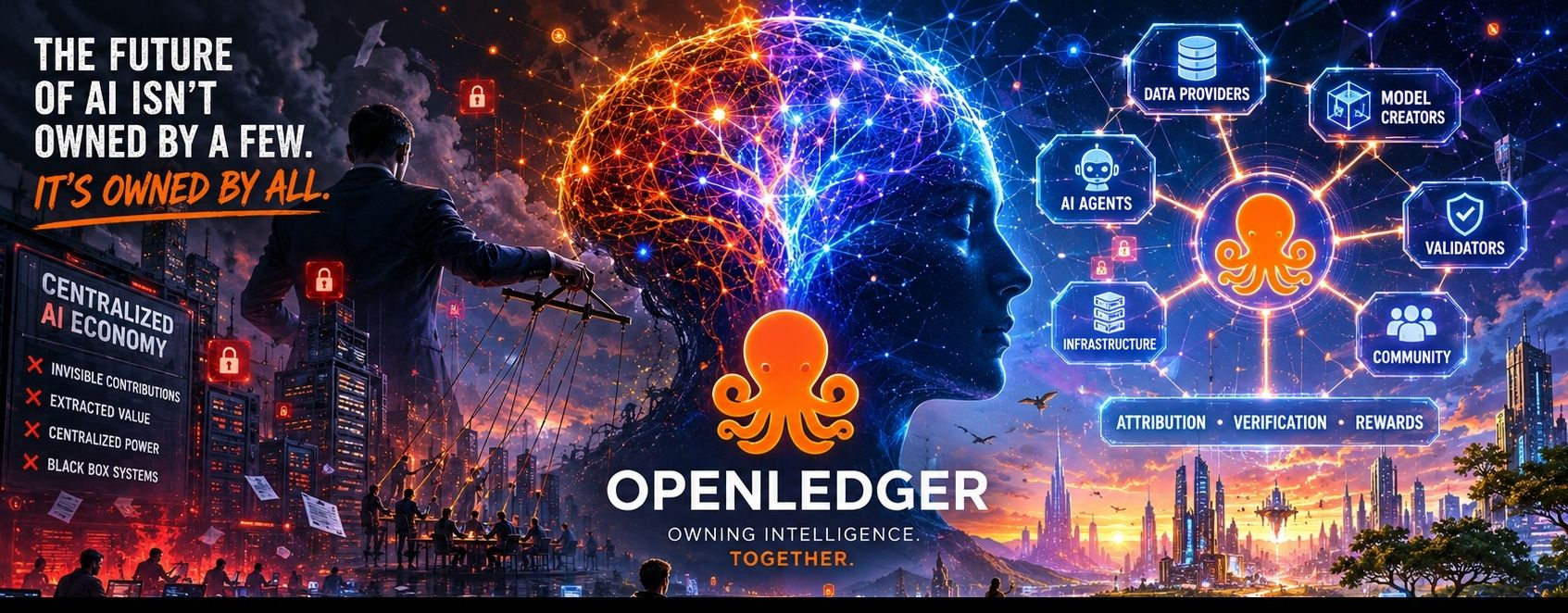
The protocol is built around the idea that data, models, and AI agents should not behave like isolated corporate assets locked inside centralized systems. Instead, they should exist within a network where contribution can be measured, attributed, verified, and economically rewarded over time. At first glance this sounds almost idealistic, but beneath the surface there is a serious attempt to redesign how value moves through AI ecosystems.
What interested me was not the branding around decentralization. Crypto has spent years promising redistribution while often recreating the same concentrations it claims to resist. What interested me was the protocol’s obsession with attribution.
Attribution sounds like a technical detail until you realize it may become one of the defining economic questions of the AI era.
Who contributed to a model’s intelligence? Which datasets improved performance? Which agents produced useful outcomes? Which participants validated quality? Which infrastructure enabled coordination? And once intelligence generates economic value, who deserves to participate in that value flow afterward?
Current systems rarely answer these questions transparently because they are not designed to. Most AI companies function through accumulation. Data flows inward. Models improve. Economic value compounds around ownership of compute, infrastructure, and distribution. The contributors themselves become increasingly invisible as scale increases.
OpenLedger is attempting to turn contribution into something legible.
That is a far more complicated problem than people realize.
Because intelligence is not a simple product. It is an emergent process. Valuable outputs often come from thousands of subtle interactions that are difficult to isolate cleanly. The moment you try to measure contribution precisely, you run into philosophical problems as much as technical ones. Human knowledge is deeply interconnected. Models learn patterns from overlapping sources. One dataset may matter enormously in one context and become irrelevant in another.
Still, OpenLedger’s architecture appears built around the belief that imperfect attribution is better than invisible extraction.
The protocol introduces mechanisms where contributors, validators, and participants interact through economic incentives tied to usefulness and verification. Data providers, model creators, and agents theoretically become part of an open marketplace where intelligence components can generate ongoing value rather than being absorbed permanently into closed systems.
I think this is where the project becomes genuinely interesting.
Most people still talk about AI as if the final model is the entire story. OpenLedger treats intelligence more like a living economy composed of interacting layers. Data is not just input. Models are not just products. Agents are not just tools. They become economic actors inside a broader coordination system.
That shift changes the meaning of ownership itself.
Traditional ownership is static. You own an asset, a company, or a product. But contribution-based systems create relational ownership. Value emerges through participation rather than possession alone. OpenLedger seems to be exploring whether intelligence can function this way at scale.
Of course, the idealism immediately collides with reality.
Decentralized systems are notoriously difficult to coordinate. Centralized AI companies move quickly because they control the stack internally. Decisions happen vertically. Incentives are aligned through hierarchy. Open systems introduce transparency and participation, but they also introduce friction, governance complexity, manipulation risks, and slower coordination.
The moment financial incentives enter the picture, human behavior changes.
If attribution becomes profitable, people begin optimizing for measurable contribution rather than meaningful contribution. Data quality risks collapsing into quantity games. Validation systems become targets for manipulation. Governance structures can slowly drift toward those with the largest economic influence. Crypto has already shown repeatedly how decentralization narratives can quietly evolve into capital concentration mechanisms.
OpenLedger does not magically escape those tensions.
In fact, the project becomes more intellectually honest when viewed through that lens. It is not solving decentralization. It is wrestling with the cost of trying to decentralize something as complex as intelligence production.
And maybe that struggle itself matters.
Because the current trajectory of AI development carries its own risks. Intelligence is becoming centralized not only technologically, but economically and politically. A handful of organizations increasingly control the compute infrastructure, proprietary data access, and distribution channels shaping global AI systems. That concentration may eventually matter more than the models themselves.
OpenLedger feels like a response to that future.
Not a perfect solution. Not a guaranteed alternative. More like an attempt to ask whether intelligence can evolve differently before ownership structures become impossible to challenge.
There is something slightly philosophical hidden underneath the protocol’s mechanics. The project implicitly argues that intelligence should remain connected to the networks of contribution that produce it. That value should not disappear entirely into black-box systems owned by increasingly powerful entities.
At the same time, there is another uncomfortable possibility.
What if turning intelligence into an open economic network changes knowledge itself? What happens when every contribution becomes measurable, tradable, and financially incentivized? Some forms of intelligence resist quantification. Some of the most valuable human insights emerge indirectly, emotionally, culturally, or collaboratively in ways that attribution systems may never fully capture.
This is the contradiction I keep returning to with OpenLedger.
The protocol is trying to humanize value distribution inside AI while simultaneously formalizing intelligence into economic infrastructure. There is something admirable in that effort, but also something slightly unsettling. Once intelligence becomes fully programmable economically, every interaction starts drifting toward transaction.
Maybe that is inevitable.
Or maybe projects like OpenLedger emerge precisely because the existing system already turned intelligence into an extractive economic machine long ago — only without transparency.
That possibility is what kept me thinking about the project long after I expected to stop caring.
I still do not know whether attribution-based AI economies scale cleanly. I do not know whether decentralized coordination can realistically compete with the efficiency of centralized systems. I do not know whether governance structures around AI infrastructure eventually collapse into the same power concentrations they were built to resist.
But I think OpenLedger exposes a question the technology industry can no longer avoid.
If intelligence is increasingly produced collectively, why is ownership becoming increasingly centralized?
That question feels bigger than one protocol.
And maybe that is why OpenLedger matters, even if the system itself remains imperfect. Not because it guarantees a decentralized future for AI, but because it forces people to think more carefully about the economic architecture forming underneath modern intelligence.
For years the internet extracted human attention. Now AI is extracting human cognition itself our language, behavior, creativity, expertise, and collective memory. The next phase of technology may depend less on how intelligent machines become and more on who controls the systems through which intelligence acquires value.
OpenLedger does not fully answer that problem.
But it understands that the problem exists.